Get Full Government Meeting Transcripts, Videos, & Alerts Forever!
Get email alerts on the Energy Grid Sb6 topic
No spam. Unsubscribe anytime.
Committee hears extensive testimony on SB6 over large loads, transmission costs and emergency load-shedding
Summary
Senate Bill 6, aimed at tightening rules for very large electricity loads and updating how transmission costs are allocated, drew detailed testimony from the Public Utility Commission, ERCOT and industry representatives at the Senate Business & Commerce Committee hearing.
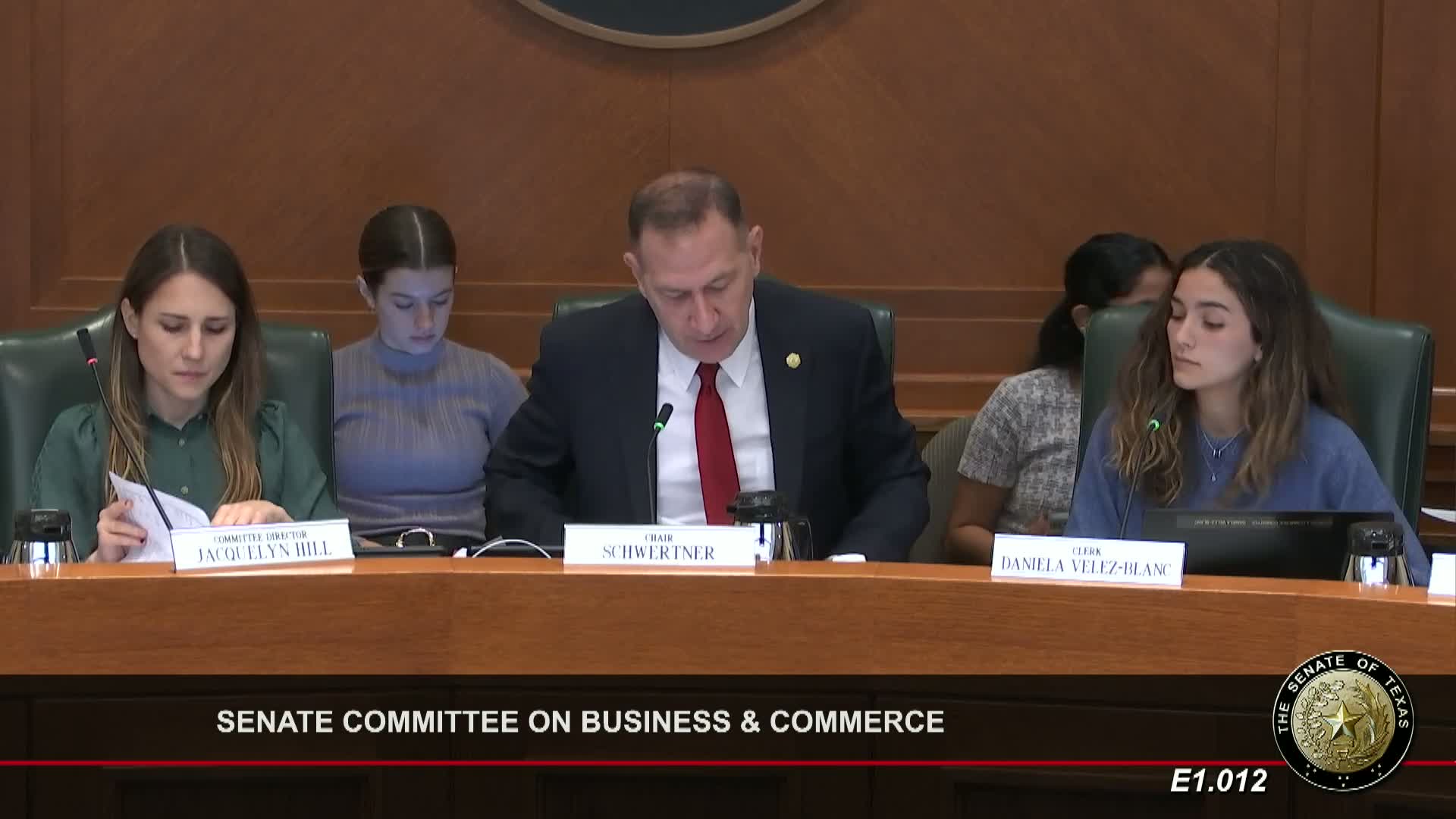
The Senate Business & Commerce Committee spent the hearing on a detailed briefing and invited testimony about Senate Bill 6, a measure that would change how large electricity consumers are treated in planning, cost allocation and emergency response.
Senator Sharon King, the bill’s author, told the committee the legislation aims to give regulators and utilities better data and tools to manage “very large” new electricity loads — primarily large data centers, AI computing facilities and heavy manufacturing — so they do not create reliability or cost-shifting risks for retail customers. “We want measures to protect grid reliability,” King said in the bill layout, and the bill sets standards for interconnection, a minimum transmission charge for loads served by on-site generation, and options to compensate large customers that volunteer to go offline before forced shedding.
Why the bill matters
Committee members and witnesses said grid planning faces an abrupt increase in projected load. Public Utility Commission Chairman Thomas Gleason said the PUC received 72 applications to the Texas Energy Fund (TEF) and that 17 are in active due diligence, representing about 8,900 megawatts of new generation. He also said one developer (Engie) withdrew for reasons related to timetable and component availability and that staff will consider backfilling that capacity at a forthcoming open meeting. Gleason and ERCOT officials said strong timelines and supply-chain uncertainty are testing the ability to deliver dispatchable generation quickly.
Gleason and ERCOT highlighted two separate but linked matters: TEF project selection and proposals to upgrade transmission to “extra-high voltage” (EHV). ERCOT’s regional transmission plan included a status-quo option relying on 345 kV infrastructure and an alternative backbone approach at 765 kV (referred to in the hearing as “7 65”). Commissioners plan a workshop with manufacturers and transmission operators to test timeline and supply-chain assumptions. The commission set an internal deadline of May 1 to reach a decision on how to treat the Permian Basin build-out; the default, Gleason said, would be to continue with the 345 kV approach unless the PUC adopts another path.
Key provisions and stakeholder views
Senate Bill 6, as laid out by King, targets four categories of concern: (1) improving the credibility of large-load forecasts by standardizing screening fees, site-control evidence and financial-security requirements for interconnection requests; (2) requiring PUC approval before existing generators remove megawatts from the ERCOT market to serve behind-the-meter loads; (3) enabling transmission-level mechanisms that let utilities shed noncritical large loads during extreme scarcity events (with an associated voluntary compensation program for loads that choose to participate); and (4) reexamining the 4 CP transmission-cost allocation method and setting a minimum transmission charge so behind-the-meter loads contribute to grid costs.
Supporters and regulators said the bill’s direction is helpful. Pablo Vegas, ERCOT president and CEO, said SB6 “provides helpful direction” to improve load forecasting and create programs to leverage backup generation and voluntary response. Barksdale English, deputy executive director at the PUC, said the commission supports balancing economic development with reliability and noted the PUC has requested seven additional staff positions in a fiscal note to implement new duties promptly.
Concerns from industry
Industry witnesses generally supported improved forecasting and planning but urged changes to operational details:
- Data Center Coalition (Dan Diorio) expressed concern about remote or transmission-level disconnect provisions that could cut service to tenants providing critical services (federal/state systems, hospitals, finance). Diorio recommended additional stakeholder work with ERCOT, the PUC and TCEQ to craft notification, procedural safeguards and environmental-permitting relief where backup generators (often diesel) might need to operate beyond typical permit limits during emergencies.
- Municipal and cooperative utilities (Taylor Kilroy, Julia Harvey, Texas Public Power Association and Texas Electric Cooperatives) said they back stronger interconnection standards and reconsideration of 4 CP cost allocation, but urged clarifications to avoid a wave of utility rate cases and to limit unintended cost shifts.
- Powering Texans and other industry witnesses supported using backup generation and voluntary programs to reduce scarcity risk, but urged careful drafting so colocation or replacement-generation arrangements are treated fairly and do not unduly penalize co-located projects that can avoid building new transmission.
Operational items, timing and next steps
PUC and ERCOT officials and the bill author discussed practical steps the regulatory agencies are taking:
- PUC staff said a workshop on EHV (including manufacturer participation) is planned (March 7 in the transcript) to clarify timelines and supply-chain feasibility for 765 kV components versus 345 kV options.
- The PUC has an internal May 1 deadline to decide how to treat the Permian Basin EHV question; the default if no decision is reached will be to continue the 345 kV approach.
- The PUC estimated staffing needs and provided a fiscal note requesting additional FTEs to implement the likely duties created by SB6.
Questions and unresolved points
Committee members repeatedly asked how to balance encouraging economic development with protecting reliability and residential customers. Witnesses flagged specific operational gaps that the bill and subsequent PUC rulemaking must address: precise notification and procedural rules for remote disconnection (“kill switch”) during emergency events; environmental permitting and enforcement discretion when backup diesel generation runs in emergencies; clear definitions for when behind-the-meter arrangements require replacement generation and where replacement generation may be sited; and how a minimum transmission charge would be implemented to avoid costly, duplicative rate proceedings.
Speakers
Speakers on the record included Senator Sharon King (bill author), Chairman Shortner and Chairman Schwartner (committee leaders referenced in the transcript), Thomas Gleason (chairman, Public Utility Commission of Texas), Pablo Vegas (president & CEO, ERCOT), Barksdale English (PUC deputy executive director), and representatives from municipal utilities, cooperatives, Powering Texans, the Data Center Coalition and other industry groups (Taylor Kilroy, Julia Harvey, Walt Baum, Dan Diorio).
No final committee vote on SB6 was recorded during the hearing. Senator King said offices are working toward a committee substitute to be prepared in the following one to two weeks and indicated stakeholder negotiations were ongoing.