Get Full Government Meeting Transcripts, Videos, & Alerts Forever!
Get email alerts on the Dnr Budget topic
No spam. Unsubscribe anytime.
DNR outlines $1.5 billion budget package, proposes gas permitting program and fee increases
Summary
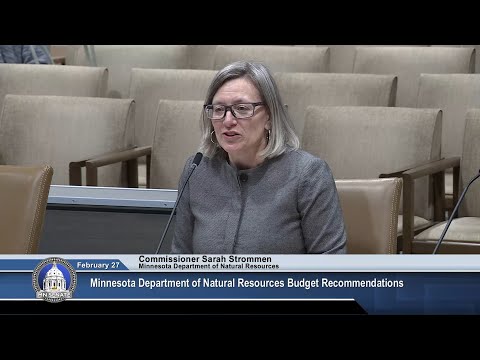
Commissioner Sarah Stroman told the Environment, Climate, and Legacy Committee on Feb. 27 that the governor's proposed FY26–27 budget for the Minnesota Department of Natural Resources (DNR) totals about $1.5 billion across all DNR funds and is intended to protect natural resources while respecting the state's fiscal constraints.
Commissioner Sarah Stroman told the Environment, Climate, and Legacy Committee on Feb. 27 that the governor's proposed FY26–27 budget for the Minnesota Department of Natural Resources (DNR) totals about $1.5 billion across all DNR funds and is intended to protect natural resources while respecting the state's fiscal constraints.
The budget matter: The proposal would pay for core operations across parks, fish and wildlife, forestry, ecological and water resources, enforcement, lands and minerals, and central operations. Stroman said about 30% of the department's overall funding would come from the general fund, about 19% from the Game and Fish Fund and roughly 10% from federal funds; other funding comes from numerous state special revenue accounts.
Major new items and staffing
- Gas permitting and leasing: The governor's package would create two separate programs to implement a temporary and later permanent regulatory framework for gas extraction, in line with recommendations from the Gas Resources Technical Advisory Committee (GTAC). The permitting proposal requests $1.3 million in general fund to support environmental review, financial assurance and other regulatory work and would fund four permitting positions. A parallel gas-leasing proposal requests $660,000 and two positions (including one attorney and one production site inspector) to handle title research, exploration-plan review and drill-site inspections.
- One-time legal-cost supplements: DNR told the committee it has seen an increase in highly contested and long-duration legal matters that exceed program budgets; the agency is requesting one-time general-fund supplements to avoid drawing down core program services. Stroman said the scale of the legal costs is affecting program budgets, but the presentation did not list a single aggregate amount for the supplement.
- Public-safety preparedness for conservation officers: The proposal includes $840,000 in general fund and one new FTE to provide training and equipment so conservation officers can assist in public-safety responses when called upon; agency staff emphasized that dedicated funds are not available for these general public-safety deployments.
Operating adjustments and fee proposals
- Cost increases: The governor's package includes an operating adjustment to cover rising employer-paid benefit costs, utilities, fleet, IT and other inflation-driven expenses: $5.4 million from the general fund plus $11.5 million from other funds. The agency cautioned this covers only part of anticipated operating increases for the biennium.
- Aquatic invasive species (AIS) surcharge: DNR proposes replacing the current flat $10.60 AIS surcharge on the 3-year watercraft registration with a sliding scale tied to boat size. The agency provided an example: for pleasure craft under 17 feet the AIS surcharge would move from $10.60 to $25 for a three-year registration period. The increased surcharge is expected to generate new fee revenue to expand grants to lake associations, tribes and local governments, increase DNR assistance for vegetation management and fund work at the Minnesota Aquatic Invasive Species Research Center; DNR said the proposal would also reduce general-fund support for AIS by about $660,000.
- Groundwater permitting fees: To boost technical capacity to evaluate complex groundwater permits, the presentation would raise permit fees. As an example, the first tier (up to 50 million gallons per year) would rise from $140 to $200 per permit; agency staff said about 85% of agricultural irrigation permits fall in that tier. DNR projected this fee shift would allow a $3.6 million reduction in general-fund support for groundwater work.
- State parks vehicle permits: The department proposes raising the daily park vehicle permit from $7 to $10 and the annual permit from $35 to $45 to generate roughly $850,000 for the Natural Resources Fund and to avoid service reductions in parks and recreation areas.
Legacy and one-time proposals
- Parks and Trails Legacy Fund: DNR proposed several one-time legacy projects and cited past uses of legacy funds that expanded access (for example, library park-pass programs and new campgrounds such as Shipwreck Creek at Split Rock Lighthouse State Park) and conservation work including American plains bison reintroduction at Minneopa State Park.
- Clean Water Fund: DNR submitted ten Clean Water Fund proposals to support watershed planning, data collection and implementation work to address lake, river and aquifer problems.
Committee questions and next steps
Senator Green pressed the agency for account balances and line-item spreadsheets; Assistant Commissioner Bob Meyer said those figures are complex, but the department committed to providing a detailed table of account balances and subfunds to the committee. The department also told senators it has identified nearly $8 million in general-fund reductions built into the governor's package through a combination of existing appropriations and proposed fee changes.