Get Full Government Meeting Transcripts, Videos, & Alerts Forever!
Get email alerts on the Border Security topic
No spam. Unsubscribe anytime.
Senate committee hears status report on Operation Lone Star, federal litigation and cartel-linked smuggling
Summary
State law enforcement and military officials told the Senate Committee on Border Security they are maintaining Operation Lone Star while awaiting federal policy and leadership decisions; officials described lowered border crossings, ongoing criminal activity between ports of entry and recent seizures tied to trafficking.
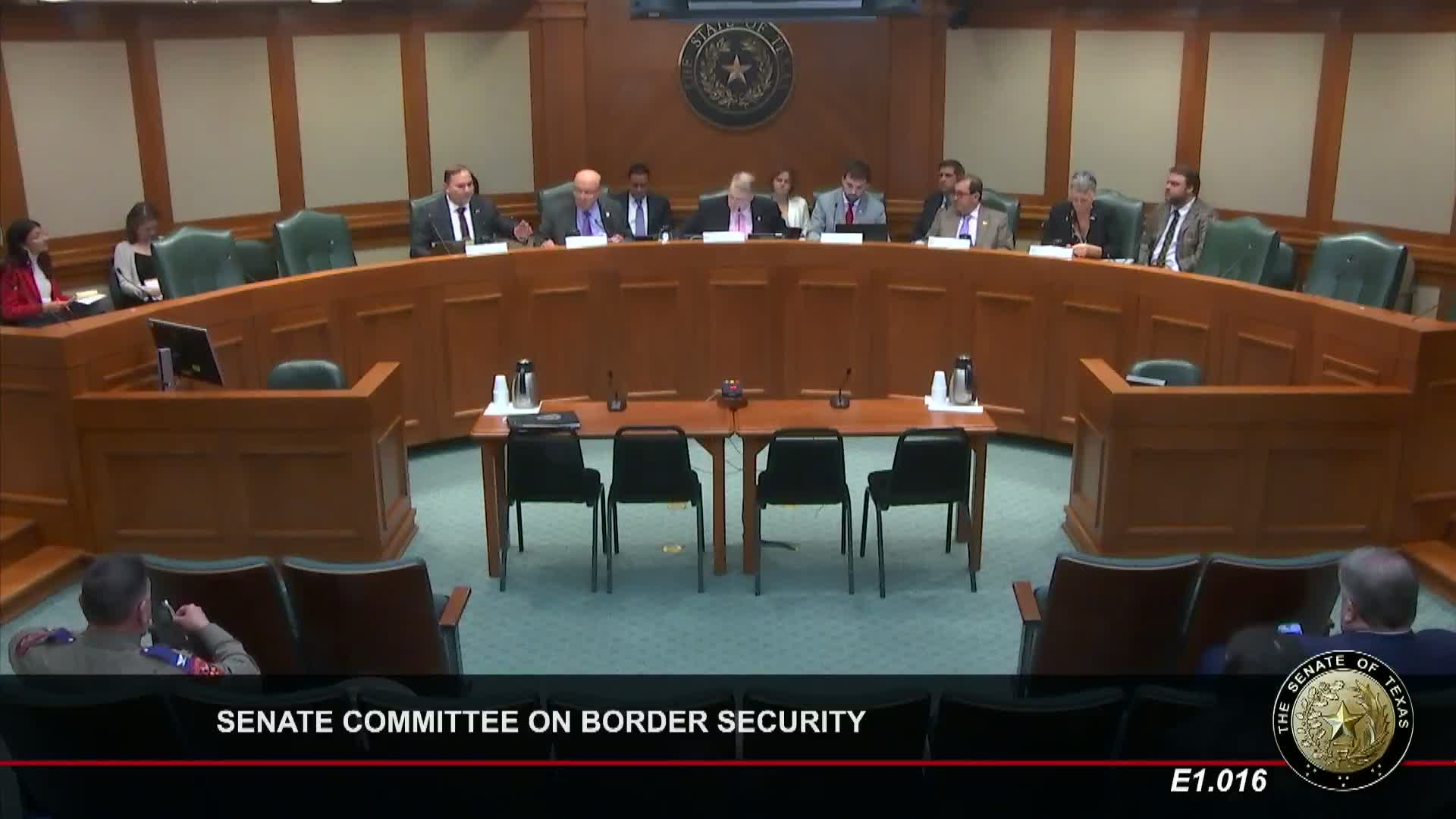
Chairman Birdwell convened the Senate Committee on Border Security and heard status briefings from state law enforcement and military leaders on Operation Lone Star and changes in federal policy.
The meeting focused on current operations, pending federal decisions that affect litigation and enforcement, and specific criminal patterns officials say persist between ports of entry. "We are in a holding pattern until DOJ leadership is in place and can start making decisions based on new policies," Ryan Kirchner, chief of special litigation in the Office of the Attorney General, told the committee.
Why it matters: committee members said they intend to keep the state's current border footprint intact while monitoring federal actions, rather than vacating positions and losing institutional capacity. That posture affects staffing, budgets and how Texas coordinates with federal partners.
Major General Tom Selzer, Adjutant General for the Texas Military Department, said the state currently has "over 5,000 state active duty personnel on Operation Lone Star," and described the force posture and capabilities deployed along the border, including boat teams, drones, quick reaction forces and a Texas tactical border force. Selzer also told the committee that Governor Abbott recently "entered into an agreement with U.S. Customs and Border Protection to deputize the Texas National Guard," allowing the Guard to operate alongside federal border agents under that agreement.
Colonel Freeman Martin of the Texas Department of Public Safety detailed operational trends since 2021, saying Texas recorded a record number of Border Patrol apprehensions in 2021 and that recent federal policy changes have produced a sharp decline in crossings. "There were several days last week that we had less than 100 in the entire Texas, all 5 sectors," Martin said, while also warning that criminal activity between points of entry has continued. He described recent seizures and enforcement results: "Just this last week, we seized 7 firearms, 22 pounds of methamphetamines, 80 arrests." Martin also told senators the department has identified migrants with active felony warrants and that the state prioritized arrests of people charged with serious crimes.
On litigation and federal policy, Kirchner said several cases the state brought or defended are effectively in pause because the U.S. Department of Justice is awaiting new intermediate-level leadership to set positions on policies created under the prior administration. He cited the CBP One app and other administrative changes as examples of policy shifts that affect ongoing lawsuits.
Committee members raised operational questions about personnel tempo, morale and deployment length. Martin and Selzer described a largely volunteer force for Operation Lone Star and said rotations have been shortened: deployments are nine days, and the agencies have adjusted lodging and scheduling to reduce strain. "When they're assigned to Operation Lone Star, they're working their days off ... they're working 12-hour days," Selzer said, adding the department can scale deployments up or down as ordered by the governor.
Senators also pressed officials about criminal networks exploiting trade and transport. Colonel Martin described "pop-up" fuel depots and overweight commercial vehicles that are used to move contraband and said cartels can coordinate convoys to outpace enforcement. Senators and staff discussed draft legislation and enforcement measures to address overweight trucking and fuel-depot theft in the Lower Rio Grande Valley.
Josh Reno, deputy attorney general for criminal justice, provided staffing figures for the Office of the Attorney General's law enforcement components: "We have around 200 certified peace officers," Reno said, adding about half are assigned to the Medicaid fraud control unit and the remainder to criminal investigations. Reno also said the office does not have a unit dedicated solely to immigration enforcement but does embed officers in task forces in overlapping roles.
Committee business: members adopted the committee's proposed rules by unanimous consent after Senator Flores moved their adoption with no objection. Chairman Birdwell said the committee plans to post hearing notices by Friday when possible and that hearings will continue on an invited-witness basis for state agencies.
Looking ahead: senators and agency leaders said they will wait for federal leadership and policy signals before recommending large changes to the state's force posture, but they emphasized the state's intention to preserve institutional knowledge and remain prepared to scale operations as needed.