Get Full Government Meeting Transcripts, Videos, & Alerts Forever!
Get email alerts on the Energy Grid Large Loads topic
No spam. Unsubscribe anytime.
Senate committee hears wide-ranging testimony on Senate Bill 6 aimed at large loads and grid planning
Summary
Witnesses representing data centers, industry groups and utilities told the Senate Business & Commerce Committee they broadly support Senate Bill 699but asked for clarifications on minimum transmission charges, disconnect devices and how ERCOT will distinguish "phantom" from real loads.
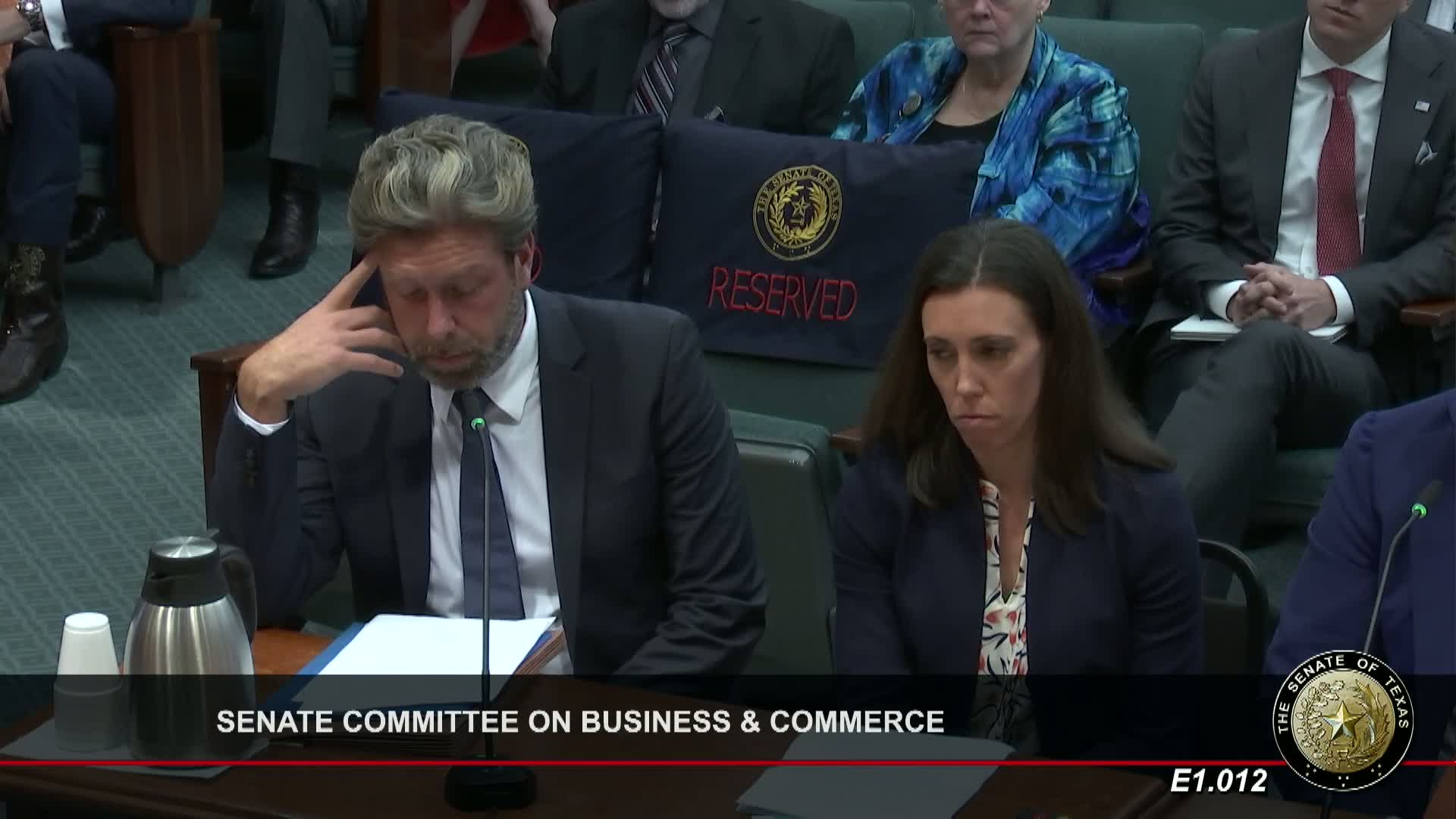
The Senate Business & Commerce Committee heard several hours of testimony on Senate Bill 6, a measure that would change how very large electricity customers are treated in interconnection, cost allocation and emergency operations.
The bill attracted developers of large data centers, trade groups and utilities, who described a shared interest in clearing ERCOT's interconnection queue and ensuring reliable service while asking for clearer definitions and protections for industry investment. "First off, I'd like to commend the committee for prioritizing this very nuanced and important topic to ensure greater liability," said Lee Bratcher, representing the Texas Blockchain Council.
Why it matters: SB 6 seeks to speed planning and to give ERCOT and the Public Utility Commission clearer tools to identify and remove "phantom" requests in the interconnection queue, set a minimum transmission charge for some new large loads, and permit control or shedding of large loads during Emergency Energy Alert (EEA) events. Proponents say the changes will improve visibility into real load growth; critics and some industry witnesses warned about operational risks and investment uncertainty if details are not clarified.
Key points from testimony - Transmission charge: Several witnesses, including Warren Lascher of the Texas Oil and Gas Association and Katie Coleman of the Texas Association of Manufacturers, asked for a clear, reasonably low floor and for carve-outs for legacy cogeneration. Lascher said the bill "provides a recommendation for 75 megawatts but allows the commission to set a lower level," and requested that 75 MW be treated as a floor rather than a ceiling. Coleman told the committee the proposed minimum transmission rate mixes wholesale and retail concepts and suggested folding the issue into the 4CP study in the bill's section 6.
- Disconnect devices and operational safety: Data center developers and operators, including Michael McNamara of Lansium (developer for the "Stargate" Abilene project) and Sarah Axelrod of Crusoe, asked for language that reflects collaborative site planning rather than an abrupt "kill switch." McNamara said a sudden disconnect for a very large load "could actually cause its own grid reliability issues" and said the Abilene project plans on-site resources including a 350-megawatt natural-gas backup and a planned 1,000-MW battery with four hours of duration.
- Distinguishing load types and queue clarity: Multiple witnesses urged better ways to separate legitimate new loads from speculative or "phantom" entries that clog planning queues. McNamara and Gideon Powell (Cholla Inc.) urged fees or requirements and improved reporting so ERCOT and planners can see which projects are likely to materialize.
- Planning methodology (4CP): Former ERCOT and industry veterans pressed the committee to consider whether the 4CP (four coincident peak) methodology needs revision. Pat Wood and others discussed longer time windows (hours or days rather than 15-minute peaks) and urged legislative clarity to avoid years of stakeholder delay.
Legislative process and next steps: Committee members said staff and members are drafting substitute language. Senator Sarah King asked witnesses to provide specific statutory language edits by the following Monday for staff review.
Voices heard: Proponents included data center builders and operators (Lansium, Crusoe, Switch, Kings Branch Data) and business/electric industry groups (Association of Electric Companies of Texas, Texas Energy Buyers Alliance). Opponents or cautious speakers included observers who argued subsidies and prior interventions have not solved reliability issues and urged market-based solutions. Bill opponents did not register a formal motion but raised policy objections during public comment.
Taper: The committee closed public testimony on SB 6 and left the bill pending for further drafting and stakeholder negotiation.