Get Full Government Meeting Transcripts, Videos, & Alerts Forever!
Get email alerts on the State Sovereignty topic
No spam. Unsubscribe anytime.
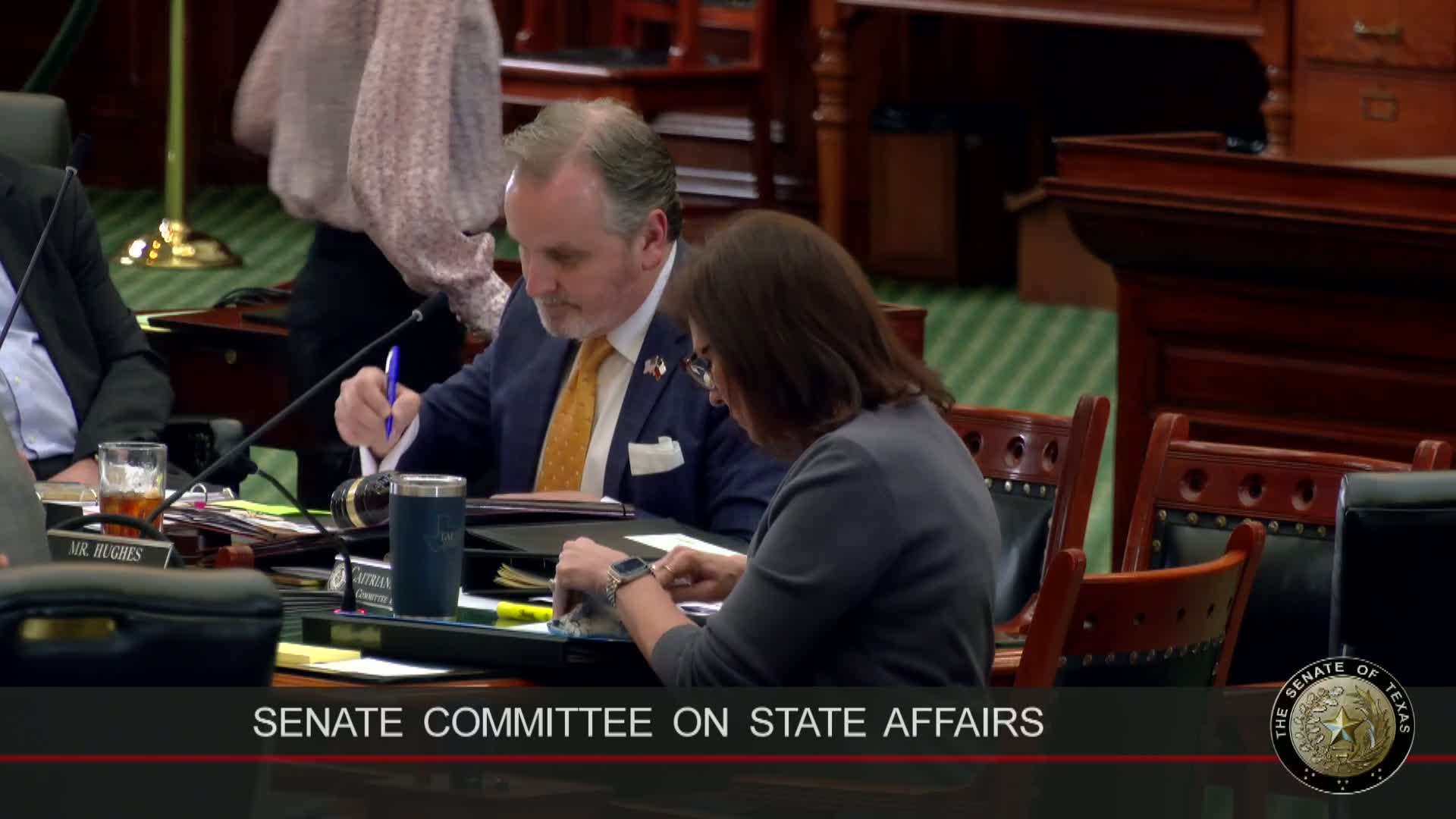
Committee hears bill giving Texas Legislature authority to bar enforcement of federal directives
Summary
Senate Bill 707 would allow the Texas Legislature to challenge federal directives and prohibit state employees from enforcing directives the legislature deems unconstitutional; proponents described it as a state‑sovereignty tool and said it requires a two‑thirds legislative vote; testimony was mixed and the bill was left pending.
Senator Middleton laid out Senate Bill 707 on behalf of Senator King, saying the bill would give the Texas Legislature the authority to challenge federal directives and to prohibit state employees and officers from enforcing mandates the Legislature deems unconstitutional. Middleton framed the measure as a federalism protection tied to the Tenth Amendment and cited recent federal regulatory activity as imposing economic costs on Americans.
Russell Withers, general counsel and director of policy for the Texas Conservative Coalition Research Institute, told the committee that the bill provides a legislative vehicle to assert state responsibility for federalism. Withers cited Federalist No. 45 and said the proposal includes a "two‑thirds majority" requirement to elevate consensus.
Tom Glass of Texas Constitutional Enforcement testified he liked the concept but opposed the two‑thirds threshold, saying a simple majority would be a more effective tool. Glass also noted that the legislature already can express opinions about federal constitutionality and suggested alternative approaches under development.
Committee members asked questions but did not take a vote; public testimony was opened and closed and the bill was left pending. The transcript record shows proponents framed the measure as a structural federalism enforcement tool and opponents or skeptics raised procedural concerns about the supermajority requirement and redundancy with other legislative actions.