Get Full Government Meeting Transcripts, Videos, & Alerts Forever!
Get email alerts on the Municipal Finance Officers Hours topic
No spam. Unsubscribe anytime.
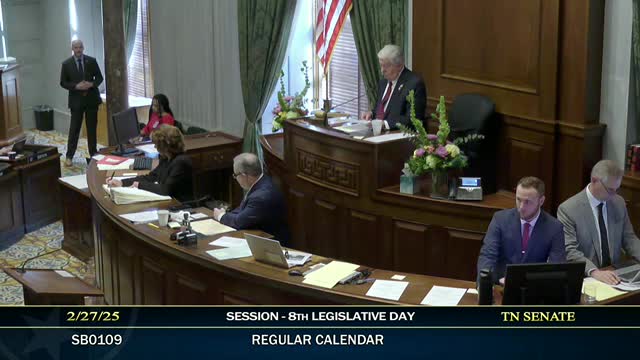
Tennessee Senate approves bill letting municipal finance officers work under 16 hours/month with comptroller approval after heated debate
Summary
The Tennessee Senate on the floor passed legislation that lets certified municipal finance officers (MFOs) contracted by municipalities perform their duties for fewer than 16 hours per month if the municipality obtains written approval from the Comptroller of the Treasury.
The Tennessee Senate on the floor passed legislation that lets certified municipal finance officers (MFOs) contracted by municipalities perform their duties for fewer than 16 hours per month if the municipality obtains written approval from the Comptroller of the Treasury.
The measure, carried by Senator Seal, drew extended floor debate on questions of local control and oversight before members voted to pass the bill on third and final consideration. After an initial passage vote, senators voted to reconsider the action; following the reconsideration the Senate gave final passage by a recorded vote.
The bill’s sponsor, Senator Seal (State Senator), told colleagues the measure was requested by municipal officials and by the comptroller’s office to give small towns flexibility. “This bill is not opening up a new job,” Seal said on the floor. “All this bill is doing is just giving municipalities the option to opt out of the 16 hour requirement, with the comptroller’s office.” Seal also told the chamber he had sought input from municipal representatives and from the comptroller’s office.
Opponents raised concerns about local consultation, oversight and potential for positions with minimal hours. Senator Yarbrough (State Senator) asked the sponsor to identify the municipalities affected; Seal read a list of 14 towns identified in the bill’s fiscal note. Several senators criticized the proposal as creating the possibility of “no-minimum” contracts, saying it could allow a contracted officer to perform only token work. Senator Yeager (State Senator) said the bill was “one of the most shameless things I have ever experienced,” arguing it was insulting to municipal officials and could expand the comptroller’s oversight in ways that warrant scrutiny.
Senator Seal also addressed questions about his interactions with the comptroller’s office. On the floor he said, “I’ve never met the comptroller,” and later confirmed that with comptroller approval there is no statutory minimum number of hours a certified municipal finance officer would be required to work under the bill.
Procedural timeline on the floor: the sponsor moved passage on third and final consideration and the chamber recorded an initial vote. Senators later approved a motion to reconsider the bill, and the Senate then voted again and approved the measure on final passage.
Votes at a glance — selected actions taken on the floor that day: • Senate Bill 109 (sponsor: Senator Seal) — Final passage after reconsideration; vote recorded in final passage 32 yeas, 0 nays (see actions). The bill authorizes certified municipal finance officers contracted to provide oversight to be assigned fewer than 16 hours per month if the municipality obtains written approval from the Comptroller of the Treasury. The transcript shows earlier numbering was inconsistently cited as “109” and “1009”; the sponsor identified the bill as Senate Bill 109. • Senate Bill 797 — passed on third and final consideration (vote recorded earlier in the session). • Multiple memorial and congratulatory resolutions (including SJR 188, SJR 190 and SJR 149) were adopted by voice or on consent earlier in the session.
What the bill does and what remains: The bill amends the practical requirements tied to contracted certified municipal finance officers by allowing municipalities to seek written approval from the Comptroller of the Treasury to assign fewer than the existing 16 hours per month. The measure places the decision point with the comptroller’s office; it does not itself set a new minimum number of hours and does not specify additional oversight mechanisms beyond the requirement of written approval. The bill’s fiscal note identified 14 municipalities that could be affected; the sponsor read those municipalities aloud on the floor during questioning.
What senators pressed for on the record: opponents asked whether mayors and local councils representing the named municipalities had been consulted; the sponsor acknowledged he had not contacted every mayor before filing the bill and said some municipal officials had requested the change. Multiple senators urged greater local input or additional safeguards to avoid token or “no-minimum” contracts.
Implementation and next steps: The bill makes the comptroller the agency that may grant written approval; any municipality seeking to use the fewer-than-16-hour exception would be required to obtain that approval. The bill does not itself establish reporting or audit requirements beyond the comptroller’s approval authority on its face; any additional implementation rules would come from the comptroller’s office or subsequent statute or administrative guidance.
Ending: The bill’s sponsor described the change as flexibility for small towns; critics on the floor characterized it as an overreach or as creating openings for minimal-work contracts. With the Senate’s final approval after reconsideration, the measure will move forward according to the Legislature’s process for enrollment and delivery to the governor.