Get Full Government Meeting Transcripts, Videos, & Alerts Forever!
Get email alerts on the Medical Licensing topic
No spam. Unsubscribe anytime.
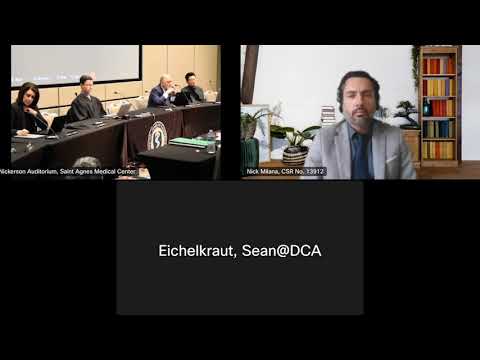
Medical Board panel hears oral argument over license denial for Dr. Sean James Seaburn
Summary
At a Feb. 12, 2025, hearing, attorneys argued whether admitted false testimony given under oath is sufficiently related to medical practice to justify denying a California medical license; the panel took the case under submission and will deliberate in closed session.
The Medical Board of California Panel B heard oral argument Feb. 12, 2025, on whether to adopt a proposed decision denying an application for a full medical license by Sean James Seaburn, M.D., after earlier proceedings in which he admitted to giving false testimony under oath.
The question before the panel was whether Seaburn’s admitted dishonesty is substantially related to the qualifications, functions or duties of a physician and therefore a valid basis to deny licensure under the Business and Professions Code. The board took the case under submission after argument and closed the record; panel members will deliberate in closed session and will mail a written decision to the parties.
At the hearing, Jeff Lewis, counsel for the applicant, argued the board lacked jurisdiction to deny licensure based on the prior proceedings and that the allegedly dishonest statements were not connected to the practice of medicine. “Statements whether they are false or not are not any more connected to the practice of medicine than the conduct about which they relate,” Lewis said in opening argument, asserting the underlying facts were private, nonprofessional conduct and that prior rulings limited the board’s authority.
Deputy Attorney General Joe McKenna, representing the complainant, urged the board to adopt the proposed decision denying the license. McKenna described the pattern of testimony at a July 2023 disciplinary proceeding and the later statement-of-issues hearing as evidence of intentional dishonesty. “Applicant systematically lied under oath in the July 2023 administrative hearing,” McKenna said. He argued intentional dishonesty under oath demonstrates a lack of moral character and is a core disqualification for practicing medicine.
Counsel for Seaburn relied on two principal legal defenses: (1) collateral estoppel and constitutional limits on probing private sexual conduct, arguing that the factual issues previously resolved or dismissed could not be relitigated to deny a license, and (2) Fifth Amendment concerns raised by the respondent’s invocation of the privilege at parts of the later proceeding. Lewis told the panel the board’s earlier decision to dismiss or limit factual findings on the underlying conduct meant those facts could not be used as a basis for discipline or denial of licensure now.
McKenna countered that the statement-of-issues before the board focused not on the surreptitious recording itself but on whether an admitted perjurer should be granted a license to practice medicine in California. He emphasized the board’s statutory obligation to evaluate honesty under Business and Professions Code section 2234(e), which directs the board to assess whether dishonesty is substantially related to the duties of a physician and surgeon. McKenna also argued the applicant had not shown contrition or rehabilitation at the statement-of-issues hearing, and that the panel needed truthful testimony to fulfill its public-protection mandate.
Panel members asked questions about both legal and rehabilitative aspects of the case. Panel Chair Richard Thorpe, M.D., said he had “not seen any evidence of contrition” and asked whether the panel had a factual basis to conclude the applicant would be truthful in future doctor–patient interactions. Other members declined to question further or passed. The administrative law judge, Wim Van Rooyen, presided and reminded parties that the panel’s deliberation would be based on the existing record and that no new evidence would be received at oral argument.
Procedurally, the record was closed at the end of argument, and the panel took the matter under submission; the parties were told they would receive the decision by mail. The case was identified in the record as Medical Board of California case number 800-2024-105866 and Office of Administrative Hearings (OAH) case number 2025010414; the oral argument was set for Feb. 12, 2025.
The hearing did not produce a decision or vote on the record. The panel moved into closed session for deliberations and indicated no additional public action would be taken that day. The board will issue a written decision to the parties at a later date.