Get Full Government Meeting Transcripts, Videos, & Alerts Forever!
Get email alerts on the Health And Human Services topic
No spam. Unsubscribe anytime.
House passes $6.3 billion Health and Human Services budget, funds new state hospital and regional behavioral care
Summary
Lawmakers approved House Bill 10‑12, the department’s biennial budget, including $330 million for a new state hospital in Jamestown, regional behavioral health investments, childcare and juvenile justice funding. The bill passed after debate on provider inflation and service capacity.
The House approved the Department of Health and Human Services’ budget on Friday, advancing a $6.28 billion package that includes major capital and program investments: $330 million toward a new state hospital in Jamestown, one‑time and ongoing funding for behavioral care, childcare expansions and juvenile justice grants.
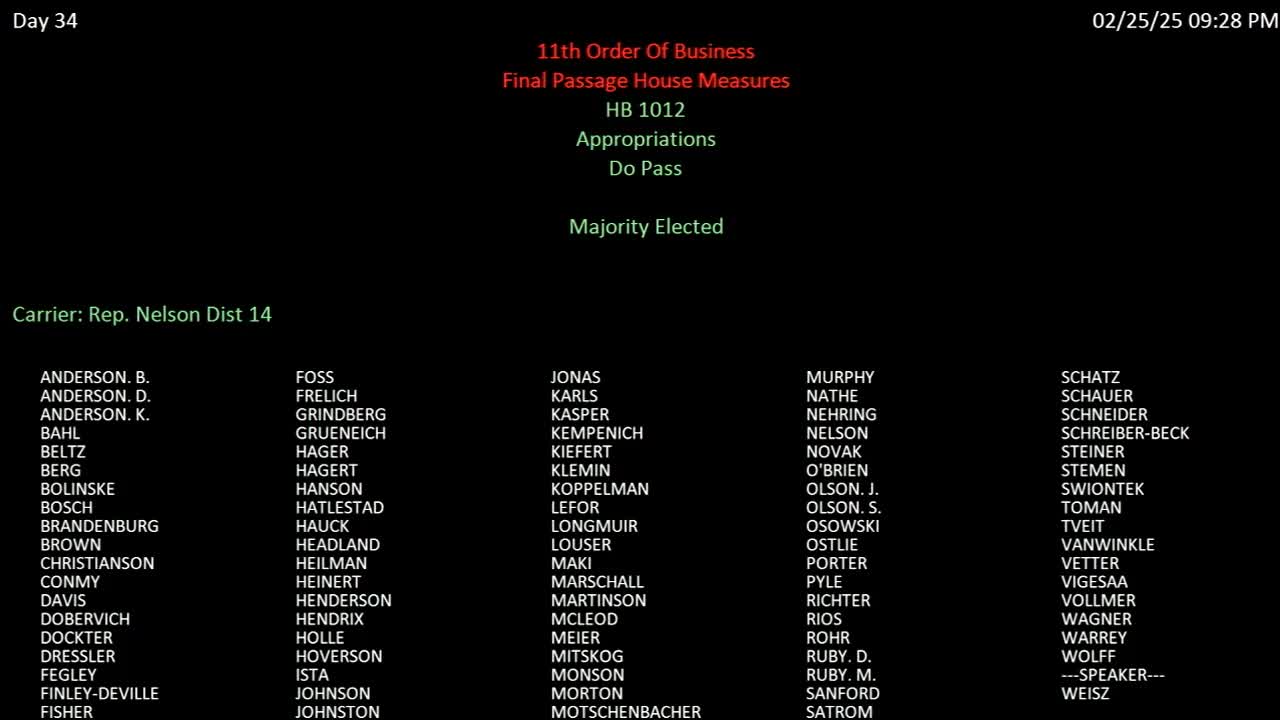
The bill (House Bill 10‑12) passed the House 52‑35. Representative Nelson, carrying the budget, described the package as the largest in state government and said it targeted behavioral health, addiction treatment capacity, and supports for families and children.
Why it matters: The package directs the largest single health care investment of the session — the new state hospital — and adds money for regional behavioral health facilities, a network of rural hospitals, and programs aimed at juvenile justice, childcare and community behavioral health clinics. Those investments will shape capacity for inpatient and outpatient treatment across North Dakota.
Key components lawmakers highlighted include:
- New state hospital: $330 million to build a 61‑bed state hospital near Jamestown — $200 million from the Strategic Investment Fund and $130 million to be funded through Bank of North Dakota borrowing. The bill establishes legislative oversight through a project steering committee with members from both parties.
- Regional facility funding: $12.96 million for a northeastern 24‑bed facility that will include adult and adolescent treatment, on a 80/20 cost‑share basis.
- Behavioral health network investment: $22 million to support the Roughrider network, a coalition of critical access hospitals working on coordinated purchasing and shared services.
- Childcare and juvenile justice: $13.2 million in childcare program funding and $7.75 million for juvenile‑justice‑related grants to address truancy and youth engagement.
Representative Nelson, sponsor (first reference at 03:33:21): “The plans that came forward were funded totally at $332,000,000… We intend to fund the new state hospital at Jamestown.”
Other items in the bill include continued investment in certified community behavioral health clinics (CCBHCs), a moratorium on immediate‑care facility bed expansions in developmental disabilities providers (a cost containment step), and targeted one‑time grants such as a conditional $1 million community cultural center grant to support Native American‑led treatment and cultural services if matching funds are raised.
The appropriations language also allows transfers and line‑of‑credit authority for some one‑time projects and includes provider inflation set at 2% in each year of the next biennium for many contracted services.
Questions and votes. Representative Hawley asked why an animal shelter grant ($300,000) appears in the DHHS package; Nelson said the Community Health Trust Fund — not general fund — supplied that award and committee members recommended it by unanimous vote. Several members also sought clarification on grant criteria, staffing and how the new beds would be phased.
Representative Hawley (first reference at 03:50:20): “Why is an animal shelter grant included in the Department of Health and Human Services budget?”
Ethics and recusals. A small number of members declared conflicts of interest and were excused from voting under House rules; committee and floor sponsors disclosed prior discussions with affected providers. Representative Ista declared a personal interest tied to an employer that could benefit from regional behavioral health funding and was excused from the vote.
Vote: House Bill 10‑12 passed on final consideration 52‑35.
Ending: The bill moves to the Senate, where details on project timelines, borrowing, and any additional operating dollars will be negotiated. The new‑hospital project will require further legislative oversight and interagency coordination as construction planning proceeds.