Get Full Government Meeting Transcripts, Videos, & Alerts Forever!
Get email alerts on the Housing And Planning topic
No spam. Unsubscribe anytime.
Soledad planning commission approves 2024 General Plan and Housing annual reports, authorizes submittal to state
Summary
The Soledad Planning Commission voted to approve and accept the city’s 2024 General Plan and Housing Annual Progress Reports and authorized staff to submit them to the California Department of Housing and Community Development and the Governor’s Office of Planning and Research.
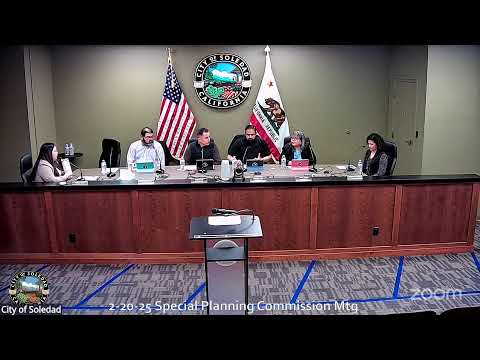
The Soledad Planning Commission voted Feb. 20 to approve and accept the city’s 2024 General Plan and Housing Annual Progress Reports and authorized staff to submit the documents to the State of California’s Department of Housing and Community Development (HCD) and the Governor’s Office of Planning and Research.
The action fulfills the commission’s role in forwarding the city’s annual progress on implementing the General Plan and the housing element to state agencies. Diane, the city’s team planner, told commissioners the annual progress report (APR) is state-mandated and must be submitted by April 1 to preserve grant eligibility and show the city’s progress on policies and programs.
Commission staff summarized 2024 highlights tied to the adopted general plan, including community and economic development work across departments, downtown Front Street rehabilitation and sidewalk repairs, parks and recreation programs, and a range of housing-site and pipeline activities. The city is working on a comprehensive general plan update, referred to as Sierra Soledad, and staff said work on land-use maps and community engagement is ongoing.
On housing, staff reviewed the city’s recent Regional Housing Needs Allocation (RHNA) performance and the new RHNA cycle targets. For the previous RHNA cycle (2015–2022), the city’s allocation was 191 units across income levels; buildout figures presented by staff showed the city completed few very-low-income units during that cycle. For RHNA cycle six, the city’s allocation is 724 units (100 very low, 65 low, 183 moderate and 376 above-moderate). Staff reported that, as of the 2023–2024 reporting window, the city had completed 0 very-low units, 6 low, 18 moderate and 181 above-moderate units, and said a robust project pipeline is projected to produce additional affordable units.
Staff highlighted several projects and programs intended to advance affordable housing: the city’s purchase of a 4.56-acre parcel on Gavilan Street (often referenced as 540 Gavilan) is planned for a development that staff expects to include about 100 affordable rental units; the Miramonte annexation is projected to yield phases of low- and very-low-income units (staff projected roughly 50 very low, 40 low, 55 moderate and 192 above-moderate for initial phases); Santa Clara Parcel E is moving forward as a public–private partnership in which the market-rate developer will donate land for affordable units being developed by Eden Housing; and other projects named in the staff presentation include Las Viviendas (nearing sellout), Allan Acres (early-stage partnership discussions with CHISPA), and workforce housing tied to the school district. Staff said financing, developer selection and tax-credit competition will shape the ultimate unit counts and affordability programs.
Staff and commissioners also discussed accessory dwelling units (ADUs). Staff said ADUs are counted toward RHNA and that the state treats many ADUs as “affordable by design” when under certain size thresholds; the city noted it lacks direct authority to require parking for ADUs because state law has limited local parking requirements for ADUs. Commissioners and staff spoke about parking pressure in established neighborhoods, code-enforcement approaches for inoperable or long-stationary vehicles, and site-design strategies in new subdivisions intended to increase driveway capacity and reduce on-street parking demand.
The staff presentation listed grant awards and funding used in recent work: a REAP 2 grant award of $85,000 supporting general-plan work and a separate $50,000 grant to study feasibility for a “shipping container” downtown project. Staff also described downtown economic activity in 2024 — Tractor Supply received a building permit and was expected to break ground in spring; Dutch Bros opened in 2024; Panda Express and a hotel application were noted as projects expected to move to building-permit or planning review in 2025 — and transit improvements including a 30-minute circulator service intended to connect neighborhoods with commercial areas and services.
After staff took questions and provided additional context about timelines and program details, a motion to approve and accept the 2024 General Plan and Housing Annual Progress Reports and to authorize their submittal to the state was made and seconded. The commission conducted a roll-call vote and the motion passed. Staff said the reports will be forwarded to the City Council and submitted to HCD and the Governor’s Office of Planning and Research as required.
The report and the city’s updated housing element were adopted in 2024; commissioners and staff emphasized that many pipeline projects remain at entitlement or financing stages and that RHNA compliance will extend over several years, with staff noting the city’s statutory timeline to meet the current RHNA cycle requirements through 2031.