Forest Grove SD 15 flags deficit spending, declining enrollment as budget season opens
Loading...
Summary
At a Feb. 25 budget committee meeting, district finance staff outlined a budget calendar, projected deficits and enrollment declines and urged the committee to plan for state funding uncertainty linked to the legislative session and special-education funding proposals.
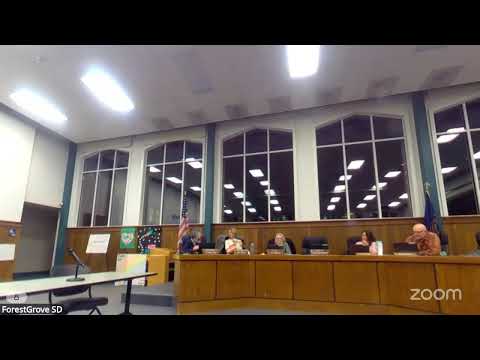
The Forest Grove School District budget committee on Feb. 25 was presented with a fiscal overview showing declining enrollment, ongoing deficit spending and uncertainty tied to the state legislative session as the district prepares its proposed budget.
Director of Finance Eileen Klute told committee members the process timeline: the budget message and proposed budget will be delivered on May 8, with optional deliberation meetings on May 15 and May 22 and a target to finalize the committee’s recommendation by May 22 so the district can meet county tax-certification deadlines in early July. “The budget document itself … sets the max appropriation levels that we can expend for the course of the year,” Klute said.
Why it matters: the committee must set maximum appropriations before the state completes its long legislative session. Any change in the state school fund or other statewide decisions will require adjustments after the committee approves the recommended budget.
Klute reviewed the district’s recent financial picture. She said last fiscal year the district reported about $133,000,000 in total resources, roughly 61% of which was general fund. She said about $81,000,000 of that total was general fund operating resources. “We are in deficit spending, and we will have to make adjustments going into this budget season,” Klute said, summarizing the presentation’s central warning.
The district’s enrollment and funding mechanics were a central focus. Klute explained that point-in-time enrollment differs from the funded average enrollment: the district’s October 1 enrollment was 5,751 students, but the district was funded for 5,718 students and for 7,191 funded weights (the weighted measure used in the state formula for students with additional needs). She described the interplay of local property tax receipts and the State School Fund: if local property tax revenue varies, the state allocation will offset some of that change under the formula.
Board members and staff discussed reserves and spending assumptions. Klute said the district historically budgets an 8–10% ending fund balance and often ends the year at a higher percentage; the district ended last year at about 21%. For the current adopted budget she said the district budgeted an 11.7% ending fund balance but is forecasting use of roughly $4,000,000 of beginning fund balance this year under current spending trends.
Superintendent Suzanne West outlined legislative risks that could materially affect next year’s budget. She said the governor’s proposed budget uses an $11.36 billion baseline for the State School Fund and includes “technical adjustments” that, if adopted, would collectively add about $600,000,000 statewide to the funding calculation. West also described three separate efforts in Salem to change how special education is funded: higher-cost disability reimbursement, lifting or raising a statutory cap on special-education weightings (the cap was described in testimony as a primary shortfall), and an initiative to increase the cap or fully fund high-cost cases. “For our district, our percent is closer to about 17%, so our gap is even more significant,” West said, explaining why special-education funding proposals are particularly important for Forest Grove.
West also flagged a pending bill that would allow employees on strike to claim unemployment benefits and said the district is watching that measure because it could affect bargaining dynamics and district costs. She emphasized that many bills and technical adjustments are still changing as they move through committee in the long legislative session and that the May 14 revenue forecast will be a significant driver of the final State School Fund number.
Other budget details covered: the district has about 68 buses in its fleet; last year’s high school gym floor was replaced after a flood and the insurance claim affected capital expenditures; the district has been using federal COVID-era grants for one-time items, including HVAC upgrades; and investment income is higher than expected because the district has exceeded its LGIP cap and has contracted external managers. “We hire Piper Sandler to help support us, and we have very strict rules on how we can invest,” Klute said.
What’s next: staff will continue building the proposed budget through April and present the formal proposal on May 8. Committee members were reminded that under Oregon budget law the committee must include public hearings and that at least six voting members must be present and vote to adopt the committee’s recommended budget.
The budget presentation and committee discussion will continue at the next preliminary meeting on April 22; the first official budget hearing and delivery of the proposed budget is scheduled for May 8.