Get Full Government Meeting Transcripts, Videos, & Alerts Forever!
Get email alerts on the Environment Salmon Recovery topic
No spam. Unsubscribe anytime.
Covington approves joining WRIA 9 interlocal agreement to fund watershed salmon recovery
Summary
The Covington City Council authorized the city manager to execute an interlocal agreement extending Covington’s participation in WRIA 9’s watershed-based salmon recovery program; council members emphasized flood, water-security and outreach benefits in addition to salmon conservation.
Covington’s City Council on Feb. 11 authorized the city manager to execute an interlocal agreement extending the city’s participation in WRIA 9 (the Green-Duwamish watershed lead entity) for watershed-based salmon recovery.
The vote authorizes the city manager to sign the agreement in substantially the form presented. Councilmember Jennifer spoke in favor of the agreement, and Councilmember Sean seconded; the motion passed by voice vote.
The agreement continues a multi-jurisdictional, watershed-scale effort that WRIA 9 officials said guides implementation of the salmon habitat plan, funds a watershed coordination staff role and supports an annual competitive project round. "The ILA really establishes that joint commitment of the 17 local governments within the watershed to guide implementation and adaptive management of the salmon habitat plan," said Matt Goring, WRIA 9 salmon recovery manager.
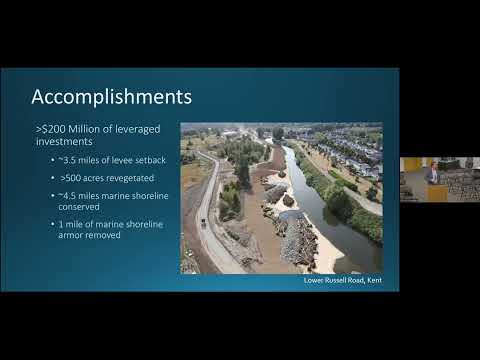
Goring told council the partnership’s annual budget includes about $600,000 from member cost shares and larger grant streams managed through WRIA 9. He summarized recent revenues directing capital projects, revegetation, research, monitoring, outreach and education, and said the partnership has leveraged more than $200 million in investments across the watershed, including roughly 3.5 miles of levee setback, 500 acres of riparian revegetation and 4.5 miles of conserved or restored marine shoreline.
Councilmembers framed the vote as supporting both salmon recovery and broader city interests. "It is important for us to continue to support the ILA not just for protection of our natural habitat, but as Matt mentioned, flooding and water security," Councilmember Jennifer said. Councilmember Sean added that small local investments can yield outsized regional benefits and urged continued outreach and education to build public support.
Goring also briefed council on the federal biological opinion related to Howard Hansen Dam and downstream fish passage, noting the Army Corps was directed to construct fish passage and that a federal funding push has secured significant appropriations to date. "The federal government released a biological opinion in 2019 saying continued operation of this dam without fish passage is going to jeopardize Chinook salmon," Goring said.
Council discussion touched on local outreach, school-based salmon education and potential walking tours of project sites in Jenkins Creek. Goring said WRIA 9 and partner nonprofits already fund education and outreach programs, and he offered to share information on a design study for a potential restoration project at the Wingfield Development Area.
The council approved the authorization by voice vote with no recorded roll-call tallies provided in the meeting transcript.