Get Full Government Meeting Transcripts, Videos, & Alerts Forever!
Get email alerts on the Medicaid Funding Threats topic
No spam. Unsubscribe anytime.
County officials warn proposed federal budget changes could threaten Medi‑Cal funding and hospital supplemental payments
Summary
County staff and policy advisers told the Health and Hospital Committee that several possible federal actions — changes to FMAP, eligibility barriers, and cuts to supplemental payments such as DSH — could significantly reduce funding for county health, and that timing and outcomes remain highly uncertain.
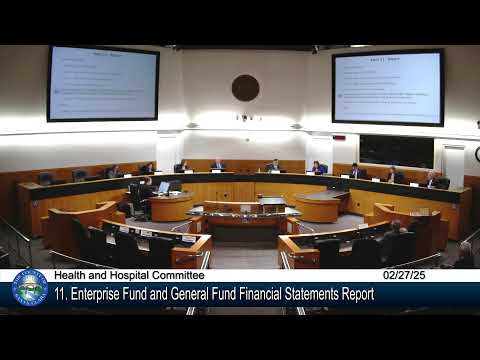
County policy staff and health system leaders briefed the Health and Hospital Committee on federal budget activity and said proposed measures in Washington could put significant parts of the county’s Medi‑Cal funding at risk.
Bert, the county’s federal/state policy adviser, explained that House and Senate budget resolutions currently diverge: the House resolution would create a pathway for large savings that are likely to affect Medicaid, while the Senate resolution does not include Medicaid cuts. He warned that the reconciliation process could take months and that December 31 remains the hard deadline if Congress intends to extend tax provisions tied to the broader package.
Speakers said several policy levers are under discussion in Washington that would affect counties: lowering the federal matching rate (FMAP) for Medicaid, capping federal payments with per‑capita models, erecting eligibility barriers (for example, work requirements), and reducing or deferring supplemental hospital payments such as the Disproportionate Share Hospital (DSH) program. Officials noted that local hospital revenue includes significant Medicaid payments and supplemental streams, and that even delayed or phased cuts could have major fiscal impacts. The county estimated Medicaid constitutes roughly $1.9 billion of patient revenue in the local system (combination of fee‑for‑service and supplemental payments); speakers emphasized the uncertainty over which parts of that revenue would be affected.
County leaders described two complicating layers: the federal proposal itself and how California’s state government would respond. Even if Washington made cuts, Sacramento’s choices on backstopping or reshaping assistance would determine local effects. Committee members were told the county is preparing advocacy and internal contingency planning but that detailed modeling will await clearer federal language.
Officials also reviewed the Disproportionate Share Hospital (DSH) history: DSH was created to help hospitals that serve large uninsured populations, was scheduled to be scaled back after the Affordable Care Act but repeatedly deferred, and now faces renewed pressure; staff said potential changes to DSH could mean tens of millions of dollars in lost county hospital revenue if policy shifts are enacted and sustained.
Committee members asked about timing on related payment deferrals and a possible government shutdown; staff said a continuing resolution (CR) expires March 14 and that other calendar items (debt‑limit measures) add further uncertainty. County staff and leadership stressed ongoing monitoring and that advocacy to members of Congress and state leaders is underway.