
El Segundo holds CEQA scoping meeting for proposed 323-unit project at Kansas and Washington
Get AI-powered insights, summaries, and transcripts
Sign Up Free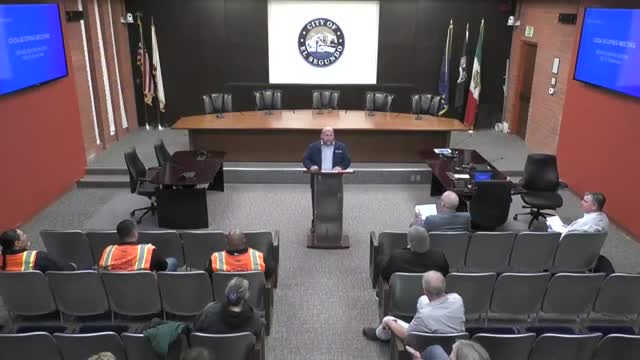
Summary
The City of El Segundo held a Feb. 20 CEQA scoping meeting to gather input for a draft environmental impact report on a proposed 323‑unit apartment development at Kansas and Washington.
The City of El Segundo held a public scoping meeting Feb. 20 to gather community input on environmental issues to be analyzed in a draft environmental impact report (EIR) for a proposed 323-unit apartment development at the corner of Kansas Street and Washington Street.
Planning Manager Eduardo Shawnborn, City of El Segundo, opened the meeting, saying the session was “to obtain comments, regarding the environmental issues that should be discussed in the forthcoming draft EIR.” David Blumenthal, the project manager assisting the city, described the proposal and next steps; Mike Harden of ESA, the city’s environmental consultant, explained the CEQA process and the technical topics that the EIR will examine.
Why this matters: The project would replace a former industrial site with a seven‑story, roughly 72‑foot building (7 stories by plan, visually about 46 feet from some viewpoints), proposing 323 residential units and about 450 parking spaces on roughly 3.67 acres. Neighbors and local groups raised immediate concerns about hazardous materials on the site, traffic and parking, noise during construction and operation, impacts on schools and other public services, and the proposed zoning and density changes.
City and consultant overview David Blumenthal, introduced as the project manager assisting the City of El Segundo, said the application requests a general plan amendment and a site‑specific plan to remove the property from the Smoky Hollow specific plan and adopt a new Grand Kansas specific plan; other entitlements include a tentative tract map and vacating a small portion of Washington Street. He described the project as 323 apartments with 450 parking spaces, multiple courtyards and roughly 9,000 square feet of combined roof‑deck and courtyard outdoor space.
Mike Harden, ESA, said the City of El Segundo is the lead agency under the California Environmental Quality Act (CEQA) and that tonight’s scoping meeting is intended to solicit public and agency input on what the draft EIR should address. Harden read the list of topics the EIR will evaluate, drawn from the initial study: aesthetics; air quality; cultural resources; energy; geology and soils; greenhouse gas emissions; hazards and hazardous materials; hydrology and water quality; land use and planning; noise; population and housing; public services; recreation; transportation; tribal cultural resources; and utilities and service systems. He reminded attendees that the notice of preparation (NOP) circulation began Feb. 6, 2025, and that the city is accepting comments on the NOP through March 7, 2025. The draft EIR will be circulated for at least 45 days when published.
Contamination and regulatory oversight Several residents cited prior technical reports and a Department of Toxic Substances Control (DTSC) case on the site. A resident said DTSC records show detections of chlorinated solvents, including PCE and TCE, and asked how the project could proceed given contamination. Harden and Blumenthal responded that the EIR will include a hazardous materials analysis and that “residential properties don't get built unless they're cleaned up to an acceptable standard.” Blumenthal said DTSC has an open case on the site and that, if the city approves the project, one condition would be obtaining full DTSC clearance for residential use before construction of residences could proceed; he said DTSC had indicated the cleanup could take more than a year and a half.
Local concerns raised at the meeting - Hazardous materials/health: Multiple attendees asked whether it is safe to walk in and use the site now and how soil vapor and off‑site migration will be addressed. City staff and ESA said airborne dust and soil disturbance during grading are the primary exposure pathways of concern and that the EIR’s hazardous materials section—and DTSC oversight—will address necessary remediation and mitigation. ESA said the EIR will incorporate available DTSC reports and technical investigations. - Traffic and parking: Residents and the neighborhood association said the proposed density (323 units) greatly exceeds nearby zoning norms and warned of roughly 1,500 additional daily vehicle trips cited by residents. ESA explained that CEQA traffic analysis now focuses on vehicle‑miles traveled (VMT) and that the EIR will analyze VMT and operational traffic noise; separate traffic studies addressing level‑of‑service at key intersections will be prepared for local planning purposes and included in the public record. - Noise: Attendees asked both about construction noise standards and ongoing operational noise from rooftop decks and common areas. ESA said noise experts will model construction and operational noise, compare results to the city's noise thresholds, and propose mitigation when levels exceed thresholds; if impacts cannot be reduced below thresholds, the EIR will identify them as significant and disclose them to decision makers. - Schools and public services: Speakers said the applicant’s estimate of 18–23 school‑age children living at the site conflicts with the school district’s estimate (over 80 students). ESA described the procedure for school‑impact analysis: the EIR team will apply school‑generation factors, notify the affected school district(s), and report capacity and projected student generation for elementary, middle and high schools. - Notices and outreach: Several residents questioned the city’s notice radius and whether all neighbors were informed. City staff said notices were mailed to property owners within 500 feet and occupants within 150 feet and published in the El Segundo Herald; project materials and the initial study are posted on the city’s pending projects page. - Local hire and construction workforce: Representatives of the Carpenters union and neighbors urged the city and applicant to consider local hire and apprenticeship programs to reduce traffic and support the local economy; staff said such suggestions can be included in the EIR and considered as mitigation or conditions if feasible.
Alternatives and next steps Mike Harden said the EIR will evaluate alternatives to the proposed project (for example, reduced density or different land uses) and technical studies (air quality, noise, traffic, cultural resources). The EIR process described: NOP comment period through March 7, technical analyses and preparation of a draft EIR, a minimum 45‑day public review period for the draft EIR, and then responses to comments in a final EIR. City staff emphasized that no approvals would be made at the scoping meeting; any planning commission and city council decisions would follow public hearings after the EIR and staff reports are complete.
What residents can do City staff and ESA urged attendees to submit focused comments on environmental topics they want addressed in the EIR before the March 7 deadline. Blumenthal said staff will upload the city comment letter to the project web page, and Harden asked residents to identify other nearby projects that should be included in the EIR’s cumulative analysis.
Ending City staff reiterated that the project team is paid and directed by the City of El Segundo and that the record of tonight’s meeting will be posted on the city website. The city will forward draft documents and notices to interested parties; the EIR and associated technical reports will be available during the draft EIR circulation for public review.
Votes at a glance: No formal actions or votes were taken at this meeting; the session was a public scoping meeting to solicit comments for the draft EIR.