
Massachusetts House adopts joint rules package, rejects audit and roll-call amendments
Get AI-powered insights, summaries, and transcripts
Sign Up Free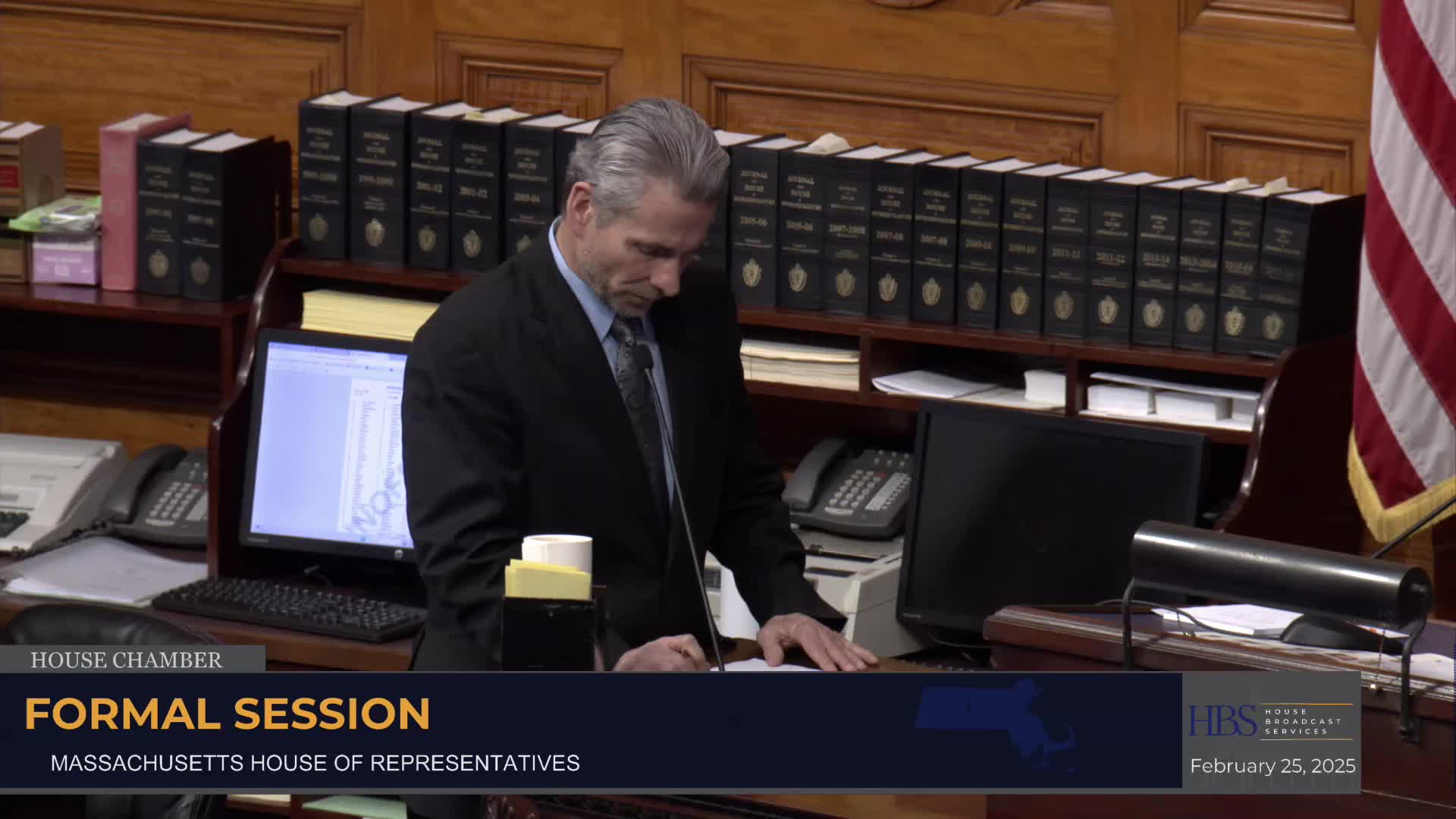
Summary
The House approved permanent joint rules for the 2025–26 legislative session by a 28-23 vote, approving new committee timelines, posting requirements and in-person voting rules while rejecting multiple amendments including proposals to require roll-call votes after July 31 and to mandate auditor-conducted audits.
The Massachusetts House of Representatives adopted a package of permanent joint rules for the 2025–26 legislative session after a contentious floor debate that ended with the order adopted on a 28-23 vote.
The rules package, presented as House Order No. 2026 and debated alongside a related House rules order (House No. 2024), includes a number of procedural changes the majority said are intended to speed the legislative process: a 60-day time limit for committees to report bills after a hearing, separate committee voting by chamber for bills filed by senators or representatives, mandatory online posting of committee summaries and attendance, and a requirement that members vote in person for hearings and formal sessions with narrowly defined exceptions for military duty, serious health conditions and pregnancy-related limits.
Supporters said the changes are designed to reduce delays and increase public access to bill information. "I rise in support of House 2026," said Mister Moran of Brighton during debate, praising the package as a way to "move bills through the process at a must faster pace." The rules also create a process to allow certain conference-committee reports to be taken up after July 31 if a conference committee was appointed before that date.
Opponents raised concerns about transparency and separation of powers in several amendment fights. Representative Jones of North Reading repeatedly offered amendments to require roll-call votes for certain late-session business and to lengthen notice and review periods for bills and electronic committee polls; those amendments were rejected by the chamber. "It's creating transparency because everybody knows there's gonna be roll calls," Jones said while arguing for mandatory recorded votes in the post-July 31 period; his proposed roll-call requirement was defeated.
Several amendments would have changed the House's approach to audits and to how the House implements a recent ballot question on legislative audits. Representative Merabian O'Grafton, supporting an amendment to require that audits "be published on the general court website in a conspicuous place within 72 hours of receipt," described the proposal as seeking "a much more transparent process of the audit being posted." That amendment was rejected. A separate proposal to require that audits of the House be conducted by the state auditor, a change supporters said would implement the ballot question voters approved in November, also failed after extended debate about the constitutional separation of powers. "This is truly a question of the separation of powers," said Mister Viera of Falmouth during debate on seeking judicial opinion; opposing speakers urged caution about ceding legislative processes to an executive-office-led audit regime.
Other amendments debated and rejected included proposals to (1) require two weeks' notice before formal sessions convened to take up certain late-year matters, (2) require a minimum two-hour window for electronic committee polls, and (3) require 12 hours' advance notice that an electronic poll would be released. Floor leaders and several members said those proposals would slow the House or hamper the chamber's ability to respond to emergencies; proponents argued they would improve members' ability to review lengthy bills. "All this is going to allow is a 2 hour window," said Mister Smoller of Warren in support of a two-hour poll window, arguing members often lack time to read long bills pulled for votes.
The final vote on the joint rules package was taken after multiple roll calls and divisions; the clerk displayed a tally of 28 in the affirmative and 23 in the negative. The House then proceeded to adopt related House rules reforms (House Order No. 2024) by a similar margin.
Votes at a glance
- House Order No. 2026 (Adoption of permanent joint rules for 2025–26): Adopted, 28 yes, 23 no. - House Order No. 2024 (Adoption of permanent House rules for 2025–26): Adopted, 28 yes, 23 no. - Amendment (require roll-call votes for specified post-July 31 business): Not adopted, recorded tally 23 yes, 128 no (as displayed by clerk during roll call). - Amendment (publish state auditor audits on general court website within 72 hours): Not adopted, tally displayed 23 yes, 128 no. - Amendment (require state auditor to conduct audits of the House): Not adopted, tally displayed 24 yes, 127 no (roll-call display cited in debate). - Multiple other amendments on notice periods, poll windows, and timing of bill publication: Not adopted (individual tallies recorded on roll calls during the session).
Context and implications
Supporters said the package will speed action on bills, require clearer committee reporting and expand online access to bill summaries and hearing records. Opponents said several rejected amendments represented efforts to preserve member notice, ensure recorded votes on consequential late-year business and to implement a voter-approved audit measure; those amendments failed after floor votes.
The debate also touched repeatedly on a pending legal dispute about the scope of the auditor's authority and whether that authority implicates the constitutional separation of powers — an issue several members said remains unresolved by the chamber and the attorney general. Lawmakers did not change that legal status during the session; critics and proponents signaled continued dispute outside the rules vote.
The House recessed and returned for additional orders and procedural matters after the rules votes; the decisions on the rules set the procedures that will govern committee reporting, committee voting by chamber, and certain late-session practices for the coming legislative session.