Get Full Government Meeting Transcripts, Videos, & Alerts Forever!
Get email alerts on the Governance Bylaws topic
No spam. Unsubscribe anytime.
Planning Commission amends bylaws to add schedule flexibility, quorum rule and timing for acting on public hearings
Summary
The Planning Commission voted to amend its bylaws to allow scheduling exceptions, define quorum as a majority of appointed commissioners, and permit the commission to act at the same meeting as a public hearing without a separate rules suspension. The motion passed on a roll-call vote.
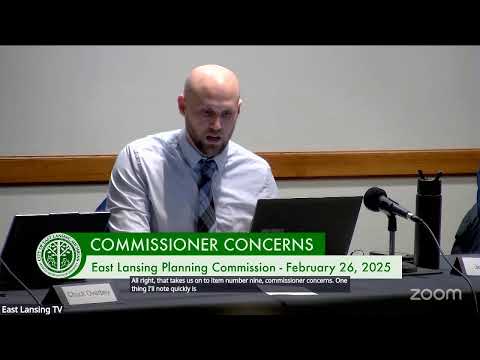
At its Feb. 26 meeting the East Lansing Planning Commission voted to amend its bylaws in three housekeeping areas: (1) allow regular meetings to be scheduled on days other than the second and fourth Wednesdays when the commission votes to do so, (2) change quorum language so that a majority of appointed and serving commissioners constitutes a quorum, and (3) remove a sentence that had said as a general rule the commission will act on an issue at the next regular meeting after a public hearing (effectively allowing the commission to act at the same meeting as a public hearing without needing an explicit suspension of rules).
Commissioner Chapin moved the changes and Vice Chair Wagner seconded. After discussion that included a single dissent on the record, the commission took a roll-call vote. The recorded tally at the meeting was: Commissioner Chapin — yes; Commissioner Denault — no; Commissioner Overby — yes; Commissioner Putz — yes; Vice Chair Wagner — yes; Chair Sullivan — yes. The motion carried and the bylaw edits were adopted.
Several commissioners discussed the third change during debate. Commissioner Denault said the existing language encouraged public input because it set a general expectation that an item would be acted upon at a subsequent meeting, giving more opportunity for neighbors to appear. Other commissioners said the edit simply removed an expectation and provided flexibility while retaining staff discretion to call for additional hearings when warranted.
Bartley said the amendments were intended as clarifications rather than substantive policy changes and that the commission could still choose to wait for additional information in individual cases. The bylaws change is an internal commission procedural matter and does not require council approval.