Get Full Government Meeting Transcripts, Videos, & Alerts Forever!
Get email alerts on the Zoning Code Amendments topic
No spam. Unsubscribe anytime.
Staff proposes wide-ranging housekeeping changes to East Lansing zoning and sign codes; public hearing to be scheduled
Summary
City staff presented draft corrections and clarifications (ordinance 15-43) to multiple sections of the zoning code and sign ordinance, focused on organization, cross-references and nonconformity clarifications. Planning Commission gave detailed feedback and asked staff to return with a public hearing-ready draft and the city attorney present.
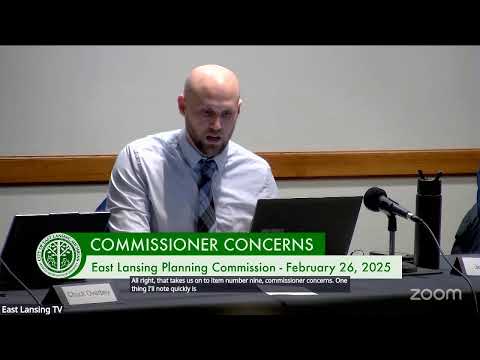
City planning staff told the Planning Commission on Feb. 26 that a proposed ordinance (15-43) would make numerous corrections and clarifications across chapter 50 (zoning) and chapter 32 (signs) without changing underlying policy intent in most sections.
Staff member Mr. Bartley described the package as primarily organizational: moving definitions to a central location, renumbering and alphabetizing permitted-use lists, adding cross-references for childcare centers and ATM rules, and correcting a map omission that left 1060 Glenhaven off an existing residential rental restriction overlay created by ordinance 12-91. Bartley emphasized the changes were intended to reduce confusion for code users and make the ordinance internally consistent.
Several zone-specific clarifications were summarized: adding childcare centers and day-care centers as special uses across multiple business districts (B1–B5) and the community district (C); including cross-references to ATM regulations so readers know to consult additional rules; and adding language in business districts that retail alcohol sales for off-site consumption are subject to State of Michigan requirements for local review and approval.
Staff also described changes in the Office/Industrial Park (OIP) district to include uses added last year by the mass-timber ordinance and noted a handful of formatting and renumbering edits for the East Village district and electric-vehicle charging definitions.
On nonconforming uses, staff proposed clarifying that if a nonconforming structure or use is reduced (for example, an addition removed), the removed portion would no longer retain nonconforming rights and could not be restored to its former nonconforming condition. Staff also proposed language to allow an owner who relocates a nonconforming structure to a conforming location to retain the right to use it; staff characterized that point as a minor policy-adjacent clarification.
On signs, staff recommended clearer standards on directory signs and maintenance: allowing maintenance and reduction in size of nonconforming signs without automatically eliminating nonconforming rights, while clarifying that once a nonconforming sign is removed or reduced (beyond maintenance) it cannot be restored to its previous nonconforming size.
Commissioners asked detailed questions about mapping ("major streets" references moved from East Village definitions), accessory-structure setbacks (concerns that some setback numbers are large for small sheds or decks), rooming/boarding-house terminology and how accessory dwelling unit rules were being changed. Several commissioners urged caution where proposed wording might amount to policy changes rather than housekeeping.
Bartley said staff will incorporate the commission's feedback, correct drafting inconsistencies (including a stray color-coded edit), and return with a public-hearing-ready draft and the city attorney available for questions. The commission indicated it expects the item back for a public hearing at a future meeting before any recommendation to council.