Get Full Government Meeting Transcripts, Videos, & Alerts Forever!
Get email alerts on the Zoning Family Definition topic
No spam. Unsubscribe anytime.
East Lansing planning commission holds public hearing on proposed change to "family" definition in zoning code
Summary
The Planning Commission opened a public hearing on proposed ordinance 15-45 to add nieces, nephews, cousins, foster children and persons under guardianship to the zoning code's "family" definition. Commissioners asked for more legal and comparative-city context and did not vote; staff will invite the city attorney to the next meeting.
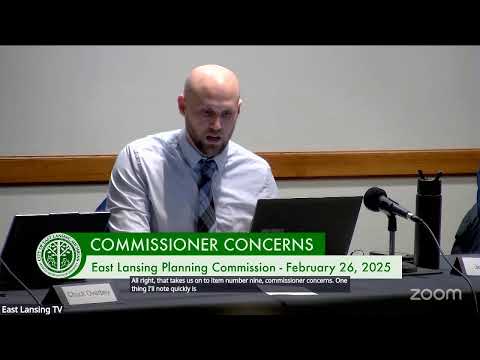
The East Lansing Planning Commission on Feb. 26 opened a public hearing on proposed ordinance 15-45, which would amend chapter 50 (zoning) to expand the code's definition of “family” to explicitly include nieces and nephews, cousins, foster children and "persons living with dwelling unit owner under guardianship." The commission did not vote and asked staff to bring the city attorney and additional background to a future meeting.
The change was introduced by staff at the request of City Council and described by staff member Mr. Bartley as "limited just to adding those words to the definition of family." Bartley told the commission the amendment was intended to align the zoning ordinance with changes anticipated in the rental housing ordinance (ordinance 15-38) and said the attorney drafted the language at council's request.
The issue drew several rounds of questions from commissioners. Commissioner Overby and others queried whether the proposed wording matched language in the rental ordinance and whether the city attorney had compared East Lansing's approach with other municipalities. Bartley confirmed the text tracks the rental ordinance language and said staff had reviewed other ordinances but that the city attorney could appear at a later meeting to explain the drafting process.
Resident Patrick Rose, who said he has followed the matter and has provided written materials, urged the commission to adopt the change and argued the proposed amendment "expands persons who can live and share costs of rent to survive and thrive without needing a rental license." Rose also told the commission that the recently passed charter amendment (referred to in public testimony as "Prop 1") did not itself require changes to the zoning definition of family and cited court precedent (including Delta Township v. DeNolfo and Moore v. City of East Cleveland) to argue courts have adopted a broad "functional family" test.
Several commissioners said they were unclear what problem the amendment was intended to solve and asked for more context. The Housing Commission letter in the packet — which commissioners discussed — recommended shifting the burden of proving family status from individuals to the city; staff cautioned that such a procedural change would raise capacity and evidentiary questions.
No motion or recommendation was made at the Feb. 26 meeting. Chair Sullivan and other commissioners asked staff to invite the city attorney and, if helpful, the council member who requested the ordinance to attend the next meeting so the commission could better understand the legal basis and policy intent before taking a recommendation to council.
The item will return to a future Planning Commission agenda for additional discussion and possible action.