Danville Utilities recommends smart-thermostat pilot to City Council to reduce peak energy costs
Loading...
Summary
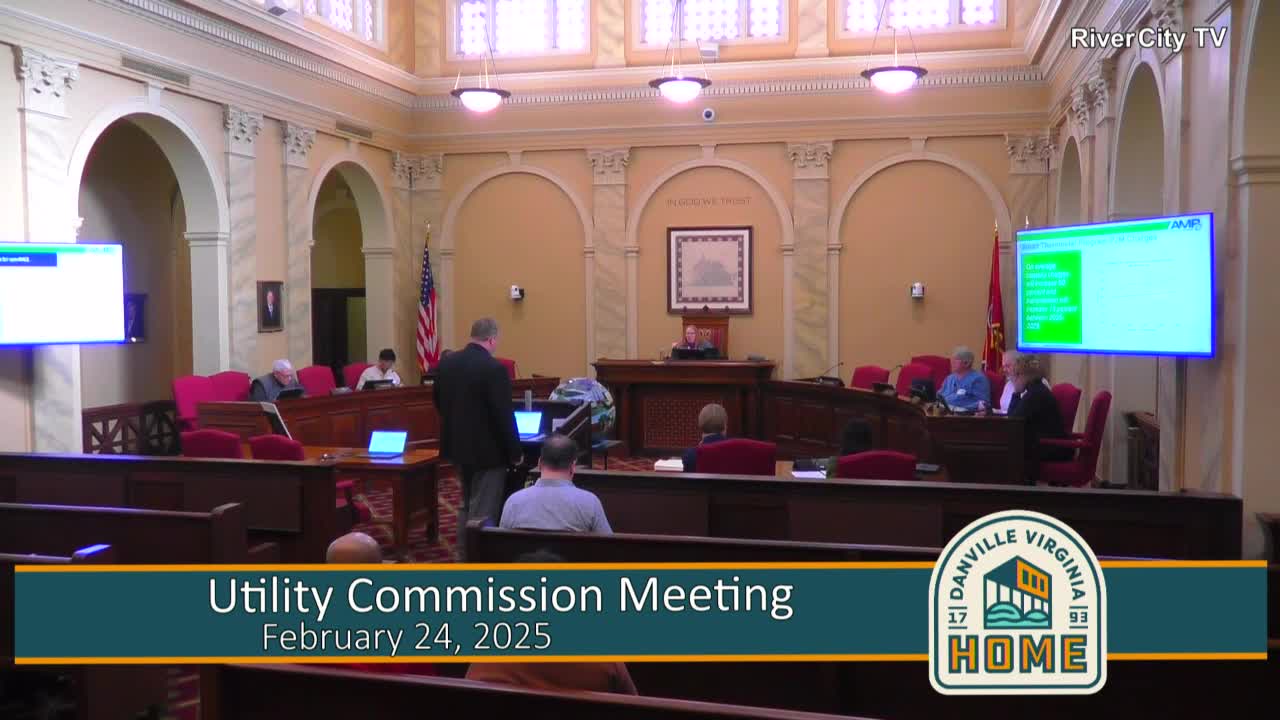
The commission voted Feb. 24 to recommend the Smart Thermostat Residential Peak Shaving Program to the City Council after a staff presentation that described partnerships with American Municipal Power and EnergyHub, voluntary enrollment, a $55 one-time incentive, and estimated system savings if 1–1.5% of customers enroll.
The Danville Utilities Commission voted Feb. 24 to recommend that the City Council approve a Smart Thermostat Residential Peak Shaving Program designed to reduce capacity and transmission costs by shedding peak load during extreme hot and cold events.
Staff described the program as voluntary and managed through a third party. Janet Davis, a utility presenter, said: “The community energy savings program reduces peak demand through voluntary management of Wi Fi or smart thermostats.” She said participating thermostats can be adjusted by program operators for no more than 80 hours per year during peak events and that customers always have the option to opt out of a given event.
Staff said Danville would join 12 other American Municipal Power (AMP) communities that use a contractor called EnergyHub to integrate with thermostat vendors such as Nest, Honeywell and Ecobee. Customer incentives would include a one-time $55 gift card for enrolling and entry into a drawing for a $250 gift card at summer’s end. Staff projected that if 1 percent of Danville Utilities customers (about 377 customers) enrolled, the utility would realize more than $26,000 in net annual savings under current capacity and transmission costs; 1.5 percent enrollment (about 566 customers) would yield more than $39,000 in annual net savings.
Staff described how the program operates during events: thermostats may pre-cool or pre-heat before a peak and then limit HVAC cycling for typically two to three hours during the peak; customers can override that control. The program requires customers to own a Wi-Fi–enabled smart thermostat; staff said participating thermostats connect digitally and no in-home installation by utility crews is required. Staff noted retail device costs vary; some models are available on sale for about $55 while others typically range up to roughly $150.
Mr. Grama encouraged resident participation, noting the program’s aggregated load-shed potential: “We find out from other utilities’ experience that a lot of customers… have over a 1 kW load shed. So if you have 300 customers participate that’s 300 kW; that is significant,” he said.
After the presentation the commission moved and approved a recommendation that the City Council adopt the program. Recorded votes on the motion were: Ms. Katzmann — yes; Mr. Merricks — yes; Mr. Reynolds — yes; Ms. Williamson — yes; Ms. Williamson Branch — yes.