Get Full Government Meeting Transcripts, Videos, & Alerts Forever!
Get email alerts on the Homelessness topic
No spam. Unsubscribe anytime.
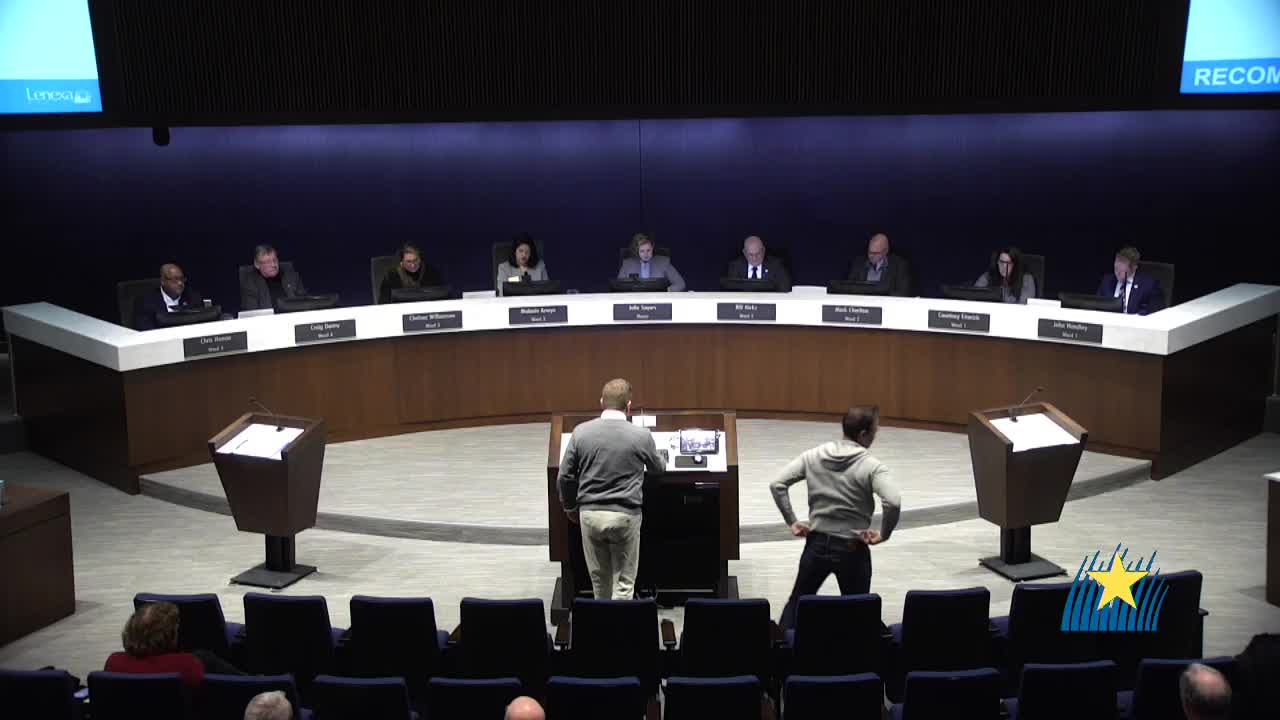
Lenexa council approves ordinance raising church-run shelter occupancy to 50, tightens enforcement
Summary
The Lenexa City Council approved an amendment to the Unified Development Code allowing qualifying churches to house up to 50 unhoused people, increases staffing requirements, and creates new civil-penalty enforcement and occupancy-revocation processes after several hours of debate.
The Lenexa City Council voted to approve an ordinance amending the city’s Unified Development Code to raise the permitted overnight occupancy at qualifying church accessory homeless shelters from 30 to 50 people and to add new staffing and enforcement requirements.
The change was approved after a lengthy discussion in which council members debated remanding the measure back to the Planning Commission and weighed neighborhood impacts, enforcement, and the capacity of operators. The council removed a Planning Commission stipulation that would have capped the total number of guests citywide at 250 after staff and the city attorney identified potential legal problems with that cap.
City staff presented the ordinance as staff-supported and stressed that the broader package includes operational and enforcement safeguards. Scott McCullough, Community Development Department, said the ordinance raises the occupancy limit for churches that meet size and transportation criteria and aligns staffing and enforcement requirements with that higher occupancy level. “The ordinance before you is supported by staff,” McCullough said during the presentation.
Under the approved text, qualifying churches — previously identified in code as those meeting a minimum facility size and transit-access criteria — may host up to 50 overnight guests. Staff recommended a staffing level of four on-site staff for a 50-person occupancy, based on Police and Fire operational analysis. The ordinance also adds civil penalties for occupancy violations and allows the city to revoke occupancy rights for up to one year for multiple violations within a 12-month rolling period; an appeal process is provided.
Council members who supported the ordinance argued that Project 10 20, the local operator discussed throughout the hearing, had demonstrated operational capability and that Lenexa should increase local capacity rather than wait for countywide solutions. Council member Chelsea said the additional beds addressed immediate public-safety and public-health needs during cold months and commended the shelter’s volunteers.
Opponents and cautious voices urged more study and pointed to potential secondary impacts near shelters. Some council members and Planning Commission members had favored a citywide cap that would limit total served across all eligible churches; staff and the city attorney advised the council that such a stipulation could be unlawful, and the council removed it when voting.
The ordinance also preserves building- and fire-code requirements: any shelter increase in occupancy must be accompanied by a new certificate of occupancy and site-specific building-fire-code compliance review. McCullough noted that changes such as additional exits, plumbing fixtures, or sprinkler systems could be required when a site seeks a higher approved occupancy.
Council members debated whether to remand the amendment to the Planning Commission for further study. Some members urged remand to gather additional input; others, citing the urgency of winter shelter needs and staff analysis that emergency services could absorb the load, urged prompt approval. The motion to approve the ordinance as originally proposed (without the Planning Commission’s 250-citywide cap) passed following a motion and second and vocal aye/oppose exchange; the transcript records the motion as passing but does not include a roll-call tally in the public record excerpt.
The ordinance applies citywide to churches that meet the code’s size and transit criteria and is intended to remain accessory to the church’s primary use. Staff described the increase as near the upper limit of what the city believes remains compatible with residential neighborhoods and emphasized the new enforcement tools that accompany the change.
City staff indicated that the code changes add a clearer, streamlined civil-enforcement path and a process to revoke occupancy privileges after repeated violations; staff also said the code retains an appeal process for operators that receive violations.
Council members asked staff to maintain situational awareness for emergency responders and to continue coordination with Project 10 20 and other stakeholders on operational matters. The ordinance became effective following the council vote and will be implemented through standard permitting and code-enforcement procedures.
Ending: The council’s vote alters Lenexa’s zoning framework for church-run shelters, increasing permitted occupancy while adding staffing and enforcement standards; staff will administer occupancy increases through the city’s building- and fire-code processes and the new civil-enforcement provisions.