Get Full Government Meeting Transcripts, Videos, & Alerts Forever!
Get email alerts on the Public Safety topic
No spam. Unsubscribe anytime.
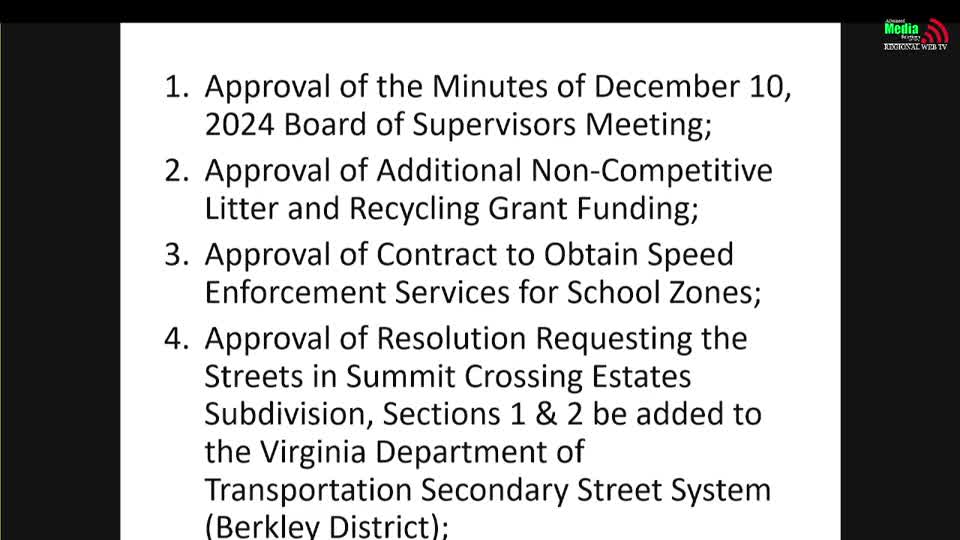
Board approves school-zone speed camera contract for five permanent zones plus mobile unit
Summary
As part of the consent agenda the board voted to authorize a contract to install automated speed-enforcement in five permanent school zones plus one mobile trailer; fines start at $50, increase to $100 for repeat offenses, a public education campaign and a 30‑day written-warning period precede enforcement.
Spotsylvania County supervisors approved a contract for automated speed-enforcement in school zones as part of the Jan. 14 consent agenda, authorizing five permanent school-zone camera sites and one mobile trailer unit.
Board members and staff said the program will start small (five permanent zones plus one mobile unit) and can expand to up to 25 school zones over time. The vendor agreement includes a required public outreach campaign and a 30‑day written-warning window before citations issue, with an earlier 30‑day social-media and community‑notification push ahead of activation.
County staff estimated about 120 days to implement the initial system; that schedule would place full operation near the end of the school year or with the next school year, depending on vendor timing. The board and staff emphasized that the enforcement would be civil citations (not criminal) and limited to when school is in session and the camera‑mounted lights are functioning.
Penalty levels discussed at the meeting: a first civil infraction carries a $50 fine and repeat infractions rise to $100 per incident, according to staff remarks during the discussion. Supervisors framed the program as behavioral (safety) rather than revenue‑generating and said signage and statutory signage requirements apply.
Ending: The measure passed as part of the consent agenda with a follow-up request: staff will run the vendor’s public-education plan and use the contract’s social-media and outreach provisions to alert residents to upcoming sites and the warning period.
Votes at meeting: The consent agenda passed first with most items; item 3 (the camera contract) was pulled for brief discussion then approved by roll call (7–0).