Get Full Government Meeting Transcripts, Videos, & Alerts Forever!
Get email alerts on the Water Resources topic
No spam. Unsubscribe anytime.
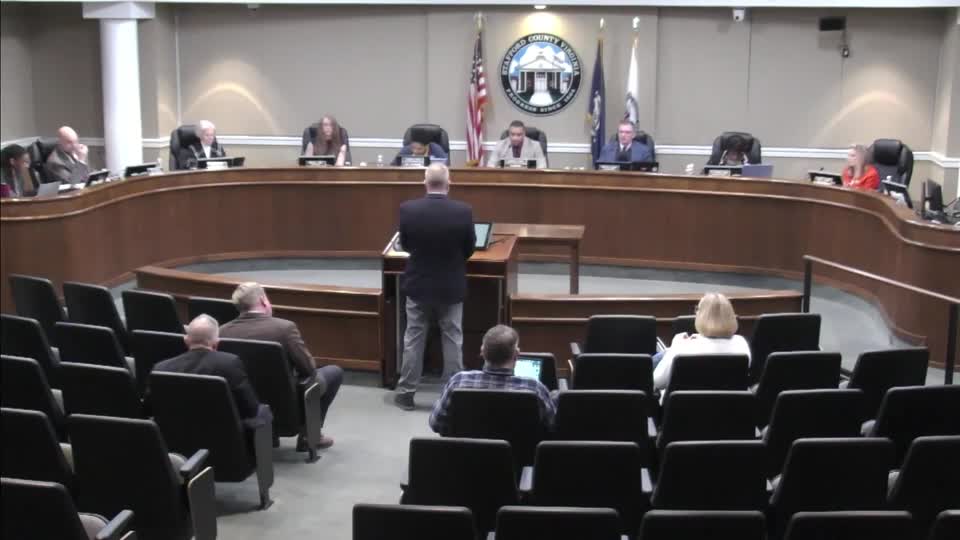
Board defers drought‑management ordinance after questions about enforcement and data‑center impacts
Summary
Utilities staff presented a draft drought management plan and an amendment to county code that would set drought triggers, staged restrictions and enforcement options including a per‑day penalty.
Utilities staff presented a proposed drought management plan and a related amendment to the county code to establish trigger conditions and restrictions for drought stages on Jan. 21. The draft includes voluntary measures, escalating mandatory restrictions and a set of enforcement options that include suspension of service and a $100‑per‑day penalty for violations.
Utilities Director John Brendel explained the proposal responds to a new withdrawal permit for Lake Mooney and the Virginia Department of Environmental Quality requirement that the county adopt a drought management plan. He said the plan combines state drought declarations (watch, warning, emergency) with local reservoir levels to determine staged restrictions.
Board concerns and deliberation
Supervisors raised several practical questions about enforcement, the legal method of imposing fines, and how the county would manage large commercial users such as data centers. Board members asked whether fines would be criminal or civil and how a residential customer would be distinguished from a large commercial connection. Several supervisors said existing water‑service agreements with large users need to include explicit benchmarks and contingency plans to prevent potable‑water reliance during drought.
One recurring concern: if a large customer remains connected and continues to draw water during a drought, would a $100 daily penalty be a sufficient deterrent compared with the operational costs to that customer? Board members said staff should evaluate different penalty structures for large or high‑volume industrial users and consider whether charges should be placed in contractual agreements rather than in the drought ordinance.
Board action
The board voted unanimously to defer the ordinance and directed staff to return with clarifications on enforcement options, civil versus criminal penalties, how to incorporate contractual measures for large users, and draft language reflecting those decisions.
Why it matters
The county’s water supply is dependent on surface reservoirs and streamflow, which are sensitive to multi‑year dry periods. Clear drought triggers and enforceable, legally defensible measures help protect public health and allocate scarce water during emergencies.
Ending
Staff will rework the draft in coordination with the county attorney and bring revisions back to the board that address enforcement structure, differential approaches for high‑volume users, and contractual protections in water‑service agreements.