Get Full Government Meeting Transcripts, Videos, & Alerts Forever!
Get email alerts on the Public Safety topic
No spam. Unsubscribe anytime.
Spotsylvania supervisors direct staff to draft school‑zone speed‑camera ordinance with $50/$100 fines
Summary
After a staff presentation, the Board voted to direct staff to draft and advertise an ordinance establishing an automated school‑zone speed camera program and to recommend civil penalties of $50 for a first violation and $100 for subsequent violations.
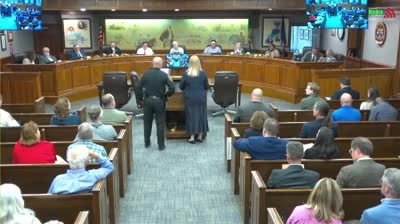
Spotsylvania County supervisors voted on Oct. 22 to direct staff to draft and advertise an ordinance authorizing automated speed‑enforcement cameras in school zones and to propose civil penalties of $50 for a first violation and $100 for subsequent violations. The board’s direction came after staff said an ordinance should accompany any camera program and asked supervisors for guidance on penalty tiers.
County attorneys and sheriff’s office staff told the board the state statute authorizes civil penalties of up to $100 but does not set specific amounts, and that jurisdictions use a variety of approaches. “It is staff’s opinion that best practices are that the county needs to adopt an ordinance before or at the same time as it adopts a speed camera program,” said Susan Cook, deputy county attorney. Captain Myrick of the Spotsylvania County Sheriff’s Office told the board jurisdictions see substantial reductions in speed violations after cameras are installed: “The overall consensus is, though, you see approximately about a 90% reduction rate in speeding through school zones.”
Supervisor Hayes moved the direction to staff, asking that the ordinance be advertised for a public hearing. After discussion about whether fines should be tiered by speed or repeat offense, the board settled on a structure recommended by the sheriff’s office: $50 for a first offense and $100 for a second or subsequent offense. Supervisors also asked staff to advertise the ordinance so the public could weigh in at a hearing.
The board voted to authorize drafting and advertisement of the ordinance; the clerk recorded the outcome as a 7‑yes majority. Staff said the proposal can be amended after public comment and that, under state law, any increase above the statutory cap would not be allowed. The ordinance will return to the board for public hearing and final action once staff has prepared the draft and the civil‑penalty language.