Get Full Government Meeting Transcripts, Videos, & Alerts Forever!
Get email alerts on the Immigration Policy topic
No spam. Unsubscribe anytime.
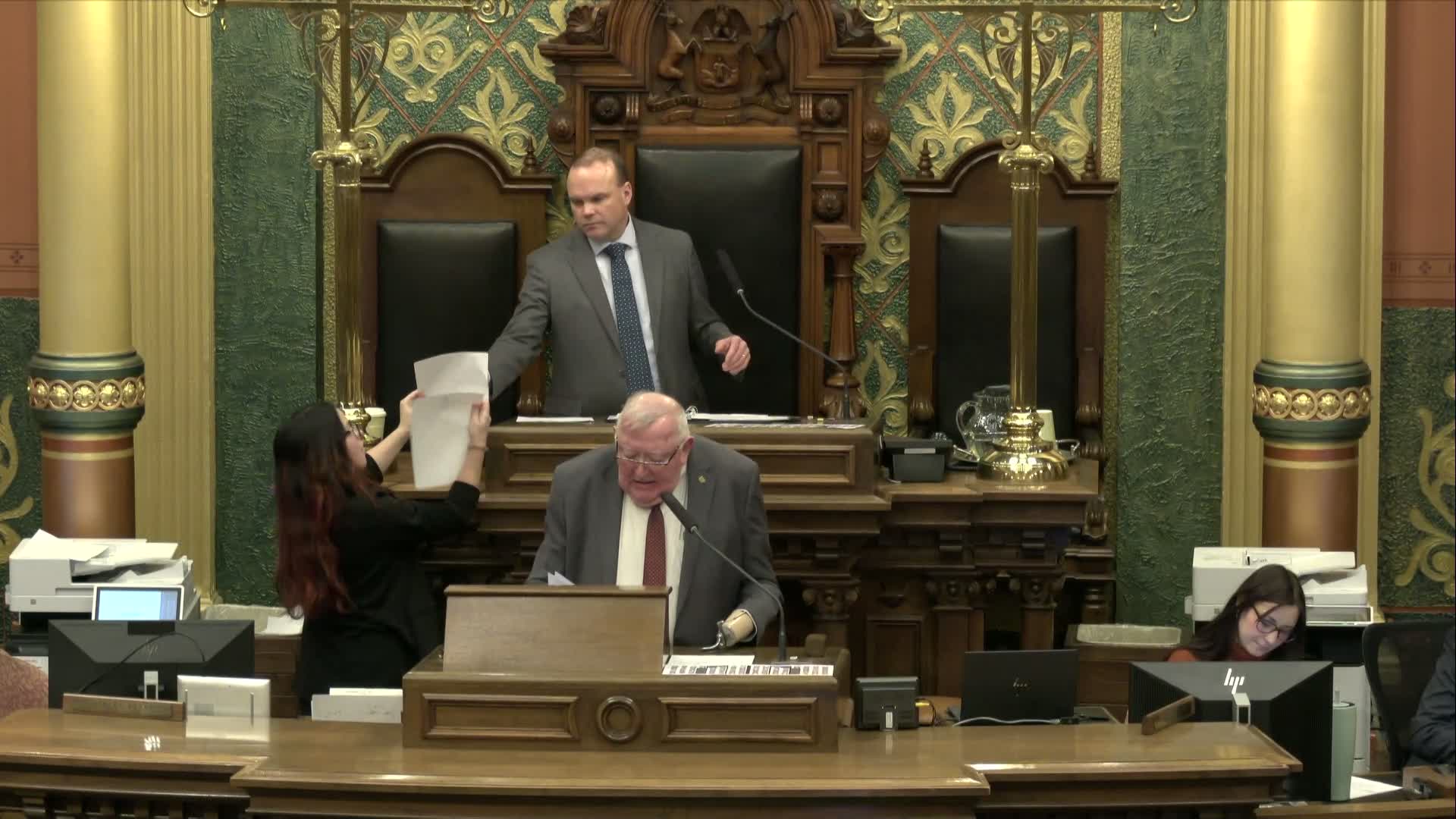
Michigan House adopts resolution threatening state project funding for ‘sanctuary’ jurisdictions, 56-50
Summary
The Michigan House on Tuesday approved House Resolution 19, a measure that conditions certain discretionary state project funding on local cooperation with federal immigration enforcement. The 56-50 roll call followed hours of debate and three failed amendments.
Lansing — The Michigan House of Representatives approved House Resolution 19 on Tuesday in a 56-50 roll call, a measure that warns local governments that certain discretionary state projects could be withheld if jurisdictions adopt policies described by supporters as “sanctuary” policies that limit cooperation with federal immigration enforcement.
Supporters framed the resolution as leverage over “pork” projects; opponents said it would undermine public safety and imperil vulnerable residents. The chamber adopted a substitute version of the resolution earlier in the floor process and rejected three subsequent amendments before the final vote.
The resolution matters because it ties eligibility for select state-funded capital or discretionary projects to local immigration-enforcement practices — an action proponents say will pressure municipalities to comply with federal immigration authorities, while opponents say it could erode trust between immigrant communities and local police.
Representative Wigela, speaking in opposition, called the measure “a power grab” that would punish municipalities that seek local protections from federal immigration officials. “Dehumanizing an entire group of people is always wrong and dangerous,” Wigela said, citing both legal and moral concerns and quoting Leviticus to emphasize a humanitarian argument.
Representative Wooden, also opposing the resolution, said the measure could lead to wrongful detentions by Immigration and Customs Enforcement and cited cases he described as examples of U.S. citizens being held in immigration custody. “This resolution puts American citizens at risk of being wrongfully detained by ICE and by removing local safeguards,” Wooden said.
Representative Tyrone Carter, a retired law-enforcement officer, told colleagues the resolution was “reckless” and risked lowering public-safety cooperation by making immigrants fearful of contacting police. “People are less likely to make calls to the police department if they don’t have that trust,” Carter said.
Speaker Mike Hall, who introduced the resolution, said the measure is intended to withhold what he described as nonessential “pork projects” from jurisdictions that declare sanctuary policies. “If you’re one of those municipalities that’s asking us to pay for your stadium or sports complex or your water park, don’t be a sanctuary city,” Hall said on the floor.
Floor action and amendments
The committee on government operations had reported House Resolution 19 with a recommendation that a substitute (H-1) be adopted. On the House floor the body voted to adopt the substitute; the clerk announced the substitute was adopted (no roll-call tally printed at that moment). Representative Tyrone Carter offered an amendment identified as Amendment 1A; Representatives Fitzgerald offered Amendment 1B and Amendment 1C. The clerk opened the board and announced each amendment was not adopted.
A record roll-call vote was requested before final adoption. Representative Postumas asked for the roll call; the clerk reported the final tally as 56 ayes and 50 nays. The presiding officer announced the resolution adopted after the roll-call results were displayed.
What the House did and did not decide
- Formal action: House Resolution 19 was adopted by roll-call vote, 56–50. The resolution conditions certain discretionary state project funding on local cooperation with federal immigration enforcement practices (the resolution text was considered on the floor; specific legal mechanisms and lists of projects subject to withholding were not specified in floor remarks). - Amendments: Amendment 1A (Tyrone Carter), Amendment 1B (Fitzgerald) and Amendment 1C (Fitzgerald) were offered on the floor and were not adopted. A substitute (H-1) recommended by the committee was adopted earlier in the debate. - Direction vs. decision: The House adopted the resolution as a policy expression and condition for discretionary project funding; the transcript does not record any immediate administrative steps (for example, specific rule changes or lists of projects to be withheld) ordered on the floor.
Who spoke on the record
Speakers recorded in the transcript on this item include Representative Wigela (opposition remarks), Representative Wooden (opposition), Representative Tyrone Carter (opposition and author of one amendment), Speaker Mike Hall (sponsor/introducer), Representative Fitzgerald (offered two amendments), Majority Floor Leader Pastumas (moved to take up the resolution), and Representative Postumas (requested the record roll-call vote). Their full remarks and positions are reflected above.
Where the measure goes from here
As a House resolution, HR 19 is a legislative expression of the chamber’s position. The transcript does not record immediate administrative implementation details, deadlines, or an enacted law changing state statute. The resolution’s practical effect on state funding processes would depend on subsequent budget language or administrative directives that are not part of this floor record.
Votes at a glance (selected)
- Final adoption of House Resolution 19: 56 ayes, 50 nays, adopted.
Ending
The House adopted the resolution after broad debate; supporters emphasized limiting discretionary project funding to pressure compliance with federal immigration enforcement, while opponents warned of public-safety and humanitarian consequences. The transcript does not record subsequent administrative steps or legal changes that would implement the funding conditions described on the floor.