Get Full Government Meeting Transcripts, Videos, & Alerts Forever!
Get email alerts on the Egle Briefing topic
No spam. Unsubscribe anytime.
EGLE director briefs House committee on agency structure, permits, clean‑water work and brownfield redevelopment
Summary
Department of Environment, Great Lakes, and Energy Director Phil Roos summarized EGLE’s organization, permitting initiatives, drinking‑water and wastewater oversight, remediation and brownfield redevelopment programs, and new digital tools such as a permitting portal; he highlighted grant work that supports local water infrastructure projects.
Department of Environment, Great Lakes, and Energy Director Phil Roos and legislative liaison Sydney Hart briefed the House Committee on Natural Resources and Tourism on EGLE’s mission, organization and major program areas, including air quality, water resources, drinking water, materials management, remediation and redevelopment, geological resources and several offices that coordinate policy and public engagement.
Roos said EGLE employs more than 1,500 scientists, engineers and other staff and that more than half the agency’s budget flows back to communities in the form of grants for infrastructure, brownfield redevelopment and related projects. He described the Michigan PFAS Action Response Team (MPART), the Office of the Great Lakes and the Office of Environmental Justice and Public Advocate as coordinating programs that draw participation from other agencies when contamination or community issues arise.
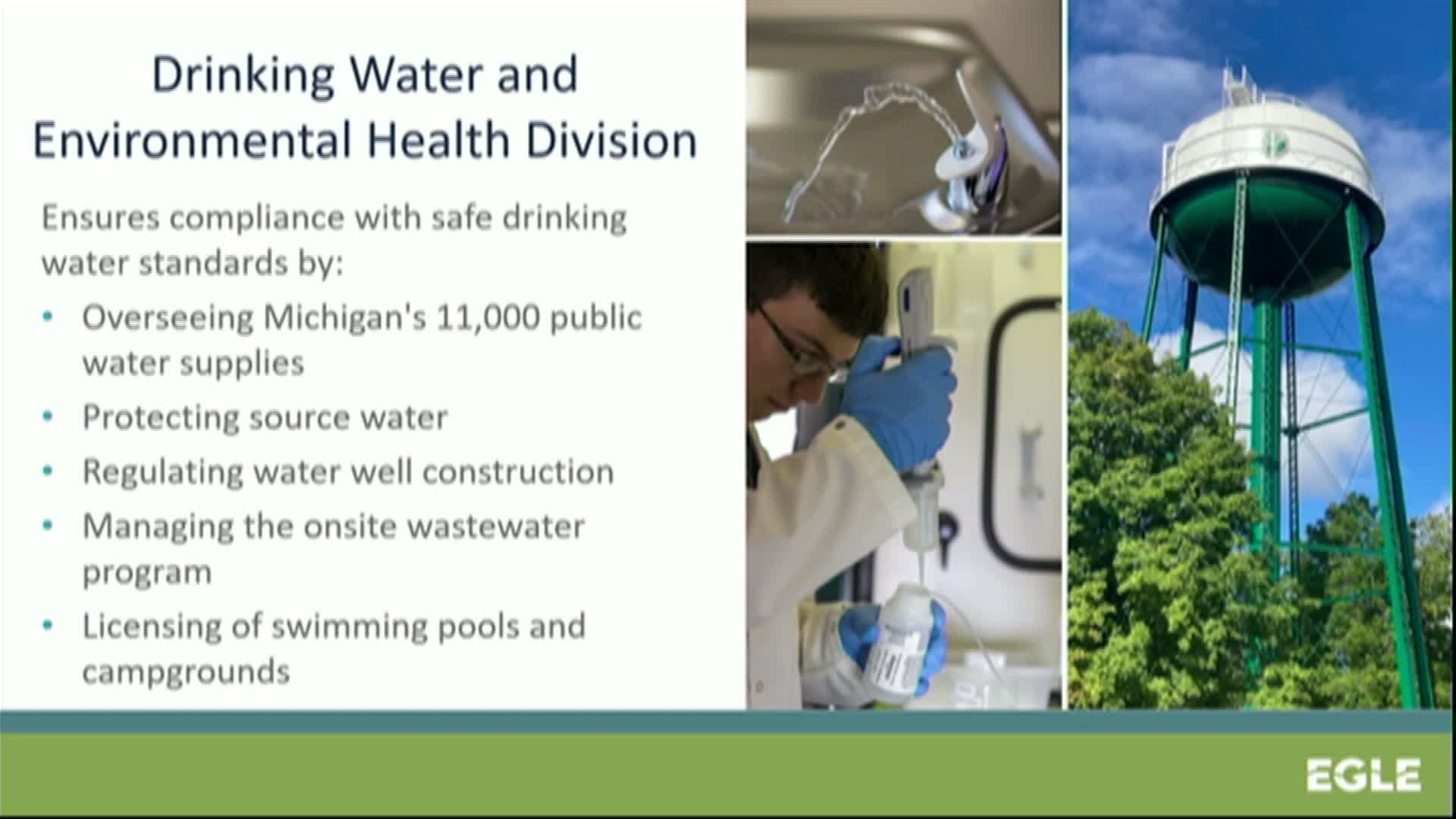
Roos highlighted a new MyEnviroPortal intended to centralize permits and related documents and said the Air Quality Division completed roughly 500 permit actions, received about 1,700 emissions reports, and operates about 200 air quality monitors. The Water Resources Division oversees permits for discharges and wetland regulation and had, Roos said, about 8,300 permits issued as of 2024; the Drinking Water and Environmental Health Division oversees more than 11,000 public water supplies and reviewed roughly 250,000 public water supply samples in the most recent reporting year.
On remediation and redevelopment, Roos described work to clean up contaminated sites and noted the brownfield program has issued more than 400 grants that Roos said spurred about $7 billion in private investment and supported about 34,000 jobs. He said the department has increased the pace of cleanup through process improvements and digitization.
Members asked about EGLE’s Upper Peninsula presence and staffing, and Roos said there is an office in Marquette and he offered to follow up with exact employee counts. Representative Johnson asked for a concrete example of the Office of Environmental Justice; Roos said the office coordinates engagement on permits and has administered grants that have had measurable local impacts.
The presentation was informational; members did not take formal committee action on EGLE matters during the session.