
Michigan State Police outlines services, staffing challenges and program requests to House Judiciary Committee
Get AI-powered insights, summaries, and transcripts
Sign Up Free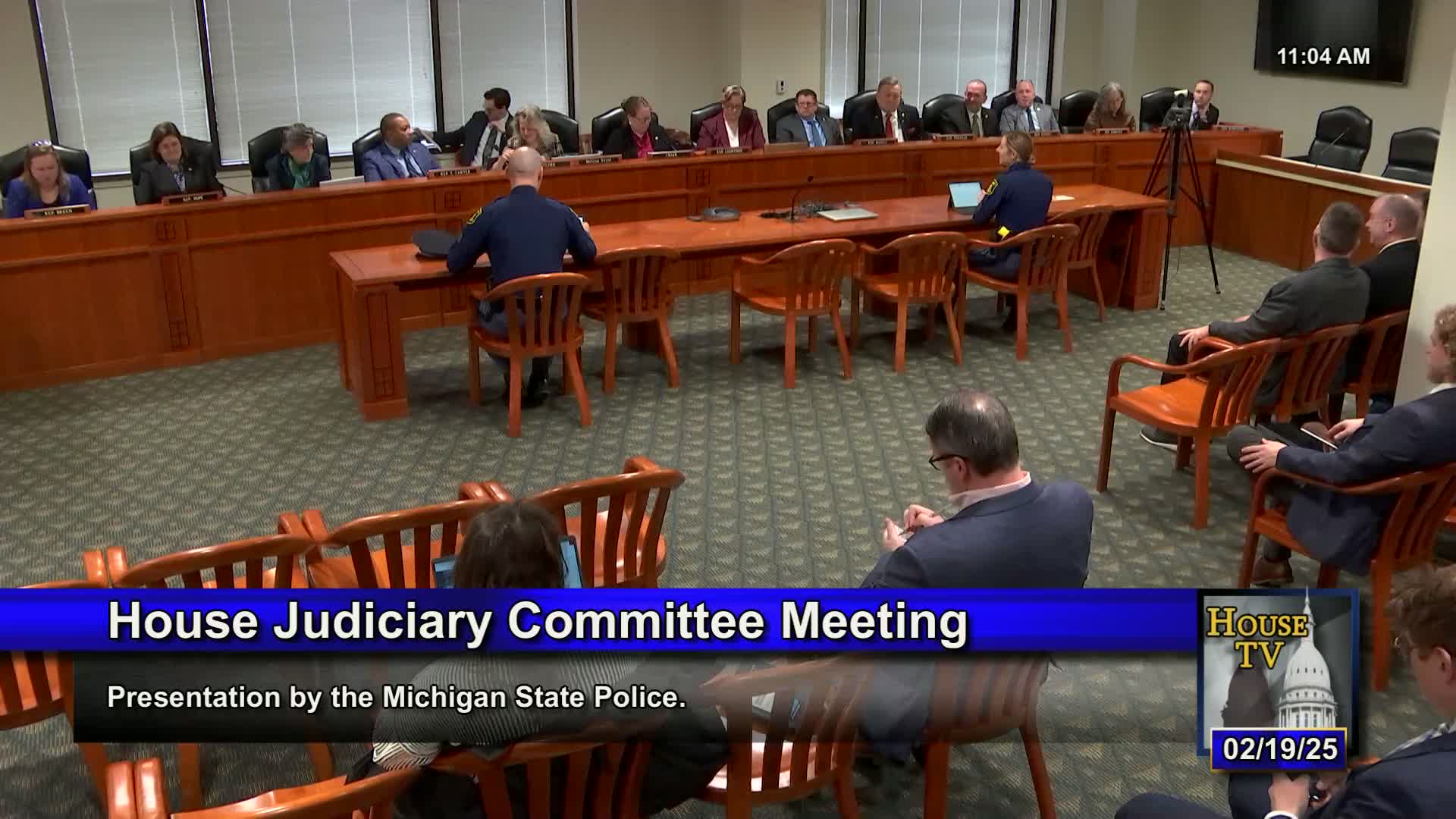
Summary
Sergeants Christina Droste and Travis Fletcher briefed the House Judiciary Committee on Jan. 30 about Michigan State Police bureaus, staffing and priorities including forensic lab timing and a $1.3 million request to expand victim-advocate staffing.
Sergeant Christina Droste and Sergeant Travis Fletcher of the Michigan State Police delivered an informational briefing to the Michigan House Judiciary Committee on Jan. 30, outlining the agency’s structure, services and staffing needs.
Droste and Fletcher described the State Police as a multi-bureau agency providing field patrol, specialized units, training, forensic services, emergency management and information-technology support to local jurisdictions. Droste, the department’s legislative liaison and a former assistant prosecutor, described recruit training and professional development practices, noting the department has graduated 147 trooper recruit schools and 27 motor-carrier recruit schools and has about 60 recruits in its current 140th trooper recruit class.
The department said it employs about 1,800 enlisted members and roughly 1,000 civilian staff and that it is currently below historical staffing levels; the speakers said retirements and members reaching retirement-eligible status have left the agency short of what it needs to maintain current service levels.
Fletcher and Droste also summarized several programs and priorities:
- Forensic lab work: The department publishes turnaround times by test type; sexual-assault kit processing is frequently cited as the highest public concern. MSP said it is normally under a 90-day average on assault-kit testing but sometimes exceeds that due to resource limits.
- Victim advocate program: The department has asked the governor for $1,300,000 in the executive recommendation to hire eight additional victim advocates to expand services across regions.
- Office of School Safety and Okay to Say: MSP manages a confidential tip line, Okay to Say, for K–12 students; in 2023 the program received about 10,000 tips and the department said response actions ranged from law-enforcement investigation to nonpolice interventions such as counseling.
- Emergency Management and Homeland Security Division: MSP described its role running the State Emergency Operations Center under gubernatorial declarations and its participation in EMAC (the Emergency Management Assistance Compact) to deploy resources across states.
Committee members asked about forensic backlog timelines, nonlethal-weapon deployment and training, recruitment and retention, and implementation of recent firearm-related laws. Droste said the department publishes lab turnaround statistics publicly and that the department is deploying new TASERs in the field; Fletcher emphasized scenario-based training and said MSP would welcome legislative support for expanded training resources. On staffing, Droste said the agency needed more than the current ~1,800 sworn members and agreed to follow up with the committee on exact shortfalls. Droste also noted that the department publishes criminal-history and crash data and can supply statistical support to the legislature.
The committee thanked MSP for the briefing and said members would follow up on recruit staffing, forensic backlogs and the proposed victim-advocate funding.
The committee adjourned with no further business.