Get Full Government Meeting Transcripts, Videos, & Alerts Forever!
Get email alerts on the Juvenile Justice Transport topic
No spam. Unsubscribe anytime.
Bill would permit limited transport of juveniles with certain adult co-defendants in same vehicle; sheriffs back measure, DHHS opposes
Summary
House Bill 4018 would allow officers in specified circumstances to transport a juvenile and an adult involved in the same criminal transaction in one vehicle, with the requirement that they be promptly sight-and-sound separated at a secure facility.
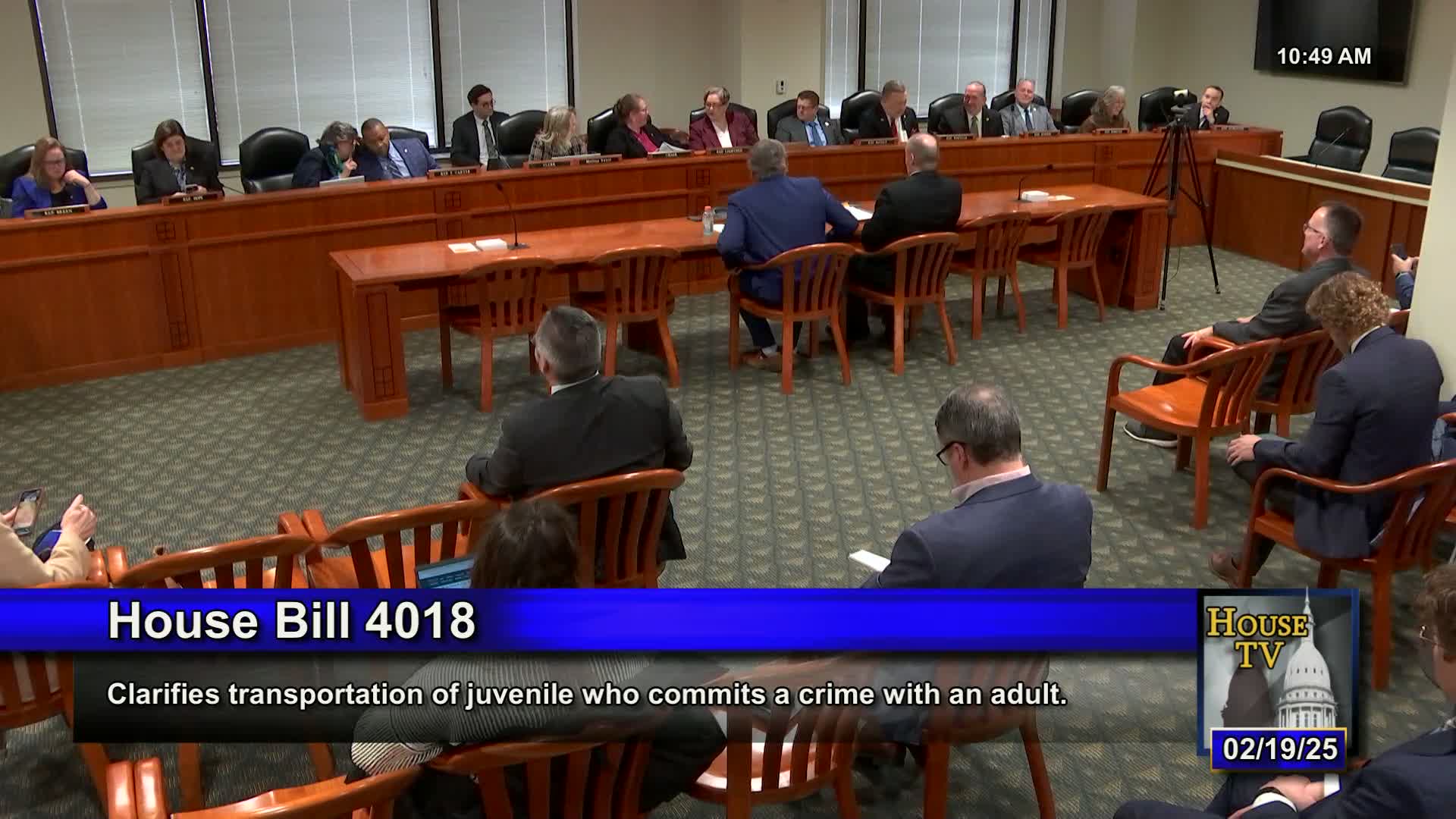
House Bill 4018, presented Jan. 30 to the Michigan House Judiciary Committee, would allow law enforcement officers, in specified circumstances, to transport a juvenile and an adult who were involved in the same criminal transaction in the same vehicle and deliver them to a secure facility where they are to be sight-and-sound separated as soon as practicable.
Representative Ben Mueller, sponsor of the bill, said the proposal responds to practical safety and staffing concerns, especially in rural areas where backup units can be far away. “You might pull someone over in the northern part of the county…you have a 17 year old that has a gun in the car and a 21 year old who’s drunk,” Mueller said, describing situations in which officers must separate juveniles from adults but lack immediate transport options.
Dan Fonas, deputy director of the Michigan Sheriffs Association, testified in support and called the bill “a common sense reform.” Fonas told the committee the change would reduce the need to wait for a second vehicle in emotionally charged scenes and would not violate federal sight-and-sound rules, which apply to juveniles held in secure facilities rather than to brief transport during arrest. “These restrictions only apply to juvenile offenders that are being held in a secure facility. They do not apply to situations that occur at the time of the initial detention or arrest by law enforcement,” Fonas said.
Supporters listed in the record included the Michigan Sheriffs Association, Police Officers Association of Michigan, Michigan Association of Counties, and Michigan Fraternal Order of Police. Shardae Burton of the Michigan Department of Health and Human Services (DHHS) was listed as opposing the bill in written testimony and did not wish to speak; testimony included a prior veto history tied to disagreements over whether a vehicle qualifies as a "facility." A speaker at the hearing said that a prior governor veto turned on a belief that a vehicle is not a facility, and DHHS opposed the bill for that reason.
Lawmakers queried specifics: Representative Wozniak asked whether advice-of-rights hearings or appellate rights would be affected; Mueller and witnesses clarified that the bill covers transport logistics and that the advice-of-rights and final-judgment processes remain unchanged. Representatives pressed that the bill is permissive, not mandatory, and asked why the bill limits applicability by age (the adult must be 25 or younger in the draft); Mueller said that limitation was a negotiated compromise intended to reduce the risk of older adults manipulating juveniles.
Members described the practice as already occurring in the field: supporters and some legislators said officers commonly transport juveniles and adults together when necessary for officer safety, and that the bill would authorize that limited practice formally. Opponents and DHHS representatives (written) remain concerned about definitions and about ensuring that federal facility-based protections apply once the parties arrive at secure sites.
No committee vote was taken on HB 4018 during the Jan. 30 hearing; multiple law-enforcement organizations filed written support and DHHS filed written opposition.
A clerk read additional written submissions into the record: support from Matt Solash (Police Officers Association of Michigan), Michigan State Police (written support noted elsewhere), and others; Shardae Burton (MDHHS) listed as opposing.
The committee then proceeded to a presentation from the Michigan State Police.