Get Full Government Meeting Transcripts, Videos, & Alerts Forever!
Get email alerts on the Accessory Structures Ordinance topic
No spam. Unsubscribe anytime.
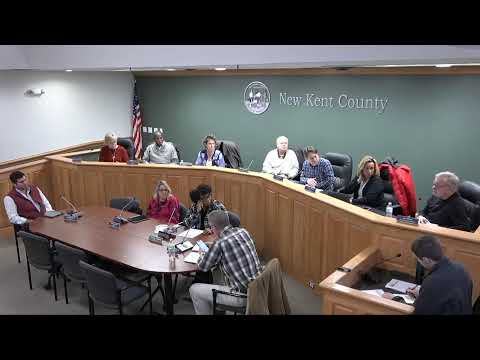
Planning Commission reviews draft changes to accessory-structure rules in A-1 agricultural districts
Summary
New Kent County zoning staff on Feb. 20 presented draft amendments to Chapter 98, Article 1, Section 98-10 of the county code that would change how the county counts and limits detached accessory buildings in A-1 (agricultural) zoning districts.
New Kent County zoning staff on Feb. 20 presented draft amendments to Chapter 98, Article 1, Section 98-10 of the county code that would change how the county counts and limits detached accessory buildings in A-1 (agricultural) zoning districts.
Angela Lefflett, the county zoning administrator, told the Planning Commission the rewrite would replace the current 3,000-square-foot aggregate cap for accessory structures on A-1 lots with a formula: up to 5 percent of the lot area behind the front-setback line but not to exceed a cumulative total of 10,000 square feet, and with a limit on the number of detached accessory buildings on smaller parcels. "The total number of accessory buildings cannot exceed 5 on a single lot," Lefflett said, adding staff may recommend applying the five-structure cap only to lots under a 25-acre threshold and is seeking feedback on whether that acreage cap should be higher or lower.
The draft also would formalize a definition for "accessory building" to make explicit that the cumulative square footage calculation includes covered roofed features such as detached pergolas, gazebos, porches and lean-tos attached to accessory structures. Lefflett said the change is intended to remove longstanding ambiguity and align the code with the county's strategic and comprehensive plans while keeping New Kent County "rural in nature as possible."
Commissioners and members of the public raised questions about how the proposal would affect working farms and existing structures. Commissioner Bennett asked whether the draft would prevent large farms from storing equipment such as combines; staff responded that they are exploring an administrative modification for "bona fide agricultural and farming uses" that would allow larger buildings for active farm operations. Lefflett also said property owners can still seek a variance from the Board of Zoning Appeals, and that staff will evaluate applications on a case-by-case basis using the statutory variance criteria in the Virginia state code.
Commissioners pressed staff on practical consequences. A commissioner asked how many parcels would immediately be nonconforming under the new rule; Lefflett said staff had identified some examples but did not have a solid countywide count and would provide that data in subsequent ordinance drafts. Staff confirmed properties that exceed a future numerical limit would be treated as legally nonconforming and would not be required to remove existing structures; the nonconforming status survives ownership transfers while use remains continuous and lapses only after two years of discontinuance, Lefflett said.
Other topics raised during the Q&A included whether movable or transient agricultural buildings would count as structures, how unpermitted agricultural buildings are currently tracked (assessments and aerial imagery were cited as detection methods), and whether the ordinance should include anti‑circumvention provisions to prevent landowners from subdividing large parcels to sidestep the square‑footage cap. Lefflett said staff would study subdivision and enforcement concerns and incorporate feedback into the draft ordinance.
The Planning Commission did not take formal action on the ordinance at the Feb. 20 meeting; staff asked for public and commissioner feedback as it prepares a subsequent draft for public hearing. Lefflett said the presentation and supporting slides will be posted and that she welcomes emailed comments.
Clarifying details from the presentation and Q&A: the current A-1 cap is written in staff materials as 3,000 square feet aggregated across detached accessory structures; staff proposes replacing that with 5 percent of the lot area behind the front setback or a 10,000-square-foot cap, whichever is less. Staff also proposed (subject to revision) a cap of five detached accessory buildings on lots smaller than 25 acres, and explicitly including roofed but unenclosed features in the square‑footage calculation. The county would continue to permit agricultural applicants to request an administrative modification or variance in special circumstances.
Next steps: staff will research outstanding questions — number of parcels already over proposed limits, subdivision anti‑circumvention language, tracking of agricultural buildings — and bring a revised ordinance back for review and public hearing.