Get Full Government Meeting Transcripts, Videos, & Alerts Forever!
Get email alerts on the Health Policy topic
No spam. Unsubscribe anytime.
Committee hears competing views on 340B drug-pricing program; hospitals warn service cuts, pharma cites cost and transparency concerns
Summary
The state House Health Policy Committee heard competing testimony on the federal 340B drug-pricing program, with hospital leaders saying 340B protects local access in rural and low-income communities and a pharma policy official warning the program has outgrown its original design and lacks needed transparency.
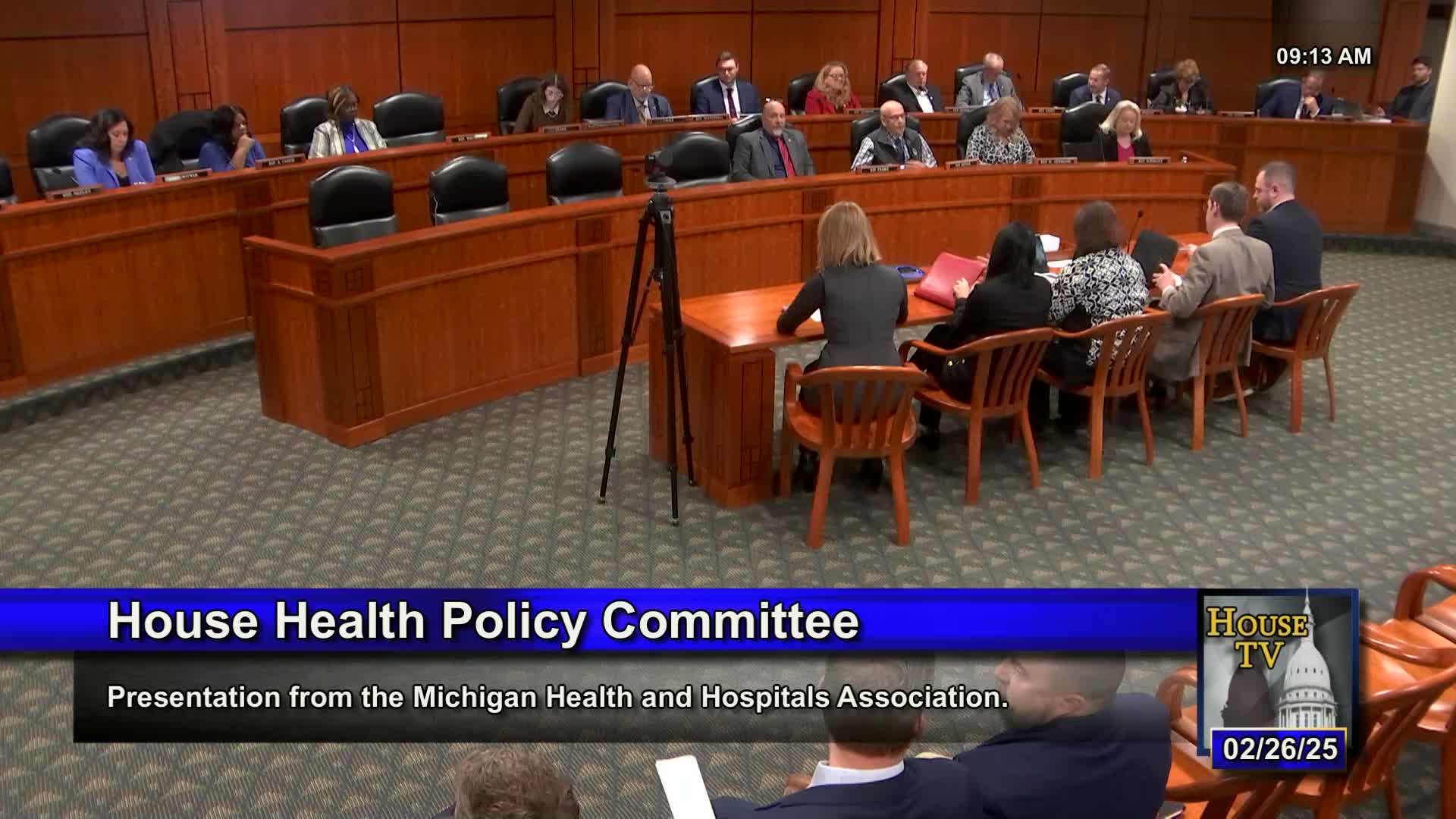
The Michigan House Health Policy Committee spent its meeting hearing educational testimony on the federal 340B drug-pricing program, with hospital leaders saying the program underpins rural and low-income care and a pharmaceutical industry representative warning the program has grown beyond its original intent and lacks transparent safeguards.
Elizabeth Cutter, a representative of the Michigan Health and Hospital Association, told the committee the 340B program “is a non taxpayer funded program that supports healthcare in your community.” She said program savings let participating hospitals fund local services such as cancer care, labor and delivery, nursing-home support, transportation and charity care.
Representatives of McLaren Healthcare and Memorial Healthcare gave community-level examples. Deidre Wilson, senior vice president of government relations for McLaren Healthcare, and Maureen D’Agostino, McLaren’s vice president of accreditation and regulatory programs, described 9 McLaren hospital organizations participating in 340B and said the savings are spent on services based on local needs. McLaren said it used 340B savings in 2024 to provide 3,870 prescriptions through a patient assistance fund and retained about $1,450,000 to support programs including free Narcan distribution; McLaren Oakland dispensed 1,213 boxes of Narcan through the emergency department in 2024, the testimony said.
Ben Frederick, associate vice president for advocacy and government relations at Memorial Healthcare, described the program as essential for independent rural hospitals. Memorial said more than 60% of its patients are covered by Medicaid or Medicare; Frederick said 340B savings helped the hospital maintain local oncology infusions and an obstetrics unit so patients need not travel long distances for care. Dr. Joe Munro, director of pharmacy and 340B compliance at Memorial, detailed compliance obligations, saying hospitals submit claims data and undergo monthly internal audits and external reviews tied to Health Resources and Services Administration (HRSA) rules.
Hospital witnesses said drug-manufacturer restrictions have already reduced program benefits. McLaren reported a $41,000,000 reduction in 340B savings in 2024 attributable to manufacturer restrictions and a further $3,900,000 reduction in the first quarter of 2025. McLaren and Memorial said those reductions prompt hard choices for low-margin services such as rural obstetrics and oncology infusions.
Speaking by videoconference, Kelly Ryan, deputy vice president for state policy at a pharmaceutical trade association, said the industry supports the program’s original intent but argued it has grown substantially and produced unintended consequences. Ryan said 340B now accounts for roughly $66 billion in discounted purchases, with hospitals representing about 80% of program purchases. She warned that the growth of contract-pharmacy relationships — from about 1,700 in 2010 to roughly 212,000 in 2024 — has allowed outside pharmacies and third-party administrators to capture a substantial share of gross program revenue.
Ryan cited analyses that, she said, show program practices can raise costs for employers and state purchasers by reducing rebates in commercial markets. She told the committee that one analysis estimated Michigan employers pay an estimated $272 million more in healthcare costs because of foregone rebates tied to 340B pricing, and that the state employee plan faces roughly $34 million in higher costs for the same reason. Ryan also characterized the program as “absolutely broken” and cautioned against state laws that would lock subregulatory federal guidance into statute without addressing those concerns.
Committee members asked both sides how savings are tracked and audited, how participating hospitals decide how to spend 340B dollars, and whether contract pharmacies and third-party administrators divert funds away from community providers. Hospital witnesses said HRSA audits, claims-data submissions (for example via the 340B ESP platform) and internal controls are used to ensure compliance; Ryan said state-level reporting mandates could entrench problematic practices and cited reports from Minnesota and IQVIA on program effects.
Chair Vanderwall and members indicated the presentations were educational and that additional briefings and follow-up hearings will be scheduled to allow deeper questioning and data review. No legislative action was taken on 340B at this meeting; the committee’s chair said future opportunities for testimony are planned.