Get Full Government Meeting Transcripts, Videos, & Alerts Forever!
Get email alerts on the Health Policy topic
No spam. Unsubscribe anytime.
House Health Policy Committee adopts rules and schedule; hears bill to remove sunset on interstate medical licensure compact
Summary
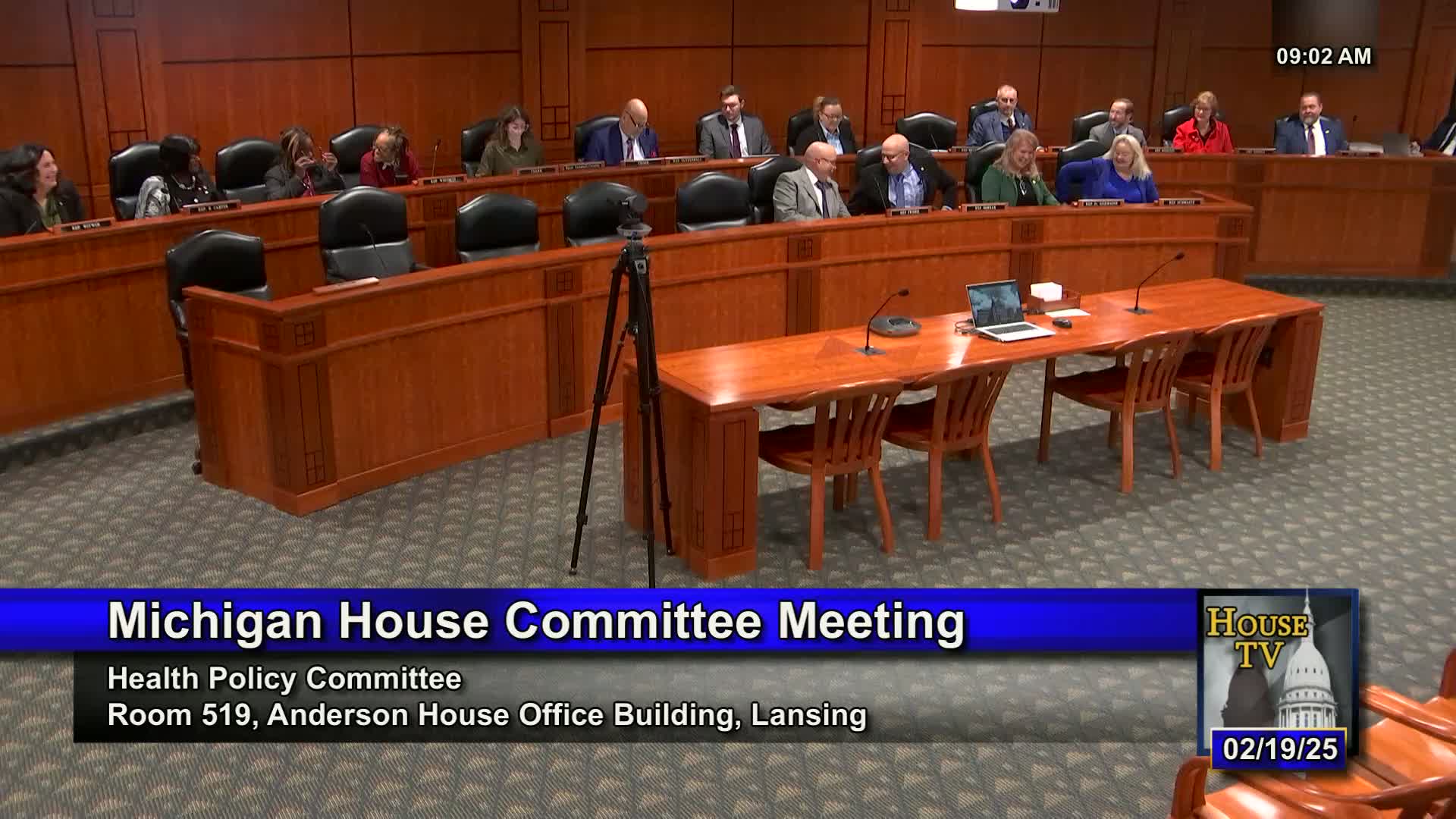
The Michigan House Health Policy Committee on Thursday adopted proposed committee rules and a regular meeting schedule by unanimous roll-call votes and heard testimony on House Bill 4,032, which would remove the sunset provision on the Interstate Medical Licensure Compact (IMLC).
The Michigan House Health Policy Committee on Thursday adopted proposed committee rules and a regular meeting schedule by unanimous roll-call votes and heard testimony on House Bill 4,032, which would remove the sunset provision on the Interstate Medical Licensure Compact (IMLC).
Representative Kurt Vanderwall, chair of the Health Policy Committee, opened the session and called the committee to order, saying the panel had 16 members present and a quorum. Representative Jamie Thompson moved to adopt the committee rule; the motion passed 16-0 on a roll-call vote. Representative Mark Tisdell moved to set the committee’s regular meeting day, time and place as Wednesdays at 9 a.m. in Room 519 of the House Office Building; that motion also passed 16-0.
The committee then took up House Bill 4,032. Representative Linting, the bill sponsor, told the committee, “House Bill 4,032 eliminates the sunset on the interstate medical licensure compact. Without this legislation, the IMLC will expire March 20 eighth of this year.” She said the compact “is an important interstate agreement between 40 states allowing expedited licensure for qualified physicians” and argued it helps address physician shortages and preserve access to care in rural communities.
Adam Carlson of the Michigan Hospital Association spoke in support, emphasizing rural access and the compact’s disciplinary-information sharing: “As part of the compact, states are able to share disciplinary action and investigative information, to make sure that…everyone in the compact is a qualified provider.”
Dr. Moe Salome, chief medical officer for Trinity Health Michigan Medical Groups, testified remotely. Salome said the compact streamlines licensure and shortens lead times for physicians who are recruited from other states, easing staffing in rural and inner-city practices. “Keeping the compact in place, beyond the sunset period, is vital,” Salome said, adding that Trinity Health employs about 2,200 providers across its Michigan service area and regularly cares for 10–15% of the regional patient population.
Committee members asked a small number of procedural and oversight questions. Representative Brenda Carter asked whether Michigan had experienced problems participating in the compact; witnesses replied there were none known. Representative Morgan Forman asked whether the executive branch or licensing department had issues with compacts; witnesses deferred to the Department of Licensing and Regulatory Affairs and said it supports the compact.
No committee vote was recorded on House Bill 4,032 during the hearing. Representative Kathy Schmaltz moved to excuse absent members later in the meeting; the motion prevailed by unanimous consent and the committee adjourned.
Details of the roll-call votes and attendee list are recorded in the committee’s minutes and appear in the transcript excerpt filed with the committee.