Lifetime Citizen Portal Access — AI Briefings, Alerts & Unlimited Follows
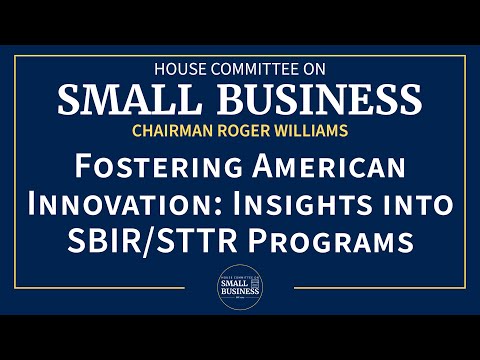
House Small Business hearing urges permanent SBIR/STTR reauthorization, focuses on China risks and commercialization gaps
Loading...
Summary
Witnesses and committee leaders at a House Small Business Committee hearing urged permanent reauthorization of the SBIR and STTR programs, warned of Chinese exploitation of awards, and recommended steps to improve transition to commercialization and agency oversight.
At a House Committee on Small Business hearing, Chair Roger Williams and Ranking Member Nydia Velázquez heard testimony urging Congress to make the Small Business Innovation Research (SBIR) and Small Business Technology Transfer (STTR) programs permanent, strengthen protections against foreign‑linked exploitation, and reduce barriers that keep early‑stage firms from reaching Phase 3 commercialization.
The panel heard repeated warnings that the programs — which witnesses said total “just under $5,000,000,000 annually” — face both an administrative “valley of death” during commercialization and active efforts by the Chinese Communist Party to acquire U.S. taxpayer‑funded research. With SBIR and STTR authorization set to expire on September 30, 2025, committee members and witnesses described reauthorization as urgent.
Why it matters: SBIR and STTR are structured to direct federal R&D to small businesses and to help translate research into marketable technologies for both civilian and defense uses. Witnesses described the programs as a pipeline for innovations ranging from medical devices to defense systems, and said lapses or funding uncertainty could force firms to close or seek capital abroad.
Witnesses and members described three linked problems: (1) foreign influence and investment that can funnel sensitive technology overseas; (2) administrative complexity and uneven agency follow‑through that slow or block Phase 2→Phase 3 transitions; and (3) constrained program administration staffing and funding at the Small Business Administration (SBA) and other agencies.
On foreign risk, multiple witnesses said China has used talent recruitment programs, venture investment through third parties, and long‑term relationship tactics to acquire U.S. innovation. Cyrus Maricata (founder and CEO, Raveland US) testified that China “will use real relationships curated over a decade” and described cases in which CCP‑linked capital and proxy investors were used to gain access to company personnel and technology. Chairman John Molineux of the House Select Committee on the Chinese Communist Party warned that “the CCP continues to exploit the SBIR and the STTR programs, siphoning taxpayer funded research back to China.”
On commercialization and the “valley of death,” witness testimony highlighted structural hurdles. Emil Mackey (CEO, Beacon Interactive Systems) and Dr. Bill Marinelli (President and CEO, Physical Sciences Inc.) urged agencies to do a better job of identifying existing SBIR‑funded technologies that meet program needs and to make follow‑on Phase 3 awards more routine. Marinelli said program permanence would “reduce the concern that those investments will be stranded at the next reauthorization.” Mackey recommended that acquisition programs document attempts to use existing SBIR technologies and, if it is impractical, explain why.
Financial and program details cited at the hearing: witnesses described typical award sizes and transition funding as approximately $100,000–$250,000 for Phase 1, larger Phase 2 awards, and agency follow‑on Phase 3 authorities that can exceed $3,000,000 where used effectively. Jerry Glover (Executive Director, Small Business Technology Council) highlighted that GSA contracting changes substantially increased Phase 3 identified contracts and argued for standardization to speed procurements.
On agency capacity and oversight, testimony noted the SBA — which administers the program — is thinly staffed relative to program size. Glover said the SBIR portfolio has grown without a parallel increase in SBA administration resources. Several witnesses recommended more funding and staff for SBA and stronger, resourced foreign‑ownership control and influence (FOCI) vetting teams across agencies (witnesses said the Department of the Air Force’s teams are among the most developed).
Committee members from both parties pressed for three near‑term policy moves repeatedly during the hearing: make SBIR/STTR permanent, expand and simplify Phase 3 transition authorities and contracting practices, and fund durable due‑diligence capacity to detect and block foreign exploitation. Representative Nydia Velázquez said, “SBIR and STTR are among the federal government's most effective engine for driving innovation,” and members from both parties asked witnesses whether they supported permanence; panelists answered in the affirmative.
What remains unsettled: witnesses differ on specific allocation increases and implementation details. Some recommended doubling agency allocations to SBIR/STTR; others urged targeted administrative fixes (standard contracts, clearer solicitations, outreach to underserved geographies). Several witnesses said enforcement and notification practices should give companies a clear chance to remediate disclosure or FOCI issues rather than imposing automatic exclusions without explanation.
The committee session closed with members agreeing to continue drafting reauthorization language and to seek more information from agencies on due diligence capacity, Phase 3 contracting, and SBA staffing. The authorization deadline of September 30, 2025, was repeatedly cited as a fixed planning point for any legislative action.
"Small business is the backbone of innovation and economic prosperity in America," Chair Roger Williams said during opening remarks.
Ending: The hearing framed SBIR and STTR reauthorization as both an economic‑development priority and a national‑security matter. Members signaled bipartisan interest in making the programs permanent and in legislation that would pair stronger anti‑exploitation safeguards with steps to shorten the transition from award to government or commercial procurement. The committee asked witnesses to provide follow‑up materials and said staff would continue negotiating reauthorization language ahead of the September 2025 deadline.