Get Full Government Meeting Transcripts, Videos, & Alerts Forever!
Get email alerts on the Appropriations topic
No spam. Unsubscribe anytime.
House Appropriations hears overview of governor's FY26 executive budget; staff to provide follow-up data
Summary
House Fiscal Agency Director Mary Anne Cleary briefed the House Appropriations Committee on the governor's fiscal year 2026 executive recommendation, outlining general fund and school aid balances, supplemental requests, major department changes and several follow-up requests from members.
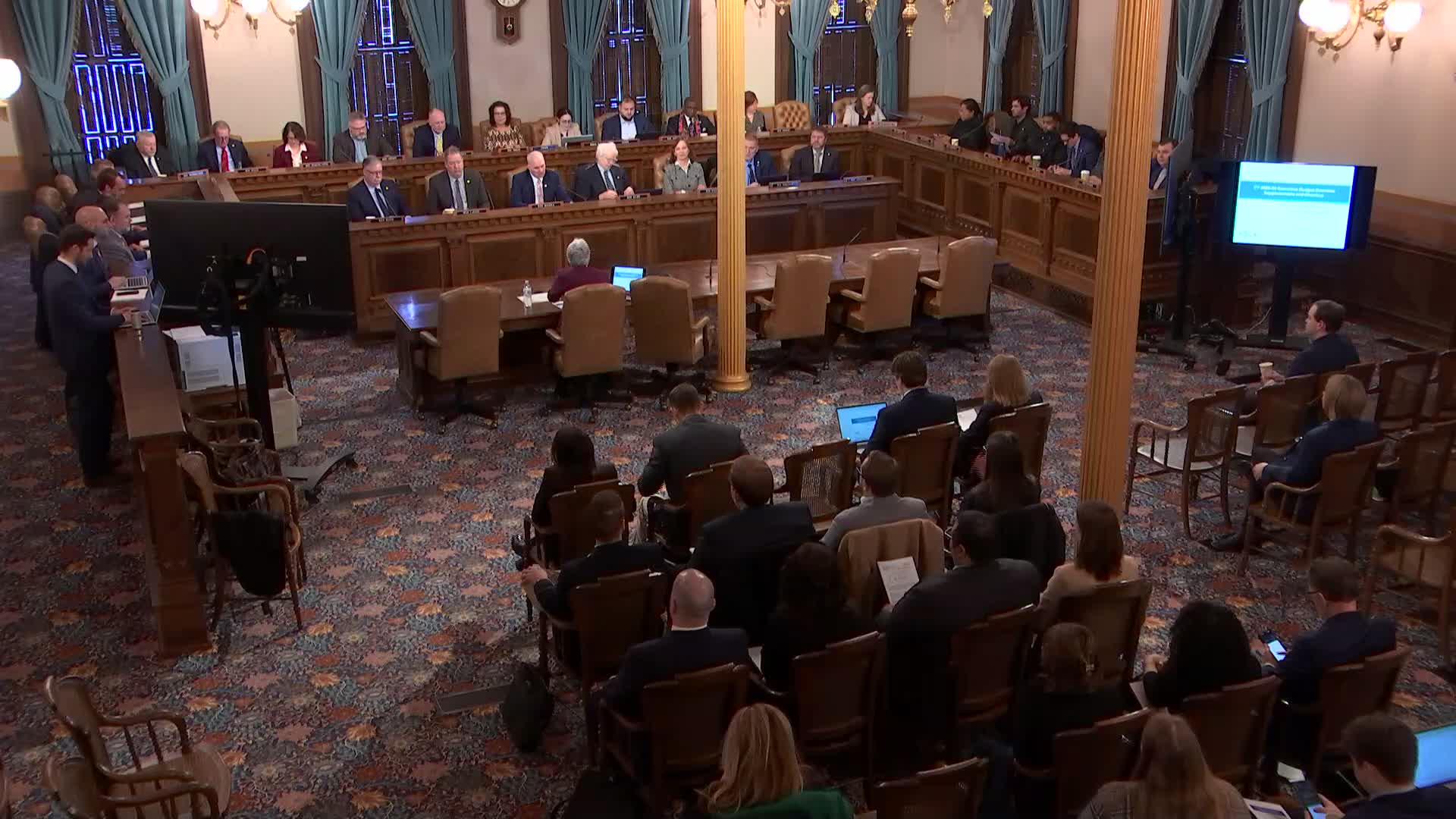
The House Appropriations Committee heard an overview of the governor's fiscal year 2026 executive budget recommendation from Mary Anne Cleary, director of the House Fiscal Agency, during the committee's Wednesday meeting in Room 352 of the State Capitol.
Cleary said the executive recommendation is a broad proposal intended to present how the administration put the budget together, not a line-by-line final plan. She said starting balances for the governor's proposal reflected stronger-than-expected revenues, noting the general fund balance at the end of fiscal 2025 was about $2.0 billion and the school aid fund balance about $1.1 billion. She told members the governor's adjusted gross appropriation totals about $83.5 billion across all funding sources.
Why it matters: the presentation outlined the components members will consider as they begin the budget process, including supplemental requests, ongoing cost increases and one-time investments that together shape available funds and potential statutory changes the Legislature must consider.
Cleary highlighted several items driving the executive recommendation. The governor's proposal includes roughly $500 million in supplemental requests for the current fiscal year, including approximately $284 million in general fund to cover Medicaid cost and utilization changes and about $81.6 million required as a federal repayment related to a prior Medicaid disallowance (this payment is one of multiple expected installments). The recommendation also asks for boilerplate spending authority to use $255 million of ARP funding for home- and community-based services projects rather than an individual line item.
On the fiscal 2026 budget, Cleary described a $594 million current-services baseline increase largely tied to Health and Human Services (DHHS) costs (about $530 million of that increase) and noted a general fund ongoing increase of just under $300 million in investments. The governor's plan proposes about 883 additional FTEs statewide (roughly 423 in DHHS), bringing total state FTEs to about 57,000 under the proposal. Cleary also said the general fund appropriations in the proposal increase by just under $395 million (about 2.7%).
Members asked questions on several specific proposals. Representative Price asked whether House Fiscal could estimate how many lead service lines $50 million would replace; Cleary said the agency does not yet have a statewide per-line cost estimate and that the number depends on local conditions, and she offered to pass along further information if it becomes available. Representative Rogers asked whether a $15 million, 47-FTE line in the executive rec for transferring patients into the new Northville psychiatric facility represents only a transfer from Walter Reuther; Cleary said the request reflects the net need compared with Reuther and is not intended to move resources from other state psychiatric hospitals.
Representative Green asked who owns the hazardous street-light wiring cited in a $25 million one-time recommendation for Detroit; Cleary said the city of Detroit owns that wiring and that the appropriation would flow from the Treasury Department to the city. Representative Steele asked whether Medicaid cost changes reflected a caseload increase or other cost drivers; Cleary said caseloads declined after redeterminations and currently are near 2.6 million recipients, and that the budget pressures largely reflect utilization and inflationary cost increases (for example managed care and nursing home costs) rather than a surge in caseload.
On education, the governor's recommendation includes a $392 per-pupil foundation allowance increase to a $10,000 foundation (cost about $516 million), limits cyber school foundation allowances to 80% of the traditional foundation amount, and proposes roughly $341 million in school-aid fund deposits to several restricted reserve funds. Cleary said the executive rec also includes one-time K-12 grants and consolidation incentives and continued funding for mental-health and school-safety per-pupil payments. Jacqueline Mullen, a House Fiscal analyst for school aid, told Rep. Glanville she would follow up with detailed Grow Your Own program metrics and other requested data.
Cleary summarized a number of large one-time items in the recommendation, including: $78 million (approximately) more in psychiatric hospital repayment obligations (part of a multi-year payback), $50 million one-time for lead service line replacement (to supplement a $30 million ongoing allocation), $42 million for the IT investment fund (ITIF), $50 million for childcare-related My LEAP activities, $25 million for Detroit hazardous street-light wiring, a proposed $50 million deposit to the budget stabilization fund, and multiple one-time investments in workforce, apprenticeship programs and small-business supports. She also noted proposed statutory changes tied to fee and restricted-revenue adjustments, including changes at the Department of Environment, Great Lakes, and Energy related to tipping fees and a proposed vaping tax that would direct revenues to DHHS programs.
The committee did not take formal action on the governor's budget during this meeting; the session was a staff briefing and question-and-answer period. Members directed staff to provide follow-up information on several items, including lead-service-line estimates, the Grow Your Own program metrics, and details on AP/IB exam reimbursement line items. Cleary said House Fiscal staff would provide additional details to members and that departmental witnesses could answer more technical or implementation questions at later hearings.
Votes at this meeting unrelated to the executive budget were recorded earlier in the session: the committee approved the minutes of its Feb. 5 meeting (Representative Maddock moved; recorded tally 27 yeas, 0 nays, 0 pass; motion approved); adopted Room 352 at the State Capitol as the committee's normal meeting time and location (Representative Beeson moved; recorded tally 27 yeas, 0 nays, 0 pass; motion approved); and adopted a proposed committee rule permitting the chair to allow public comment and accept written testimony in lieu of oral testimony (Representative Borton moved; recorded tally 27 yeas, 0 nays, 0 pass; motion approved). The chair moved to excuse absent members by unanimous consent and adjourned the committee.
Cleary closed by offering House Fiscal assistance to members during the budget process and saying the agency would follow up with the committee's requested data.