Get Full Government Meeting Transcripts, Videos, & Alerts Forever!
Get email alerts on the Solar Ordinance topic
No spam. Unsubscribe anytime.
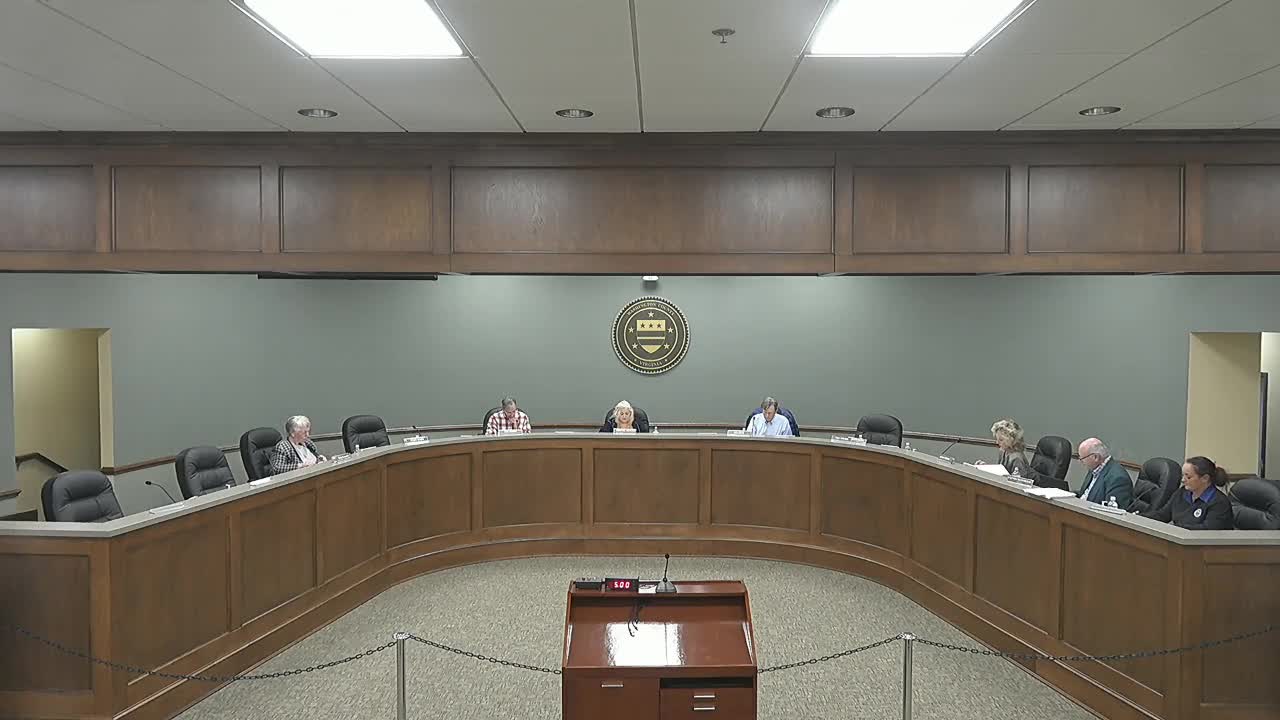
Washington County planning commissioners workshop proposed solar ordinance; focus on setbacks, slope, decommissioning and water safeguards
Summary
Washington County Planning Commission members reviewed a draft solar energy ordinance at a February workshop and agreed on edits addressing setbacks, slope and stormwater alignment with state rules, decommissioning and baseline water testing.
Washington County Planning Commission members spent a February workshop reviewing a draft solar energy ordinance and agreed on a set of edits and implementation steps to bring to the Board of Supervisors.
The commission, chaired by Chairman Reifas, framed the session as a workshop rather than a public hearing and walked through the existing ordinance, a recently proposed draft, and public comments received in advance. The discussion focused on how the ordinance should treat agricultural properties, how to measure and manage stormwater and slope, decommissioning and contamination protections, battery storage and PFAS, noise from inverters, and vegetative screening and setbacks.
Why it matters: commissioners said the county must balance farmland protection, view‑sheds and property rights against state environmental requirements and the practicalities of safe solar installations. Several changes the commission favored could limit where and how utility‑scale projects develop, while other decisions steer the county to defer technical stormwater and slope standards to state regulators.
Planning staff explained that a Virginia Department of Environmental Quality (DEQ) memorandum changes how solar projects are treated for stormwater: "those panels are impervious surfaces," Mr. Richardson told the commission, explaining that projects without an interconnection approval by the end of 2024 must meet the memorandum's requirements. He added that meeting DEQ's quality and quantity standards likely will require professional design and, in some cases, purchase of water‑quality credits.
Commissioners agreed to remove a sentence from the draft that could be interpreted as broadly exempting "solar energy projects for agricultural purposes on properties zoned for agricultural use." Members said that language risked creating an unintended wide exemption; instead they kept small‑project exemptions (passive and de minimis installations) but clarified that larger ground‑mounted projects will be subject to the ordinance's review and, where applicable, special‑exception procedures.
On project scale, the planning commission discussed and asked staff to include a clear numeric threshold for "large‑scale" projects. The group agreed to insert an 8.5‑acre ceiling into the large‑scale definition in the draft so large projects are explicitly defined for review purposes, while recognizing the Board of Supervisors will make the ultimate decision.
Setbacks and height: commissioners debated minimum buffers and reached consensus to increase setback distances beyond earlier drafts. After discussion the commission accepted a 200‑foot setback on all sides for ground‑mounted systems as a working policy for the draft; commissioners noted that such a distance would effectively preclude ground‑mounted systems on many small lots and leave rooftop systems as the practical option there.
Slope, stormwater and technical approvals: commissioners expressed concern about adopting arbitrary slope limits that could ban most solar in the county's steep terrain. Several members urged the commission to align slope, erosion control and stormwater performance criteria with DEQ standards and require documentation prepared and stamped by a qualified, licensed professional engineer. Mr. Richardson and commissioners said applicants will typically need to complete the DEQ review and interconnection steps before the county permit review.
Topsoil, decommissioning and contamination: the commission discussed decommissioning language, including a written comment that "the concrete pillars upon which the panels are mounted should also be removed." Members asked staff to add or retain provisions requiring preservation and on‑site storage of topsoil removed during grading, restrictions on excessive grading/compaction, and a decommissioning plan that addresses contamination and the removal or remediation of hazardous components at end of life. The commission also recommended including language that would make developers responsible for mitigation of off‑site damage caused by panels or components in natural disasters.
Water quality and baseline testing: commissioners and commenters pushed for baseline water testing where projects are sited near private wells. The commission instructed staff to require pre‑construction environmental testing within an appropriate radius (to be determined with the county health department or DEQ) and to propose a retest frequency or monitoring plan for the draft ordinance.
Noise and inverter standards: the commission heard a public comment urging a transmission‑level approach to inverter noise. Amy Venable, who provided written and oral comments, recommended using a pre‑construction baseline and limiting inverter noise to "3 dBA above pre construction background or 40 dBA total measured at any property boundary." The commission favored a baseline‑plus standard (pre‑construction background plus 3 dBA, capped at 40 dBA) and directed staff to add that language to the draft.
Batteries, PFAS and components: commissioners reviewed a suggestion to require applicants to list all major components, specify battery storage configurations when used, and provide manufacturer certification if components are PFAS‑free. The commission asked staff to add requirements for documentation of battery systems, containment plans for PFAS‑containing technologies, and proofs of acceptable recycling/disposal arrangements if recycling is proposed.
Vegetative screening and long‑term maintenance: the group discussed screening requirements and plant survival. Commissioners favored stronger enforceable standards: screening vegetation should reach a practical screening height (commenters suggested 10 feet) within a finite period (suggested four growing seasons) and applicants should be contractually responsible for replacement or financial assurance if plantings fail. Staff was asked to research possible maintenance bonds or other enforceable mechanisms.
Other items: commissioners kept language reserving the authority of the Planning Commission and Board of Supervisors to add site‑specific conditions during a special‑exception review; they asked staff to add an item clarifying that small residential systems (as currently defined) do not require a special exception. Commissioners also asked staff to add or retain language addressing wetlands, water sources, fire suppression planning and emergency access.
Next steps: Heather (paralegal/planning staff) will compile the edits and send the commission a marked draft by email. The commission will present its recommendations to the Board of Supervisors; the board will determine timing for public hearings and any further edits.
The meeting also recorded routine procedural votes: the commission approved the meeting agenda and the January minutes and later adjourned by motion. The ordinance workshop produced multiple specific drafting directions for staff but no ordinance adoption at this meeting.