Get Full Government Meeting Transcripts, Videos, & Alerts Forever!
Get email alerts on the Solar Ordinance topic
No spam. Unsubscribe anytime.
Residents, planners urge retaining special-exception review as county revisits solar ordinance
Summary
Public commenters and members of the Washington County Planning Commission and Board of Supervisors urged keeping special-exception review, slope limits, decommissioning sureties and other protections in the county's solar ordinance and agreed to hold a workshop to refine the language.
A broad group of residents, technical experts and planning commissioners urged Washington County officials on Feb. 11 to retain protections in the county's solar ordinance, including a special-exception (special use) review, slope restrictions, decommissioning surety bonds and setbacks, saying recent proposed edits would weaken local oversight.
Speakers at the meeting's public-comment period included residents who said they oppose large-scale solar installations in agricultural and residential areas, and technical experts who urged the county to preserve engineering and viewshed safeguards. Planning Commission members and several supervisors discussed those concerns and agreed the commission should hold a workshop and recommend revisions before the Board of Supervisors takes action.
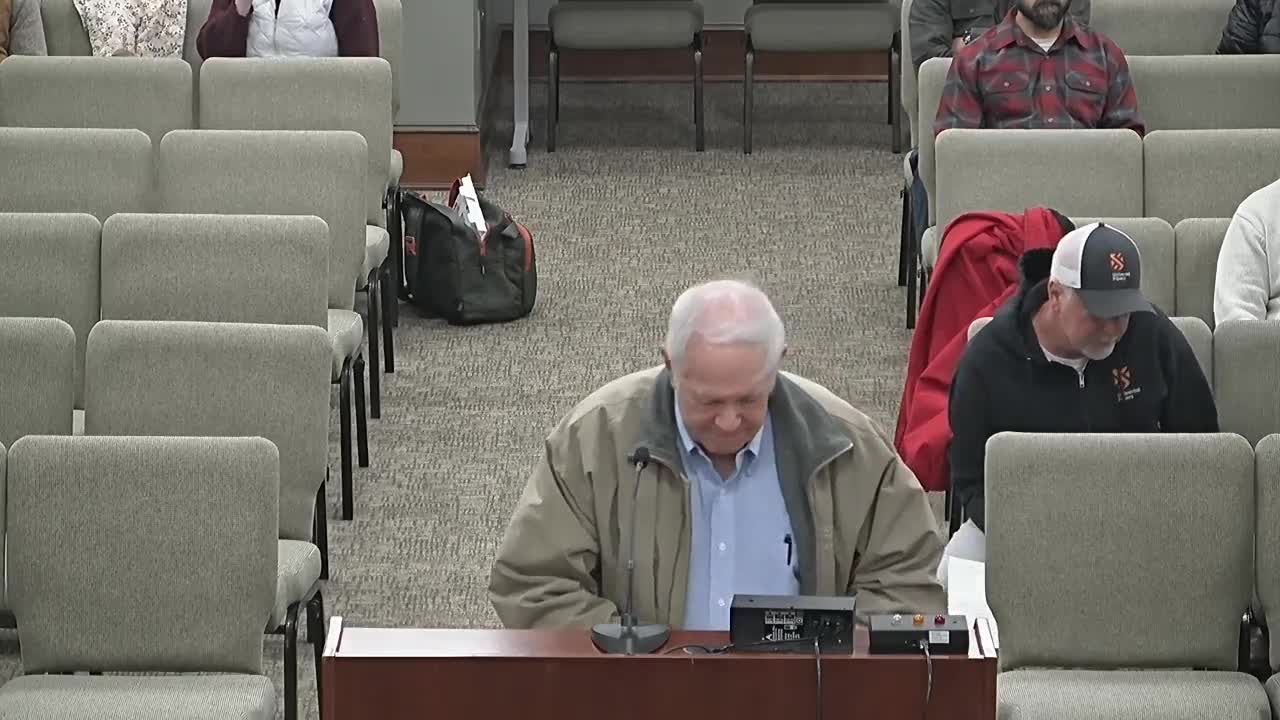
The most substantive public comments came from William Bish of Windale Road, who criticized proposed changes that would allow solar projects of 8.5 acres as a by-right use and said the draft ordinance removes slope limits, decommissioning bonds and other protections. "I think the 1 acre is appropriate," Bish said, arguing the board should require larger proposals to return for review.
Other residents voiced similar objections. Eric McReynolds said he and a group of county residents oppose utility-scale projects and worry about environmental impacts and abandoned equipment. David Rose urged restoring a 1-acre threshold and questioned language about decommissioning costs. Amy Venable, who said she and her husband farm on land held by family since the 1930s, recommended larger setbacks (she proposed 300 feet), tighter noise limits (no more than 3 dBA above preconstruction background or 40 dBA), and specific screening standards to reduce visual impacts.
Emma Wyatt, who identified herself as a certified zoning administrator for Virginia, an AICP-certified planner and chief operating officer of a community development entity, reviewed the ordinance's technical provisions. Wyatt recommended keeping restrictions on siting solar on steep slopes (she cited preservation of a prohibition above 15% slope and specific measures for 10'15%), retaining the special-exception permit process so neighbors have formal input, and requiring land-disturbance plans prepared by a qualified engineer.
Soil scientist and farmer Hunter White told the commission the community had previously spent more than a year developing the current ordinance and said proposed edits "pull all the teeth" from the document. Several planning commissioners also voiced concerns that removing the special-exception path would take local review away from citizens and could allow projects to be sited across agricultural land without community input.
At the planning commission's portion of the joint meeting, commissioners discussed several specific edits that had been blacked out in the proposed rewrite, including slope protections and language requiring engineer-prepared land-disturbance plans. Commissioners asked for clarification of an exemption for solar projects "for agricultural purposes" and whether that language would allow expansive development on farmland without acreage limits.
The planning commission reached consensus to keep the existing solar ordinance on the books while scheduling a workshop to identify and propose targeted revisions. Commission Chair Rufus called for regrouping and a workshop to consider whether to "beef this ordinance up" or to make focused clarifications; commissioners agreed and asked staff to return recommendations to the Board of Supervisors. That consensus, as recorded in the joint meeting, is not a formal ordinance adoption; it directs further work by the commission and staff.
Planning staff and several supervisors also noted the political context: speakers referenced state-level legislation (identified in public comments as SB 1190) and said the county should consider legal advice and coordinate with local legislators if statewide policy proposals reappear. Several speakers suggested seeking an opinion from the Virginia attorney general's office to ensure the county's ordinance would not trigger preemption or invite immediate state scrutiny.
The planning commission's next steps, as stated on the record, are to hold a workshop incorporating the evening's discussion, keep the existing ordinance in effect during the review and prepare recommendations for the Board of Supervisors.
The public comment period and planning commission discussion together spanned the meeting's opening public-comment and the formal joint-agenda review; members of the public who attended urged retaining siting controls and environmental protections while commissioners sought legal and technical clarity before recommending any rewrite to the board.