Get Full Government Meeting Transcripts, Videos, & Alerts Forever!
Get email alerts on the Partnership Districts topic
No spam. Unsubscribe anytime.
Partnership-district review: 45 districts assessed; chronic absenteeism and staffing cited as top needs
Summary
The Office of Partnership Districts reported results of its 18-month benchmark structured conferences: 27 districts on track, nine making progress, nine off track; districts requested about $24 million in 21H funding while OPD has roughly $6.1 million available for one-year disbursement.
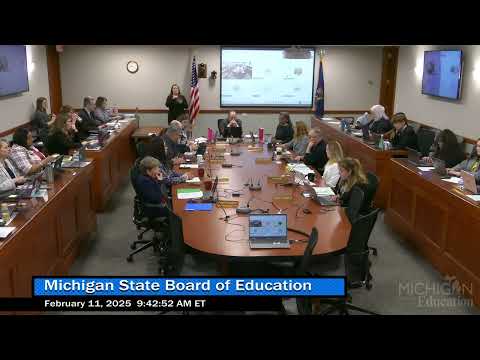
The Michigan Department of Education’s Office of Partnership Districts (OPD) on Feb. 11 presented results of an 18-month benchmark review for districts in partnership agreements.
OPD said it currently supports 45 partnership districts (18 traditional districts and 27 public school academies) with 99 schools in partnership agreements and 36 schools identified for comprehensive support and improvement. The 18-month ‘‘structured conference’’ process included documentation of evidence, partner benchmark reviews by district/ISD/OPD, a structured conference meeting and a summary report for local school boards.
OPD reported that, following the 2024 structured conferences, 27 of the partnership districts were ‘‘on track’’ to meet their 18-month benchmarks, nine were ‘‘making progress’’ and nine were ‘‘off track.’’ Benchmarks include demonstrating progress that puts students on track to meet or exceed grade-level proficiency, at least one proficiency or growth outcome based on a state assessment or benchmark assessment, graduation-rate improvements and attendance-rate goals.
OPD identified three primary opportunity areas requiring additional support across districts: chronic absenteeism, leadership recruitment and retention, and teacher recruitment and retention. Districts described varied strategies funded or requested under the 21H funding line: increased instructional time, targeted professional development, teacher mentors, staffing for counselors and social workers, diverse classroom libraries, and transportation supports. OPD said districts requested about $24 million in 21H funds for the year but the office has roughly $6.1 million available for one-year disbursement.
OPD described monitoring and next steps: districts will revise continuous-improvement plans based on summary reports, share results with local school boards, and use OPD technical assistance to refine strategies. OPD also noted third-party evaluation and interviews (University partners) to provide additional feedback on district progress.
Board members asked for more granular data, examples of districts that exit partnership status, and suggested anonymous third‑party surveys of parents and students as an accountability measure. Presenters said OPD will continue follow-up work and encouraged continued legislative funding for 21H supports.