Get Full Government Meeting Transcripts, Videos, & Alerts Forever!
Get email alerts on the Tax Incentives Rd Carryforward topic
No spam. Unsubscribe anytime.
Finance panel reviews proposed repeals of small tax incentives and an extension of R&D credit carryforward to attract high-growth industries
Summary
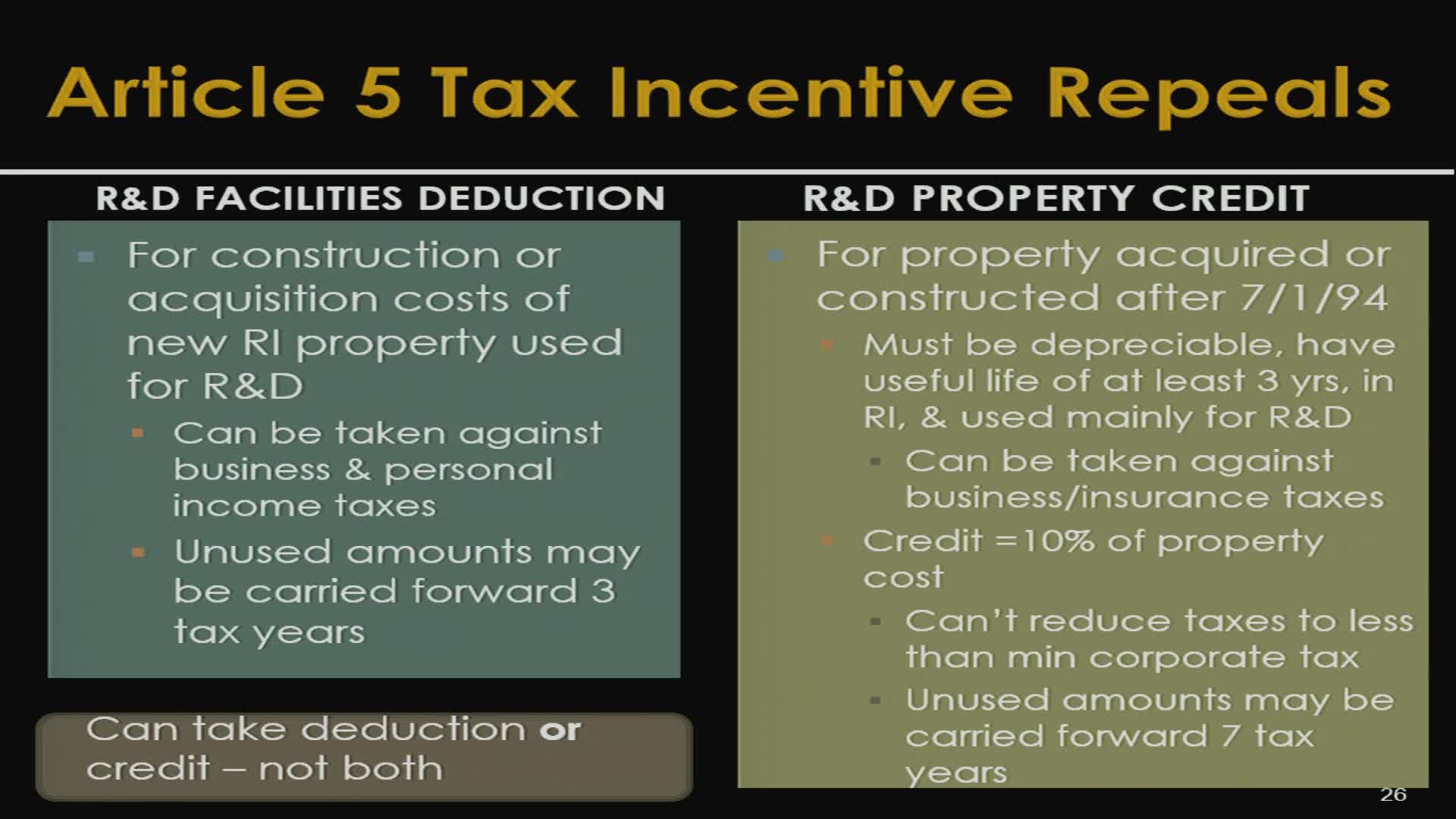
Committee heard administration rationale to repeal underused tax incentives and to extend the carryforward for the R&D expense credit from 7 to 15 years to align with neighboring states and support life-sciences and other R&D-intensive industries.
The administration asked the committee to approve a package of technical changes that would repeal several underused tax incentives and extend the carryforward period for the research-and-development (R&D) expense tax credit.
Sharon and Office of Revenue Analysis staff presented a list of small credits and incentives identified as underutilized in recent program reviews; combined repeals were expected to reduce general-revenue costs by roughly $200,000 in the budget year and annualize to about $400,000 in subsequent years. Sharon told the panel these programs had been formally evaluated and had limited uptake.
By contrast, the R&D expense tax credit was characterized as producing a strong return on investment. Administration witnesses said the Office of Revenue Analysis estimated that every dollar foregone on the R&D expense credit returned about $3.76 in state revenues, and that Rhode Island—s current seven-year carryforward period makes the state less competitive than Massachusetts and Connecticut, which allow a 15-year carryforward. Brian Daniels and revenue staff recommended extending the carryforward to 15 years to better align with regional competitors and to support life-sciences and cybersecurity investments referenced in recent voter-approved capital projects.
Committee members asked about fiscal timing. Staff said the carryforward change would have negligible near-term fiscal impact because credits would not begin to be claimed beyond the existing seven-year window until later years; repeals of rarely used credits yield small immediate savings. The panel did not vote on the package; members requested additional details on estimated long-term fiscal effects and asked for the lists of specific incentive sunsets.
Administration also said it would provide more detailed program evaluations and legal language for proposed repeals if the committee desired.