Get Full Government Meeting Transcripts, Videos, & Alerts Forever!
Get email alerts on the Career Technical Education topic
No spam. Unsubscribe anytime.
State Board urges funding to expand CTE programs; resolution passes Yes except one No
Summary
The State Board approved a resolution calling on the Legislature and governor to provide additional funding to open new state-approved Career and Technical Education (CTE) programs, citing rising enrollment and remaining geographic and socioeconomic access gaps; the motion passed with one recorded No vote.
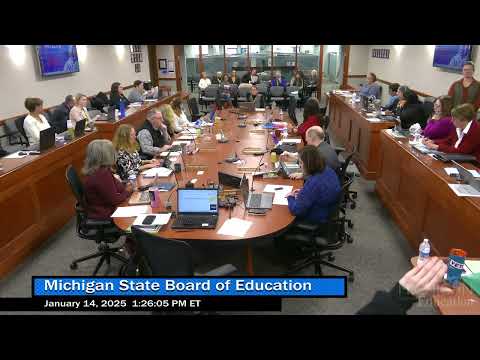
The Michigan State Board of Education voted Jan. 14 to call on the Legislature and governor to provide additional funding for local and intermediate school districts to open new state-approved Career and Technical Education programs, particularly in so-called CTE deserts and communities with opportunity gaps.
Board member Dr. Pugh moved the resolution and Dr. Mitchell Robinson seconded it. Dr. Pugh read the resolution into the record and cited recent CTE participation and completion data included in the resolution: statewide CTE enrollment rose from 102,988 in 2020-21 to 112,156 in 2023-24, and the number of students completing a full CTE program rose to 52,625, the highest level recorded in state history.
"CTE offers students opportunities to earn college credit, industry certification and licenses in high wage, high skill and in-demand fields," Dr. Pugh read as she moved the resolution. The board discussion emphasized CTE's role in improving graduation rates, increasing postsecondary credential attainment and supporting local economic needs.
The resolution passed on a roll-call vote. Tom McMillan recorded the sole No vote in the official roll call recorded in the transcript; other named members voted Yes. McMillan said during discussion he favored innovation and non-governmental approaches to expand options and therefore would vote no on the resolution.
Why it matters: MDE and board materials cited research showing students who complete CTE programs have higher graduation rates and employment or continued-education outcomes after high school. The board resolution requests legislative appropriations to expand access, fund middle-school pilot programs and address geographic and socioeconomic inequities in program availability.
What happens next: The resolution is a formal request to the Legislature and governor to consider increased funding for CTE expansion; it does not itself appropriate funds.