Get Full Government Meeting Transcripts, Videos, & Alerts Forever!
Get email alerts on the Financial Institutions Data Match topic
No spam. Unsubscribe anytime.
Committee debates automated bank-data match to collect delinquent taxes amid privacy and process concerns
Summary
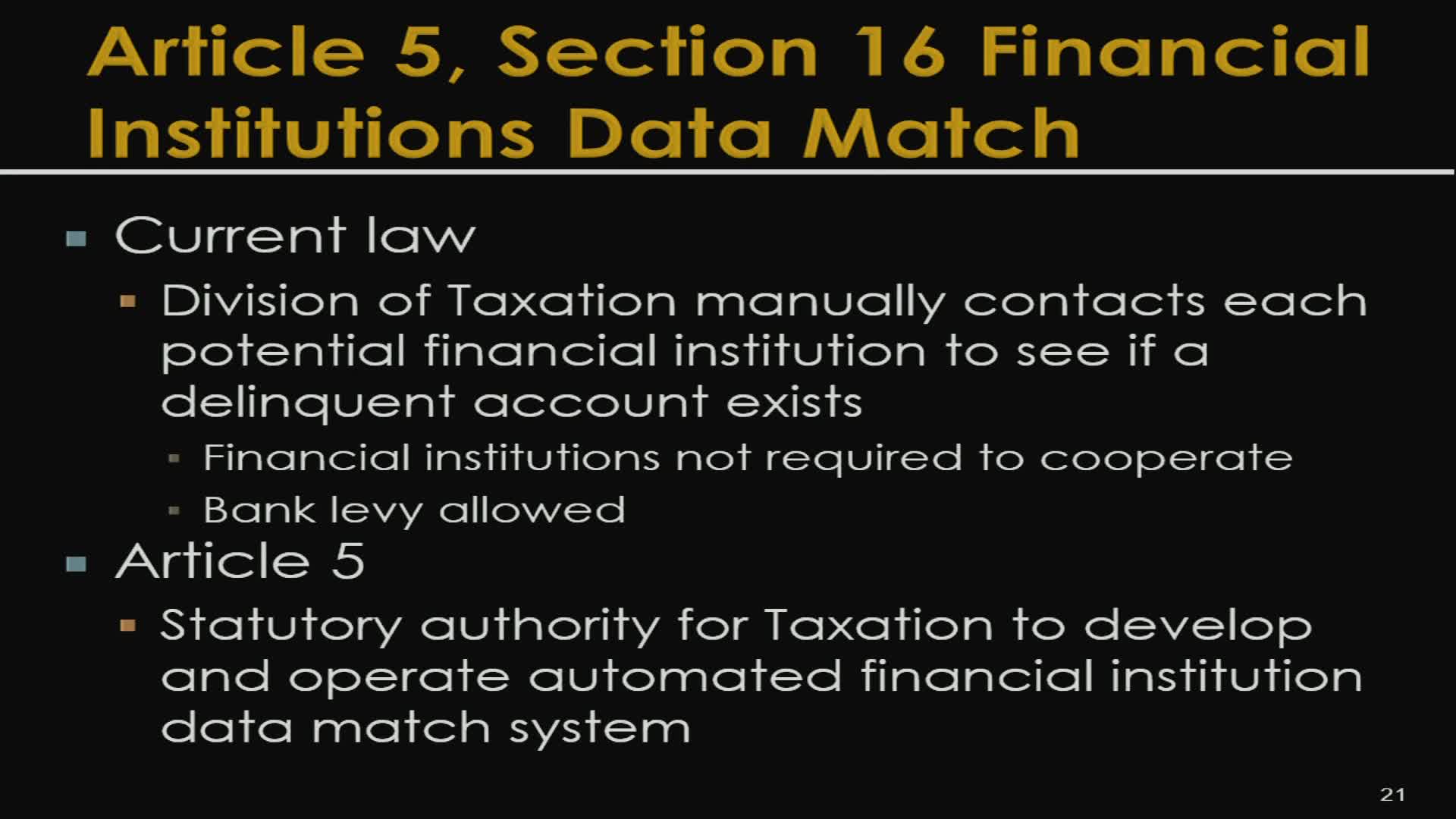
Article 5, Section 16 would require financial institutions to provide quarterly data matches to the Division of Taxation to identify delinquent taxpayers. Supporters described similar programs used for child support and in other states; privacy advocates, CPAs and business groups warned about data security, notice and due-process safeguards.
The committee considered Article 5, Section 16, a proposal to require financial institutions to provide quarterly data to the Division of Taxation to identify accounts tied to delinquent taxpayers, in order to increase collections.
Administration witnesses said the current process is manual and that automated matching is routine in 22 states, including neighboring states. The Office of Management and Budget and Department of Revenue argued the tool is targeted at longstanding delinquencies and would help recoup unpaid liabilities: "This is yet another tool that we have to start chipping away at those taxes that are owed to the state," Director Brian Daniels said. Revenue staff said existing notice rules would remain, and the bank-levy authority would not be expanded; taxation generally issues multiple notices and offers payment plans or offers-in-compromise before levy action.
Opponents raised cybersecurity, due-process and fairness concerns. The ACLU of Rhode Island opposed the proposal on the grounds of data security and the absence of a strengthened notice requirement; the ACLU noted recent state breaches and urged stronger protections and explicit notice procedures. The Rhode Island Society of CPAs and the Rhode Island Business Leaders Alliance warned that the state—s recent cybersecurity incidents (RIbridges and other breaches) made any large personal-data repository high-risk, and they said the proposal lacked judicial oversight and sufficient safeguards for taxpayers with disputed liabilities. CPA and business witnesses also said the state—s penalty and interest regime and long look-back periods should be addressed before deploying automated seizures.
Committee members asked about notice and about other states— practices. ACLU and business witnesses said Massachusetts and Connecticut include notice requirements in their programs and urged Rhode Island to adopt similar protections. Revenue staff said current rules require many notices before levy and that offers-in-compromise and payment plans remain possible. Witnesses urged caution in light of recent cyber incidents, suggested tightened limits on look-back periods, and asked for stronger judicial or administrative review before financial institutions would be required to provide data or before levies could be triggered.
No formal action was taken. Committee members requested more information on how other states handle notice and safeguards; opponents urged delay until the state—s IT security posture and procedural protections are improved.