Get Full Government Meeting Transcripts, Videos, & Alerts Forever!
Get email alerts on the Indigenous Education topic
No spam. Unsubscribe anytime.
Michigan Indigenous Education Initiative outlines co‑governance, curriculum and teacher learning work
Summary
MDE presenters and tribal partners described the Indigenous Education Initiative’s government-to-government approach, a curriculum project to teach Indigenous history (including the boarding school era), and training and consultation infrastructure established under Executive Directive 2019-17.
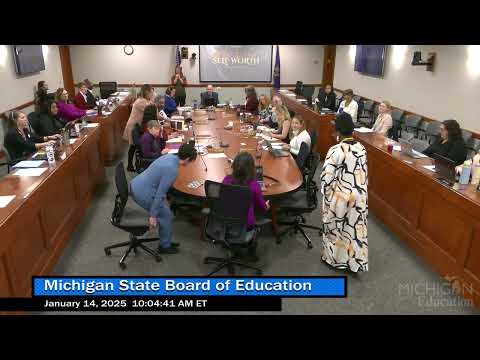
State and tribal education leaders outlined the Michigan Department of Education’s Indigenous Education Initiative (IEI) and its work with the Confederation of Michigan Tribal Education Departments during a Jan. 14 State Board presentation.
IEI leaders said their work is grounded in a government-to-government collaborative governance model and cited Executive Directive 2019-17 from the governor’s office as the policy infrastructure that formalizes consultation expectations between state agencies and tribal nations. “We operate in a space between the department and the tribal nations,” Initiative Director Jen Huskin LaPointe said, describing quarterly meetings among tribal education directors and regular co‑designed consultation policies.
Presenters said a key, funded project is an Indigenous history curriculum effort to develop optional curriculum modules and professional learning for grades 8–12, explicitly including content on the boarding-school era. The work began after advocates and tribal partners pressed for the state to teach Indigenous history more fully; the transcript notes that money was appropriated and tribes were named in an appropriation to co-design, implement and evaluate professional learning and optional curriculum modules "inclusive of the boarding schools." Melissa Isaac, who identified herself as a citizen of the Saginaw Chippewa Indian Tribe and protector of the young for the IEI, described boarding schools as a painful era when children were taken from families, languages were suppressed and generational harm resulted.
The presenters described steps the initiative has taken to build capacity and authentic relationships: appointing a tribal liaison in state agencies (Terri Rink was named as the Department’s tribal liaison), developing a co‑designed consultation policy signed by department leadership, and creating an infrastructure for training state staff and local educators. The initiative also produced ‘‘essential understandings’’ — a set of foundation concepts the IEI and tribal partners consider critical background for teaching Indigenous history — and will present those publicly through a comprehensive history webinar series in April.
Why it matters: The initiative commits state resources and a co‑governance model to ensure tribal voices shape how Indigenous histories and knowledge systems are represented in public-school instruction. Presenters said the curriculum will be place‑based and tribe‑led where appropriate, and that the initiative seeks to move Indigenous histories from being confined to November observances into year‑round instruction.
What the board discussed: Board members asked about district and intermediate school district engagement, the reach of tribal education programs beyond reservations, and how teachers and local districts can access resources and field trip opportunities. Presenters said tribal cultural centers and tribal educational offices regularly host field trips and community programming; programmers advised districts to form genuine relationships with tribal partners rather than one‑off outreach.
Ending: Presenters asked the board to engage and learn with tribal partners; the IEI said the work is ongoing, grounded in relationship-building, and that additional professional learning modules and essential understandings will be publicly available soon.