Get Full Government Meeting Transcripts, Videos, & Alerts Forever!
Get email alerts on the Diversity Equity Inclusion topic
No spam. Unsubscribe anytime.
MDE highlights diversity in literature, comprehensive history webinars and new language-access plan
Summary
Michigan Department of Education presenters described programs to increase diverse classroom libraries, a continuing webinar series on comprehensive history, and a language-access plan under Public Act 241 of 2023; presenters also reviewed teacher workforce recruitment and Grow Your Own efforts.
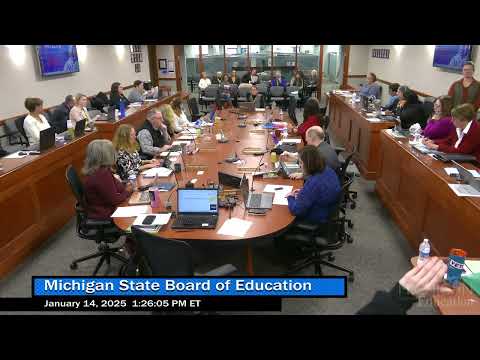
The Michigan Department of Education on Jan. 14 updated the State Board on work across offices to strengthen diversity, equity and inclusion in schools, with five highlighted efforts: diversity in classroom literature, teaching comprehensive history, increasing the quality, quantity and diversity of the teacher workforce, the Student Advisory Council, and a new language-access plan that implements Public Act 241 of 2023.
"We believe that all children have the right to see themselves in their literature, history, and teachers," said Dr. Renee Garcia, Director of the Office of Diversity, Equity and Inclusion, opening the presentation. The Literacy Unit and Office of Educational Support described a 2023 guidance document encouraging diverse classroom libraries and efforts to align classroom-level book use with the science of reading.
Dr. Delsa Chapman, Deputy Superintendent in the Division of Assessment, School Improvement and Systems Support, said the department has produced resources and a symposium to support diverse-library development and that MDE partnered with Benton Harbor-area schools to develop lessons that pair diverse books with structured literacy activities. Chapman cited National Assessment of Educational Progress (NAEP) 2023 data to note that reported daily recreational reading among middle-school students is at a low point and framed diverse classroom libraries as one strategy to boost engagement.
The department described an extended webinar series for teaching comprehensive history launched in April 2022 and supported by a competitive grant program. Topics listed in the presentation included the Harlem Renaissance, the Great Migration, women's antislavery activism, the U.S. temporary labor program (Bracero), women's experiences in the Holocaust and other subject matter presented with university and museum partners. MDE said the legislature provided $6 million to districts via competitive grants for related work.
On workforce, Deputy Superintendent Michelle Harmala reviewed multiple recruitment and credentialing initiatives: Grow Your Own programs, Future Proud Michigan Educator Launch programs, Talent Together teacher apprenticeship cohorts (56 ISDs participating), and steps to increase candidate diversity. Harmala reported growth in teacher preparation enrollments since 2016 and noted a 34% increase in teachers of color over eight years, while acknowledging the student-teacher demographic gap (students of color: 36.6% vs. teachers of color: 10.7%).
MDE also previewed a language-access plan to comply with Public Act 241 of 2023 (Meaningful Language Access to State Services Act). When fully implemented, MDE said family-facing documents will be translated into Spanish and Arabic, with access information available in six additional languages (Bengali, Chinese, Albanian, Japanese, Vietnamese and Urdu) and that materials will be ADA-compliant. Plain-language training for staff who engage families directly is planned.
"Diverse literature is a great tool for learning more about comprehensive history, which we believe should be taught all year long," Chapman said. Board members asked for ongoing access to webinar recordings and for more data on areas such as teacher gender representation; MDE staff said webinars and many resources are posted online and some materials were completing ADA compliance at the time of the presentation.
Why it matters: The initiatives connect literacy practice, cultural representation in curriculum, educator recruitment and language access in a linked strategy to improve engagement and equity in Michigan schools.