Get Full Government Meeting Transcripts, Videos, & Alerts Forever!
Get email alerts on the Foster Care Education topic
No spam. Unsubscribe anytime.
MDE outlines foster-care education changes, shares youth testimony and new state responsibilities under recent laws
Summary
Michigan Department of Education officials briefed the State Board on foster-care education work, new statutory duties under three 2024 public acts, a youth-voice initiative, and implementation steps including reviews of child-caring institutions and a new CCWIS data warehouse.
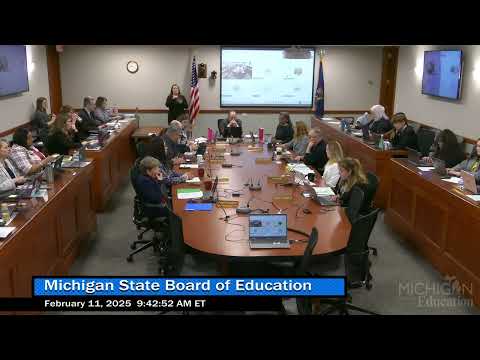
Michigan Department of Education officials told the State Board of Education on Feb. 11 that recent state laws and collaborative work with the Michigan Department of Health and Human Services have expanded requirements and supports for youth in foster care, and that listening sessions with youth have informed new guidance.
Presenters said three bills enacted in 2024 — developed with Representative Stephanie Young’s office and described in the presentation as House bills advanced into Public Acts — create new duties. Staff described the most significant changes as requirements for comprehensive transition planning, school-enrollment timelines, guaranteed extracurricular access and a requirement that child caring institutions (CCIs) prioritize students’ access to the Michigan Merit curriculum so youth in CCIs can earn high school credits that transfer when they change placement.
MDE officials said Public Act 10 will require an annual foster-youth education report to the Legislature; Public Act 11 will require MDE to review educational programs at roughly 100 child-caring institutions; and another Public Act cited in the presentation addresses transition planning and enrollment timelines. MDHHS has primary responsibility for the required annual report, with MDE and the Center for Educational Performance and Information (CEPI) contributing to compilation.
The department described collaborative training and technical assistance in 2024: joint ‘‘road-show’’ sessions for local education agency foster-care liaisons and MDHHS case managers, conference presentations, and a four-part youth voice series in which youth with lived foster-care experience participated in listening sessions in February, May, August and September of 2024. Staff also said they contributed to federal U.S. Department of Education nonregulatory guidance published in November 2024 and worked with MDHHS on forms and policies.
Three youth who participated in MDE’s Foster Youth Voice Initiative addressed the board. Ms. Mary Cooper, a former foster youth and current university student, said the sessions gave participants a ‘‘platform’’ to share experiences and urged schools to ‘‘create a more consistent personalized academic experience’’ for foster youth. A facilitator and participant, Peter (Pura) Strong, described the sessions as ‘‘humbling’’ and urged that stories from youth be used as data to inform services. Breanna (Brina) Williams, who facilitated one session, said, “Nothing about us without us,” and asked that youth remain part of implementation so they can see how their input was used.
MDE staff described implementation steps and supports: participation in multiagency trainings, revisions to judicial bench cards via the State Court Administrative Office to clarify adult roles in foster cases, work on a new Comprehensive Child Welfare Information System (CCWIS) that will include more education data, and planned spring 2025 trainings (a five-part virtual ‘‘lunch and learn’’ on the federal guidance and statewide training series for MDHHS case managers and district foster-care liaisons).
Officials said some data on foster-youth outcomes are available now (state-level graduation and achievement rates) and that Public Act 10’s annual report and CCWIS data should enable more detailed analysis. MDE emphasized the need for continued cross-agency work to reduce barriers that affect graduation and stability for foster youth.
No formal board votes were taken on the presentation. Board members thanked youth participants and asked for continued focus on school stability, transportation and supports that reduce churn in student enrollment when children enter care.