Get Full Government Meeting Transcripts, Videos, & Alerts Forever!
Get email alerts on the State Budget topic
No spam. Unsubscribe anytime.
Governor’s FY26 education request includes recurring children’s mental‑health funding, CTE expansion and per‑pupil increase
Summary
The governor’s FY26 executive recommendation proposes a 4.1% per‑pupil increase, $150 million recurring for children’s mental health, a five‑year $125 million CTE expansion line, and recurring support for school meals and LETRS training, department staff told the State Board.
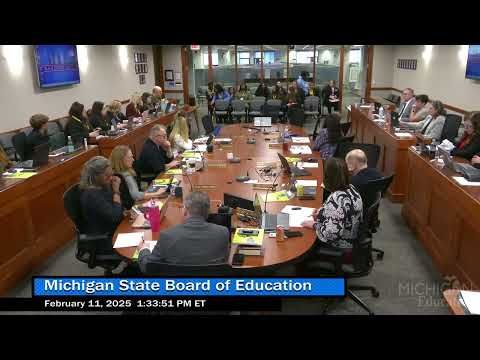
Michigan Department of Education staff briefed the State Board on Feb. 11 about the governor’s proposed fiscal year 2026 executive budget recommendation, highlighting recurring investments in children’s mental health, a proposed expansion of career‑technical education and a 4.1% increase in the per‑pupil foundation allowance.
Olivia Ponte, legislative liaison in the Office of Public and Governmental Affairs, summarized recent education‑related bills that were signed into law and then reviewed the governor’s FY26 priorities. The recommendation would raise the per‑pupil foundation allowance by 4.1 percent to an even $10,000 and increase several weighted formula grants including at‑risk and special‑education elements.
On mental‑health funding, the executive recommendation would make $150 million recurring for children’s mental health in public schools; the FY25 appropriation included $125 million nonrecurring and $25 million recurring. The administration recommended $200 million in recurring funds to continue a universal school‑meals program.
The governor proposed a large investment in CTE: a new $125 million line item (61V) spread over five years for program expansion plus a separate $20 million for CTE equipment upgrades. The budget request also included $10 million recurring to support LETRS literacy training and nearly $3 million for technical support to expand CTE opportunities to students in underserved areas. Other recommended items included funding for school consolidation and infrastructure and targeted dollars (section 16b) for schools identified as lower performing and for a pilot that would test cell‑phone‑free policies in high schools.
Department officials noted the executive recommendation is the first step in a legislative process that will produce House and Senate budget bills and a conference committee report. Board members asked clarifying questions; Superintendent Michael Rice and staff said they will track the proposals as the legislature proceeds through the budget cycle.