Get Full Government Meeting Transcripts, Videos, & Alerts Forever!
Get email alerts on the Special Education Endorsement topic
No spam. Unsubscribe anytime.
State Board reviews proposed standalone special-education endorsement amid support and concern
Summary
The Michigan Department of Education presented proposed standards for a new standalone special-education teacher endorsement, backed by Optimize and special-education stakeholders, and met with both broad support from practitioners and caution from some board members about de-categorizing endorsements and placement implications.
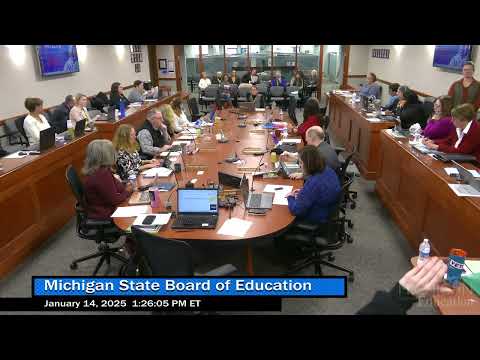
The Michigan Department of Education on Jan. 14 presented proposed standards for a new standalone special-education teacher endorsement and fielded public comment from educators, advocates and parents who largely supported the move as a way to address staffing shortages and improve preparation for special educators.
The proposal, presented as an informational item and not a request for adoption, would create an endorsement focused solely on special-education pedagogy that does not require an accompanying general-education endorsement. Michelle Harmala, Deputy Superintendent for the Division of Educator Excellence, said the department is asking only for public comment now: “Weare not asking you to do that today. This is informational,” she said.
The Standards Writing Team—25 members on the writing team and 13 participants in targeted feedback, according to MDEaligned the draft standards to the Council for Exceptional Children (CEC) practice-based preparation standards and to recommendations from Optimize, the legislatively created task force charged by Section 94d of the State School Aid Act with developing a multi-year plan to attract, prepare and retain special-education personnel. Kelly Brozanski, Director of the Office of Educator Excellence, said the standards were intended to strengthen preparation and broaden placement flexibility for teachers while keeping existing categorical endorsements available.
Supporters who spoke during the public comment period described the standards-writing process as collaborative and urged adoption after public comment. Heather Eckner, Statewide Director of Education at the Autism Alliance of Michigan, said a statewide stakeholder survey found continuing systemwide barriers for students with disabilities and urged the board to consider the survey results in implementation. Paula Lancaster, a member of the Standards Development Team and dean at Central Michigan University, said the standards align closely with high-leverage teaching practices and the CEC frameworks and represent "exactly the direction we need to be moving toward." Several other speakers from Optimize, higher education and ISD leadership emphasized that the standards aim to reduce unnecessary barriers into the profession and create a clearer pathway into full-time special-education teaching.
Board members voiced both support and reservations. Board member Nikki Snyder said the proposal is controversial among some special-education teachers and advocates because it would de-emphasize the current categorical endorsements (for example, cognitive impairment, autism, visual impairment) that match specific program placements. "Iheard this morning that we're trying to categorize mild, moderate and severe and the reimbursement rates for the cost of special education. Now I'm hearing let's generalize it from a teaching standpoint," Snyder said, adding that she wants to ensure students receive placements and services appropriate to their needs.
MDE officials responded by distinguishing three separate things: student eligibility, teacher endorsement (what is being proposed), and student placement (where a student receives services). Gina Garner, Higher Education Consultant, said the proposed endorsement would be an additional option and would not remove any currently available special-education endorsements. The department also said some specialized programs (for example, early childhood special education, deaf and hard of hearing, visual impairment, some autism placements) would be excluded from placement under the new endorsement because they require additional clinical training.
Next steps: MDE will open a public-comment period (Januaryto February), reconvene the Standards Writing Team to review feedback, and return to the board in the spring or summer with a revised proposal. If approved, changes to the Michigan Administrative Rules for Special Education and a new Michigan Test for Teacher Certification aligned to the standards would follow; implementation steps were estimated to take 18to 36 months, with teachers from new programs expected to appear in 2028or 2029.
Why it matters: The department framed the proposal as a response to a continuing shortage of special educators and as an effort to increase quantity, quality and diversity of the workforce while keeping standards for practice high. Supporters say a more direct pathway into special education could reduce barriers of time and cost for prospective teachers; critics say decategorization risks mismatches between student needs and teacher expertise.
Board members indicated they expect significant public comment; several said they would continue to weigh implementation details, how endorsement changes intersect with funding and placement rules, and whether categorical expertise would be preserved for students with specialized needs.