Get Full Government Meeting Transcripts, Videos, & Alerts Forever!
Get email alerts on the School Mental Health topic
No spam. Unsubscribe anytime.
State education officials outline expansion of school mental‑health system, BH Works rollout and Medicaid billing supports
Summary
Michigan Department of Education staff provided an update on building a comprehensive school mental‑health system, citing growth in 31N‑funded providers, expansion of BH Works usage among ISDs and plans for training, Medicaid billing technical assistance and school‑based screening.
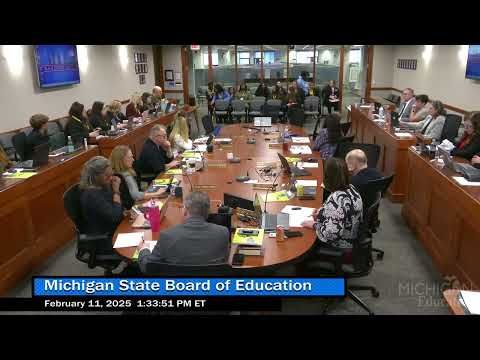
Department of Education officials told the State Board of Education on Feb. 11 that Michigan is expanding school‑based mental‑health services through state funding and technical systems, but work remains to standardize practice, data and workforce training.
Dr. Diane Golczynski, deputy superintendent for the Division of Business, Health, and Library Services at MDE, told the board the department is concentrating on eight core features the U.S. Department of Education identifies for a comprehensive school mental‑health system: trained support personnel, screening, family–school–community collaboration, evidence‑based practice, resource mapping, data use, integration with Multi‑Tiered System of Supports (MTSS), and funding strategies. “We need to focus on capacity, growing the profession, and sustainability,” she said.
MDE officials reported growth in 31N subsection funding that supports school‑based providers. MDE staff said the department is tracking the number of schools with at least one 31N‑funded provider, the full‑time equivalent providers hired and the unduplicated students served; those measures have increased since 2019. Deputy superintendent Golczynski highlighted ongoing work to train clinical providers who now serve in schools, to give supervisors the skills needed to manage clinicians in school settings, and to provide Medicaid‑billing technical assistance so districts can sustain services.
Amy Allen, director of the Office of Health and Safety, and Scott Hutchins, School Behavioral Health Unit supervisor, described the BH Works platform rollout: 43 of Michigan’s 56 intermediate school districts (ISDs) were live on BH Works at the time of the presentation, two more were in progress and four were considering adoption. MDE used one‑time ESSER funds to expand BH Works access to all school‑based mental‑health providers (previously limited to 31N providers), and plans to add school‑nurse workflows next year.
On screening and MTSS, presenters said moving from Social‑Emotional‑Behavioral (SEB) language to Social‑Emotional‑Behavioral Health signals an integrated approach. MDE emphasized that screening should be used to identify students’ strengths and risks early so schools can provide preventive or targeted supports.
The presenters reiterated that many elements are still mid‑implementation: workforce training, consistent data collection tied to outcomes, and clarifying scope‑of‑practice questions (for example, when a school‑based provider must refer to community mental‑health for substance‑use disorder). Board members asked detailed questions about parental notification and scope of practice; MDE staff said providers have reporting obligations when a student is in danger, and districts may refer specialized matters to community partners depending on licensure and scope of practice.
The presentation was informational; no votes were taken.