Get Full Government Meeting Transcripts, Videos, & Alerts Forever!
Get email alerts on the Digital Ad Tax topic
No spam. Unsubscribe anytime.
House finance panel reviews governor—s digital-ad tax as proponents and opponents clash
Summary
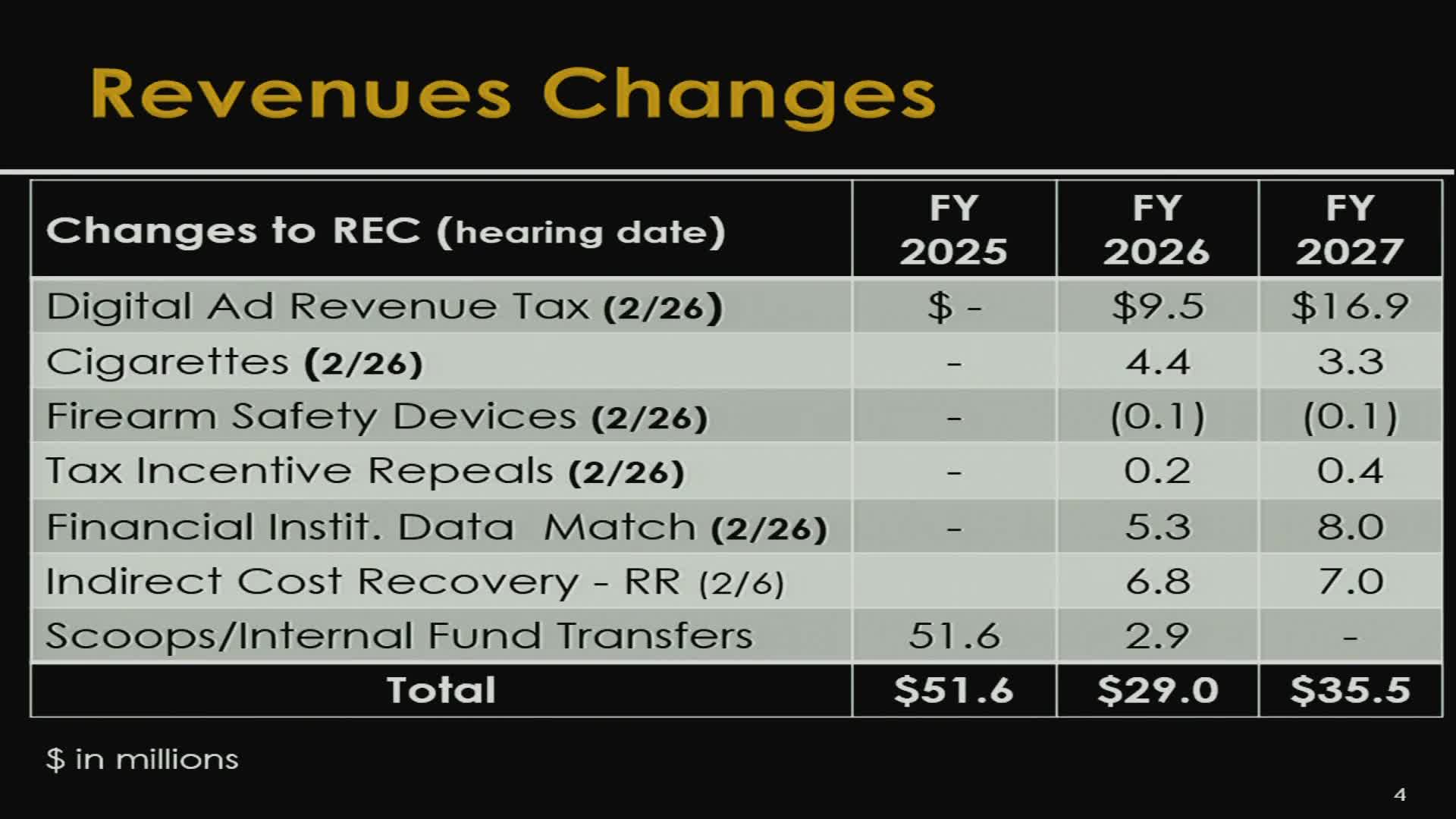
House Finance Committee members heard extended testimony on Article 5, Section 17, the governor—s proposal to impose a 10% tax on digital-advertising revenues derived in Rhode Island by companies with at least $1 billion in global revenues.
House Finance Committee members heard extended testimony on Article 5, Section 17, the governor—s proposal to impose a 10% tax on digital-advertising revenues derived in Rhode Island by companies with at least $1 billion in global revenues.
The proposal would exclude news media and broadcast outlets under a budget amendment, prohibit companies from separately passing the tax to consumers as a line item and make the new tax effective Jan. 1, 2026. The administration estimates $9.5 million for tax-year 2026 and roughly double that the following year; it said most revenue would come from very large firms.
Committee members were given two lines of argument. Office of Management and Budget Director Brian Daniels and Department of Revenue staff described the tax as a modernization of the tax code that targets a rapidly expanding sector of the economy. Daniels said digital advertising is different from broadcast or print because much of it is personalized and monetized by platforms and therefore goes untaxed: "Digital advertising is tailored to the individual... businesses are making money on that on your eyeballs and on your interactions, but you do not get money from that," he said. Revenue analysis staff said the proposal follows Maryland—s structure but omits a tiered rate and includes the media exemption.
Opponents argued the tax would hurt Rhode Island businesses and consumers and face near-certain litigation. Deb Peters, testifying for Americans for Digital Opportunity, said research shows advertising taxes are often passed down to consumers and small advertisers: "Adding a gross receipts tax to digital advertising ... will actually adversely impact every single business that advertises online in Rhode Island," she said, warning of constitutional challenges and of damage to small businesses that rely on online ads. The Rhode Island Broadcasters Association supported the media exemption in the governor—s amendment but urged caution about taxing advertising generally. Broadcasters— president Bill George told the panel broadcasters were relieved by the exemption and said local stations play a unique role in emergencies.
Committee members repeatedly asked administration witnesses about litigation risk. Bethany Widmarsh, assistant tax administrator, said the state was monitoring Maryland—s legal challenges and coordinating with counterparts there. Daniels said Maryland—s experience informed revenue estimates and implementation assumptions but acknowledged legal risk: "We are monitoring the litigation very closely," he said.
Public commenters and business groups urged rejection or modification. Deb Peters called the measure "extremely misguided," citing Deloitte and other analyses of advertising taxes. Opponents said the tax would effectively be borne by local advertisers and consumers either through higher prices or reduced advertising, and they predicted enforcement and auditing challenges tied to tracking revenues attributable to devices located in Rhode Island.
The committee did not vote on the provision. The administration said the amendment exempting news media was intended to reduce the tax—s reach and that staff would provide additional technical detail if the committee requested it.
The discussion leaves open both legal questions about the tax—s design and practical questions about auditing and pass-through. Members asked for more detail on administration and enforcement, and proponents said they will monitor other states— litigation that could influence Rhode Island—s approach.