Get Full Government Meeting Transcripts, Videos, & Alerts Forever!
Get email alerts on the Special Education topic
No spam. Unsubscribe anytime.
State Board fails to add resolution urging continued federal oversight of special education to agenda
Summary
A motion to add a resolution encouraging continued federal oversight of special education failed on a roll-call vote after debate about accuracy of claims and prior board work on special education.
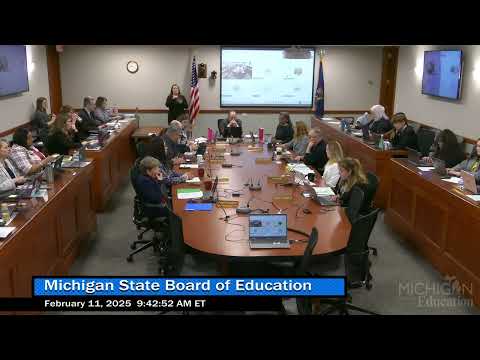
The Michigan State Board of Education on Feb. 11 voted down a motion to add a resolution recommending continued federal oversight of special education to the day’s agenda.
The motion to place “State Board of Education Resolution to Encourage Continued Federal Oversight in Special Education” on the afternoon agenda was made by Ms. Nikki Snyder and seconded by Mr. Tom McMillan. After discussion the board conducted a roll-call vote; the motion failed (Yes: McMillan, Pugh, Snyder; No: Lipton, Pritchett, Robinson, Tilley). The board president called the motion defeated.
The proposed resolution cited the Individuals with Disabilities Education Act (IDEA) of 1975, a currently open Office for Civil Rights federal investigation and alleged declines in state compliance after administrative shifts to intermediate school districts. Snyder told the board she wanted an immediate committee to review special-education governance and “what Michigan in particular should be doing to remedy” the federal concerns. Dr. Pamela Pugh and other board members pushed back on several factual statements read into the record and emphasized ongoing board advocacy and prior board actions, including a unanimous October 8, 2024 resolution urging Congress to meet the federal funding commitment for special education.
Dr. Mitchell Robinson urged caution about inaccurate statements in the motion’s text and recommended careful review before formal action. Mr. McMillan expressed support for discussing the matter on the board floor and said he welcomed the opportunity to ‘‘put it before us and start discussing it.’’
Board members debated whether to refer the issue to the legislative committee or to place it on the full board agenda for further discussion that day. After a short discussion, the roll-call vote failed to place the resolution on the agenda.
No additional formal actions occurred on the substance of the resolution during the meeting. Several board members who spoke described ongoing activities — advocacy for increased special-education funding, presentations at prior meetings, and department work on seclusion and restraint — and noted the board has repeatedly discussed special education over multiple meetings.
The board will consider other agenda items as scheduled; no further formal motion on Snyder’s resolution was recorded in the transcript.