Get Full Government Meeting Transcripts, Videos, & Alerts Forever!
Get email alerts on the Egle Program Update topic
No spam. Unsubscribe anytime.
EGLE staff report registrations, tool metrics and Michigan Potash withdrawal status
Summary
EGLE staff reported January–February registration metrics for the water‑withdrawal assessment system, a watershed depletion status map and the current registration status for Michigan Potash wells; staff also summarized federal funding and ARPA program activity and noted ongoing coordination with USGS and MGS.
EGLE staff provided the Water Use Advisory Council with program updates including recent registration metrics, watershed depletion zone counts and the registration status of two Michigan Potash withdrawal points.
EGLE reported that between Jan. 1 and Feb. 6 there were 26 registrations processed through the online tool and 24 site‑specific review (SSR) registrations done by staff. On depletion status, the department said the map shows the majority of water‑management areas in Zone A (green) with "a little over close to 4,200" areas; 882 areas are in Zone B (yellow), 4 are in Zone C (orange) and 25 are in Zone D (red/pending review). EGLE staff noted that streams in Zones B/C/D cannot pass the tool and require staff review.
On Michigan Potash, staff summarized two current registrations for the company: one registration for a withdrawal in Water Management Area (WMA) 6282 (Pogue/Bogie Creek) and another in WMA 10557 (Big Stone Creek area). EGLE said the company has drilled both wells and logged them in WellLogic but had not yet installed pumps and connected them to a power source; registrations expire Aug. 16 of the year specified if the pumps are not installed and operational. EGLE listed the total registered pump capacity for the two registrations as 1,380 gallons per minute, just below a 1,389 GPM threshold that would require a Part 327 permit application.
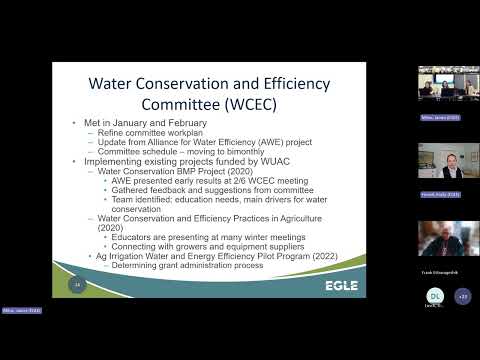
EGLE staff also described multiple funded projects supported by legislative appropriations and ARPA funds: updates to the groundwater data management system (ECWIS), upgrades to the withdrawal assessment tool user interface and depletion tools, USGS partnerships for monitoring, the geologic/hydrogeologic data enhancement project with AEM flights, and groundwater‑mapping work via contracts with Barr and Michigan Geological Survey. Staff warned that federal funding flows (including some ARPA‑derived projects) had experienced temporary interruptions and that grant administrators were monitoring account status.
Council members asked where to find details for PFAS soil and water work; staff directed members to EGLE program leads for those projects. EGLE said it would bring more detailed user‑interface and depletion‑tool updates to the next council meeting.