Get Full Government Meeting Transcripts, Videos, & Alerts Forever!
Get email alerts on the Transportation Budget topic
No spam. Unsubscribe anytime.
House appropriations panel gets fiscal overview of Michigan transportation budget; trunk-line shortfall estimated at $2.5 billion
Summary
The Michigan House Appropriations Subcommittee on State and Local Transportation received an overview from the House Fiscal Agency of the current-year transportation budget, funding sources and long-term gaps, including a $2.5 billion shortfall to return state trunk-line pavement to a previously adopted performance goal.
The Michigan House Appropriations Subcommittee on State and Local Transportation heard an overview of the current-year state transportation budget and system funding on (presentation date not specified), led by Bill Hamilton of the House Fiscal Agency.
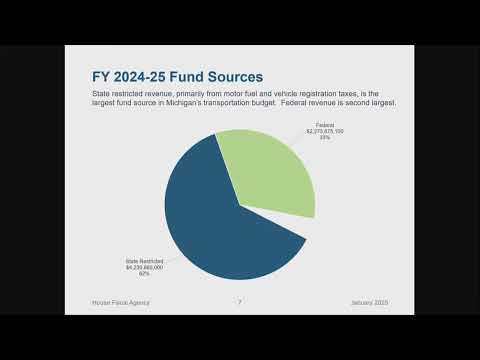
Hamilton told the committee the state transportation budget totals about $6.8 billion in gross appropriations, with roughly $4.2 billion in state-restricted revenue, a roughly one-third share in federal funds and $193 million in state general fund support. "This is an overview of the current year state transportation budget," Hamilton said, adding the largest program share supports state and local road and bridge programs.
The presentation outlined how appropriations break down by program: roughly $5.7 billion (about 83 percent) for road and bridge programs, about $805.6 million (about 12 percent) for public transportation, and about $330.3 million (about 5 percent) for aeronautics. Hamilton said much of the budget is distributed monthly from the Michigan Transportation Fund (MTF) to county road commissions, cities, villages and the state trunk-line fund under the distribution model set by Public Act 51 of 1951.
Why it matters: committee members were shown long-term revenue trends and condition data that the House Fiscal Agency and Michigan Department of Transportation (MDOT) use to set priorities. Hamilton said MDOT projects an additional $2.5 billion would be needed for the trunk-line system to return to and sustain a pavement performance target adopted in 1997 — a goal that had reached 90 percent "good" condition by 2007 and has since fallen below that level.
Key revenue points and constraints
Hamilton told the panel vehicle registration revenues are now the largest contributor to state-restricted transportation revenue, followed by motor-fuel taxes. He said the motor-fuel tax rose to 31 cents per gallon on Jan. 1 (year not specified in the transcript). He also noted a $600 million annual income-tax earmark to the MTF created in the November 2015 road funding package and referenced the recreational marijuana excise tax as another statutory credit to the MTF. "Article 9, Section 9 of the Constitution dedicates those for transportation purposes," Hamilton said, describing the constitutional designation for key revenue streams.
Hamilton distinguished state-restricted (distributive) revenue, which the MTF distributes monthly and typically carries no year-end fund balance, from federal funds that are "made available" for qualified projects. He also noted that current federal authorizing law for surface transportation — the Infrastructure Investment and Jobs Act (IJA) — is in effect through Sept. 30, 2026, as presented in the briefing.
Debt, bonding and program pressures
The briefing included a summary of transportation-related debt. Hamilton said outstanding State Trunk Line Fund debt was just under $3.3 billion as of Sept. 30, 2023, with annual debt service on the order of several hundred million dollars (Hamilton cited about $226 million for 2023 and an estimate of $257.6 million for a later year). He said the State Transportation Commission had authorized up to $3.5 billion in trunk-line bond authority; MDOT had sold about $2.8 billion of that authority and retained roughly $700 million of authority available to sell in the current year, depending on market and cash-flow needs.
Pavement condition, system characteristics and local impacts
Hamilton highlighted that state trunk lines account for about 9,700 linear miles (about 8 percent of total road miles) but carry roughly 52 percent of vehicle miles traveled and a disproportionate share of bridge deck area. He said the trunk-line system includes the interstate highways and principal state-numbered routes and that MDOT selects and lets capital projects in an open competitive bid process.
Committee questions and next steps
Members asked how structural changes in driving and vehicle ownership might affect revenue. Representative Robert Edwards (State Representative) asked whether lower registration rates among younger people would affect the registration revenue stream; Hamilton responded that registration revenue tends to track vehicle value and that even when registration counts decline, registration tax receipts can rise as vehicle prices increase. Representative Sara Morgan (State Representative) asked whether budget figures are inflation adjusted; Hamilton said budget development includes economic adjustments and that MDOT tracks contractor cost changes, but recommended seeking further MDOT data to evaluate whether revenue growth keeps pace with asset deterioration and rising costs.
Representative questions also covered whether transportation appropriations can be used for underground utilities during road projects (Hamilton said drainage or utility work is typically addressed within major reconstruction projects but not directly earmarked by the budget) and the distributional role of Act 51 in distinguishing state trunk-line and local road responsibilities.
Formal action
At the end of the meeting the committee recorded a procedural motion. The committee chair moved to excuse absent members; the motion received voiced support and no roll-call vote was recorded on the transcript.
The committee chair said the subcommittee will continue to meet and "dig into" program details in future sessions to examine pavement, bridges, transit, airports and related funding and bonding questions.
Ending
The presentation and discussion provided the subcommittee with a baseline accounting of revenue sources and program shares, a reminder of statutory distribution rules under Act 51, and an MDOT-presented estimate of a trunk-line funding gap of roughly $2.5 billion to meet a long-standing pavement goal. Committee members requested additional, more detailed data from MDOT and the House Fiscal Agency for future meetings, including inflation- and performance-adjusted projections and debt-service schedules.