Get Full Government Meeting Transcripts, Videos, & Alerts Forever!
Get email alerts on the Nuisance Wildlife Drone Use topic
No spam. Unsubscribe anytime.
Subcommittee approves drone-use bill for nuisance species with amendment to remove 'relocate' language; moves bill 5-0
Summary
The wildlife subcommittee approved H3945 with an amendment removing the word “relocate” from two sections after DNR raised concerns; members voted 5-0 to pass the bill to the full committee.
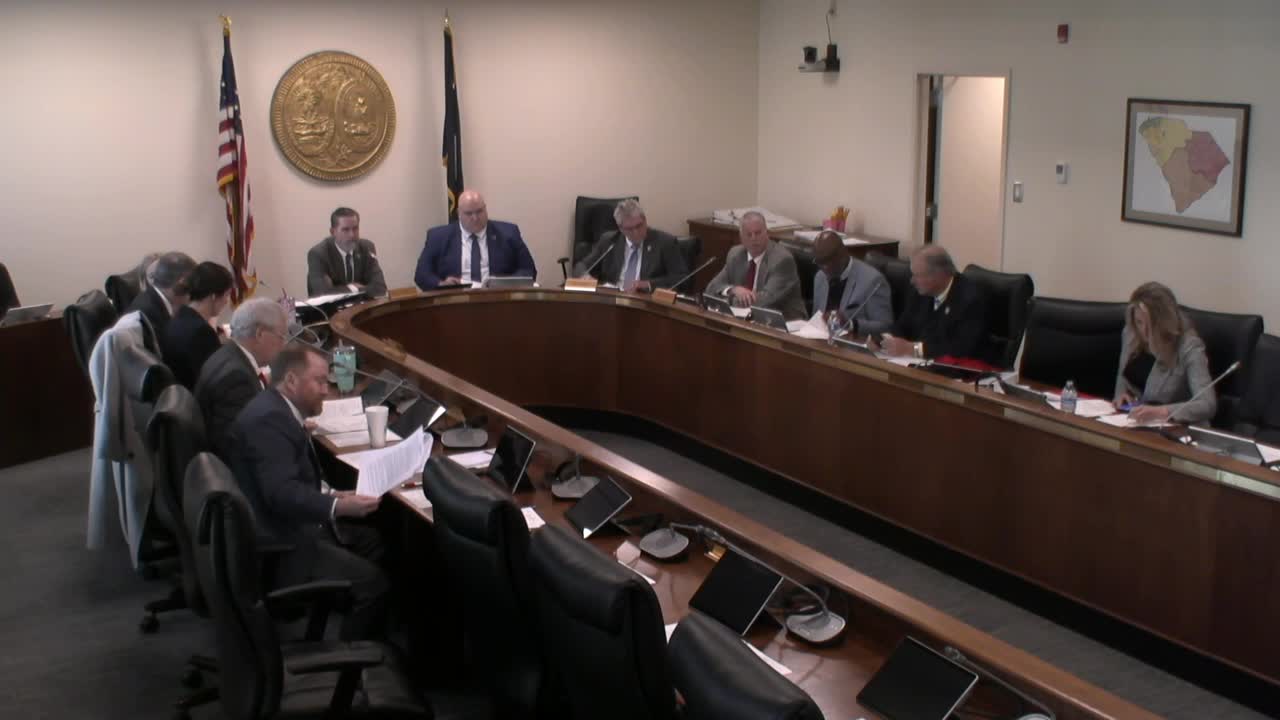
The Agriculture, Natural Resources and Environmental Affairs wildlife subcommittee approved House Bill H3945, a measure that would authorize certain activities involving unmanned aircraft related to nuisance wildlife, after adopting an amendment to remove the word “relocate” from two sections. The subcommittee voted 5-0 on both the amendment and the bill and forwarded the measure to the full committee.
Chief Billy Dukes of the South Carolina Department of Natural Resources (DNR) said the department had “no concerns” about the bill from a resource-protection standpoint but asked sponsors to delete the term relocate from sections the bill would affect because “there are already statutes on the books that prohibit relocation.” Dukes told the panel the statute governing feral swine and coyote handling allows relocation only under very specific conditions and that removing the term would avoid conflict with existing law.
Dukes also told the subcommittee that current law does not generally prohibit the activities anticipated under the bill so the bill “would certainly be a good start” if the sponsors wanted to add guardrails for drone usage in wildlife control. “As long as someone is in compliance with all, their their, FAA and drone certification licenses, there's nothing currently in law that prohibits the activities that would be allowed by this bill,” Dukes said on the record.
Legislators questioned how effective existing methods have been for controlling feral swine. Dukes said eradication remains difficult: “We have not…eliminated hogs. Absolutely not. In certain areas we have considerably reduced hog damage,” he said, and described a mix of trapping, aerial shooting performed by federal partners, and emerging technologies. On turnover and methods, Dukes said toxicants remain a research topic and cautioned there is likely no single “silver bullet,” adding that sustained cooperation of public and private landowners will be necessary to reduce populations.
Representative Gibson moved and the subcommittee adopted an amendment that struck the word “relocate” from section references read into the record (section numbers cited in discussion). The amendment passed by roll call, 5–0. Representative Gibson later made a motion to approve H3945; the committee recorded a 5–0 vote to move the bill to full committee.
Votes at a glance
- Amendment to strike “relocate” from bill sections (proposed following DNR recommendation): Passed, 5–0. - Bill H3945 (as amended): Passed, 5–0; moved to full committee.
Background and context
Dukes described a suite of current control measures—trapping, USDA aerial shooting assistance, and improved traps—and said DNR is open to reasonable statutory guidance about drone use so long as it does not conflict with other laws governing the handling or relocation of wildlife. The department said toxicants specific to feral swine are not yet an available tool and cautioned about non-target risks.
The subcommittee discussion included direct exchanges about tactics used on private land and the challenges of removing entire breeding groups rather than individual animals, and members acknowledged other states’ experiences with different regulatory approaches to hunting or transport of nuisance animals.