Get Full Government Meeting Transcripts, Videos, & Alerts Forever!
Get email alerts on the Cpc Guidelines And Schedule topic
No spam. Unsubscribe anytime.
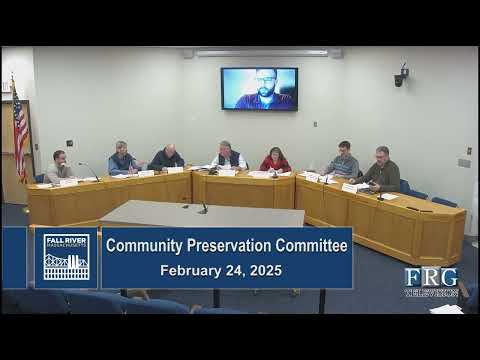
Fall River Community Preservation Committee tweaks schedule, tightens application rules and asks church to seek emergency funds for steeple
Summary
The Fall River City Community Preservation Committee on Feb. 24 discussed changes to the FY 2026–27 application and review schedule and made drafting decisions aimed at reducing project risk and clarifying applicant responsibilities.
The Fall River City Community Preservation Committee on Feb. 24 discussed changes to the FY 2026–27 application and review schedule and made drafting decisions aimed at reducing project risk and clarifying applicant responsibilities. Committee members also discussed an apparent safety issue at a local church’s steeple and asked the congregation to submit an emergency funding application for review.
Committee members front-loaded planning changes for next year’s Community Preservation Act (CPA) cycle, saying eligibility applications will again be tied to an early-September deadline and that funding applications will remain on a December 1 due date while the committee shifts funding hearings later in January to allow more time for applicant follow-up. The group discussed specific hearing dates around Jan. 20–21 and deliberation dates in early February to give staff and applicants more time after the holidays.
The discussion focused on making the application materials and review process more rigorous and clearer. Committee member Kristen Cantero Olivera urged that attendance at CPC funding and eligibility hearings be mandatory rather than merely “recommended,” saying applicants should be “expected to be present” to answer questions at the hearing. Members asked staff to update the CPC web page and application forms to reflect the changes.
Most of the edits under consideration are technical but consequential. Committee members agreed to add or clarify requirements that applications include contractor or architect cost estimates (or professional estimators), a statement of project team qualifications and relevant licenses, and a clear budget showing any outside funding sources. The committee discussed explicitly requesting commitment letters from banks or other financial institutions when projects rely on loans or private financing, and adding a checklist box for “other funding sources” on the application form. Members recommended that nonprofit applicants include recent operating budgets or documentation of dedicated project funds.
On procurement and cost reporting, members discussed the longstanding rule that projects should seek three bids. Recognizing specialty-work shortages in the region, the committee agreed to change the wording to require a “good-faith effort to attain three bids” and to accept documentation of efforts when fewer bids are available. The group also debated contingency language: staff currently show 10 percent; members recommended increasing that contingency and settled on a middle ground recommendation of 15 percent for guidance in the materials.
The committee also moved to tighten technical standards for certain project types. Members asked that application guidance require appropriate licensed professionals for the scope of work (for example, licensed landscape architects for off-road trail design, civil/structural engineers for shared-use paths or road work, and architects with historic-preservation experience for historic projects). Members agreed the forms should request plans stamped by a licensed professional in Massachusetts when professional documents are provided. The committee asked staff to replace several outdated references to state-specific phrasing and to use the National Park Service Secretary of the Interior’s Standards where applicable in historic-preservation language.
On procedural documents, members reviewed the eligibility form, funding application, award agreement templates, and payment request forms. Edits discussed include: clarifying that CPA funding and deed restrictions and other required agreements must be signed before disbursing CPC funds; adding clearer fields for applicant contact information separate from organizational addresses; and revising the certificate/ payment request form so the amount field and inspection-date line are clearer for reviewers.
The committee agreed to package the edits and asked staff to circulate electronic draft revisions for review; the committee voted to move final discussion and approval of the award-agreement edits and the CPC plan to an April meeting so members can deliver line-by-line comments in advance. The committee also voted to forego its March meeting unless an emergency application requires an earlier session.
Separately, members discussed an urgent masonry issue at a local church (reported by the applicant’s consultant and an independent masonry professional). Committee members described visible mortar separation and stone movement near the steeple that have raised safety concerns. The committee asked staff to invite the church to submit an emergency application and to bring professional documentation and photos; committee members said they would consider scheduling a special meeting to review an emergency request if the timing does not align with the April agenda.
Votes and formal actions at the Feb. 24 meeting included approval of the Jan. 27 minutes, a vote to defer final edits to April so the full committee can review proposed changes, and a vote to cancel the March meeting unless an emergency item is filed. Staff were directed to update the CPC web page and to circulate revised forms and the draft CPC plan for electronic comment.
The committee did not make final policy on every point discussed; members instructed staff to implement the agreed wording changes where possible and to return marked-up documents for formal adoption at the April meeting or an earlier special meeting if needed.