Get Full Government Meeting Transcripts, Videos, & Alerts Forever!
Get email alerts on the Institutions topic
No spam. Unsubscribe anytime.
Yuval Levin urges rebuilding of institutions, warns performative culture erodes public trust
Summary
At a Hinckley Forum at the University of Utah, Yuval Levin said Americans are experiencing a social crisis driven in part by declining trust in institutions, arguing that institutions must form character and be rebuilt after becoming platforms for performance.
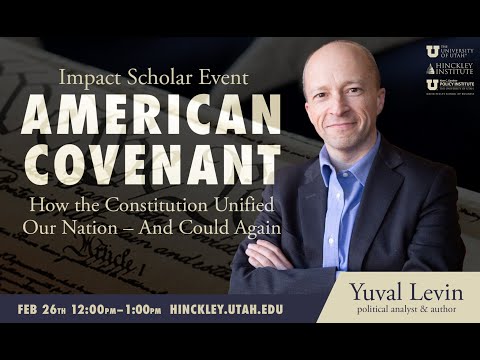
Yuval Levin, director of social, cultural and constitutional studies at the American Enterprise Institute, told a Hinckley Forum at the University of Utah that Americans are living through a “social crisis” driven in part by a long collapse in public confidence in core institutions and by institutions’ shift from forming character to serving as platforms for performance.
Levin said the change has degraded institutions’ ability to build mutual trust and social cohesion. “When we don't think of our institutions as formative but as performative...they become harder to trust,” he said, urging attendees to ask themselves, “Given my role here, how should I behave?”
Levin opened by framing institutions as durable social forms — families, professions, universities and other organized bodies — that give people roles, responsibilities and expectations. He said that decline in trust is visible across decades of public-opinion data and that the problem goes beyond episodic scandals or political battles: “We Americans are living through a social crisis,” he said, linking polarization, loneliness and substance abuse as related symptoms.
To illustrate the scale of declining confidence he cited long-running Gallup measures: confidence in doctors and hospitals dropped from about 80% in the early 1970s to roughly 37% last year; organized religion fell from about 65% to about 39%; public-school confidence declined from about 60% to about one-third; confidence in the presidency fell from about 52% in 1975 to 32% last year; and trust in Congress fell from about 42% to roughly 11% in the same span. Levin attributed part of the decline to institutions adopting performative incentives that reward visibility and personal branding rather than internal standards and the molding of character.
Levin warned that institutions retooled as platforms incentivize spectacle over stewardship: politicians, journalists and professionals who use institutional authority mainly to gain an audience, he said, fail to cultivate the forms of restraint and accountability that make institutions trustworthy. He suggested institutional repair will require both structural reform and changes in individual behavior inside institutions — a mindset shift that starts with the question, “Given my role here, how should I behave?”
During a question-and-answer session, attendees raised social media, populism and minority accountability. Levin said social media can be a useful supplement to real-world organizing but that it too often substitutes for sustained civic work, creating passivity rather than durable civic engagement. On populism, he called it a historically healthy corrective to elites but warned that populism is primarily a mode of criticism, not a program for constructing durable institutions. Asked about accountability for minority groups, Levin said effective institutional accountability requires clear limits and constraints on power and that rebuilding trust depends in part on institutions reestablishing and enforcing those boundaries.
Jason Perry, director of the Hinckley Institute of Politics, introduced Levin and emphasized the forum's theme of civic engagement, telling the audience that “unity does not mean thinking alike at all,” a principle Perry said is central to fostering constructive disagreement and continued participation in public life.
Levin closed by urging students and other listeners to start locally: identify manageable problems where they live, join or build institutions that address them and hold institutional roles with a view to forming trust rather than merely gaining attention.
The forum was presented in partnership with the Kem C. Gardner Policy Institute and included a roughly 50-minute talk followed by an extended question-and-answer period.